Connect Master Level 314 Solution Walkthrough & Answer
How to solve Connect Master level 314? Get instant solution & answer for Connect Master 314.
Connect Master Level 314 Pattern Overview
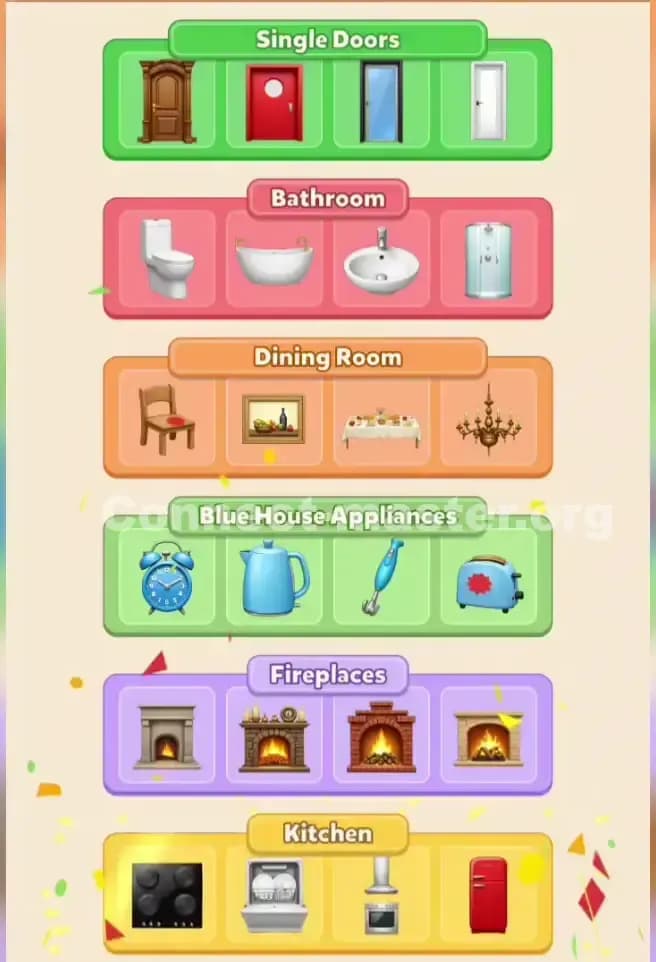
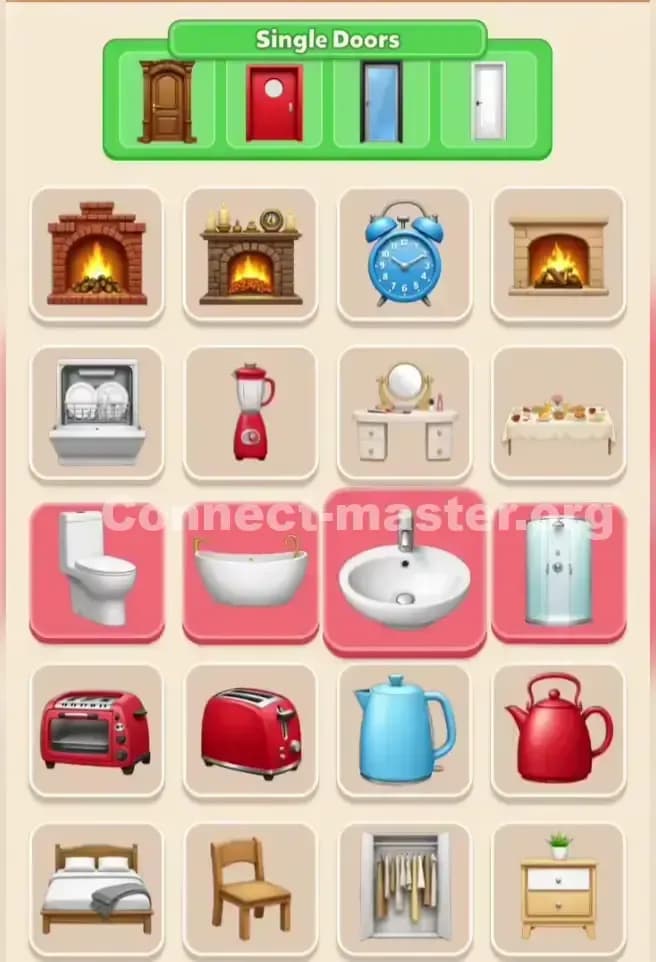
Connect Master Level 314 is a home-design themed puzzle that pulls together rooms, fixtures, and appliances from across a typical house. You're looking at six distinct sets of four tiles each, arranged by room or category. The puzzle mixes architectural elements (doors, fireplaces) with furniture and appliances, so at first glance it feels like a grab-bag of household items. However, once you recognize the underlying categories—Single Doors, Bathroom, Dining Room, Blue House Appliances, Fireplaces, and Kitchen—the logic snaps into place remarkably fast.
Each set in Connect Master Level 314 represents a cohesive grouping tied to either a specific room or a shared visual characteristic. Single Doors groups four different door styles by their function and appearance. Bathroom collects essential plumbing fixtures. Dining Room brings together furniture and decor you'd find in a formal eating space. Blue House Appliances zeroes in on kitchen tools unified by their distinctive blue color. Fireplaces showcases four different hearth designs, each with its own architectural flavor. Kitchen rounds out the puzzle with major appliances and cookware. The beauty of Connect Master Level 314 is that these categories don't overlap once you've identified them—but getting there requires careful observation of both obvious and subtle details.
Why Connect Master Level 314 Feels So Tricky
The trickiest set in Connect Master Level 314 is undoubtedly Blue House Appliances, and here's why most players miss it at first: you're scanning the board looking for rooms or traditional groupings, so a category that's purely color-based feels counterintuitive. The alarm clock, teapot, whisk, and first-aid kit don't belong together by function or room—they're unified only by their bright blue color and the fact that they're all smaller handheld or countertop items. Once you realize Connect Master Level 314 allows for color-based sets, this group becomes obvious, but that mental switch takes time.
Another source of confusion in Connect Master Level 314 stems from the overlap between Dining Room and Kitchen. Both involve eating spaces, so tiles like chairs and cookware can feel interchangeable. The distinction, though, is clean once you lock it in: Dining Room focuses on furniture and decorative elements where you actually sit and eat (chair, wall art, centerpiece, chandelier), while Kitchen is strictly appliances and tools you use to prepare food (stovetop, dishwasher, blender, refrigerator). The key is asking yourself: Would I use this while cooking, or would I use it while eating? That question alone eliminates the confusion.
I needed two retries here before I stopped conflating the two categories and started treating them as distinct functional spaces. The moment I committed to "eating versus cooking," the puzzle opened up, and I realized how obvious the separation actually was. There's also a subtle visual trap where the door tiles in Single Doors can feel like they might belong to different rooms, but they're grouped purely by their style—you've got a classic wooden door, a bright red single door, a blue-frame door, and a plain white door, each distinct in appearance but all equally valid as entrances.
Step-by-Step Solution for Connect Master Level 314
Opening: Start with the Most Obvious Sets
When you first load Connect Master Level 314, I'd recommend locking in Fireplaces immediately. All four fireplace tiles are unmistakable—they're ornate, glowing, and instantly recognizable. There's zero ambiguity here, and clearing them off the board gives you psychological momentum and opens up breathing room to study the remaining tiles. Next, tackle Bathroom without hesitation. A toilet, sink, shower stall, and bathtub are unquestionably bathroom fixtures; no tile from any other category looks remotely similar. Clearing these two sets reduces your working board by half, and you've built confidence in your pattern-recognition abilities.
Mid-game: Process of Elimination and Detail Comparison
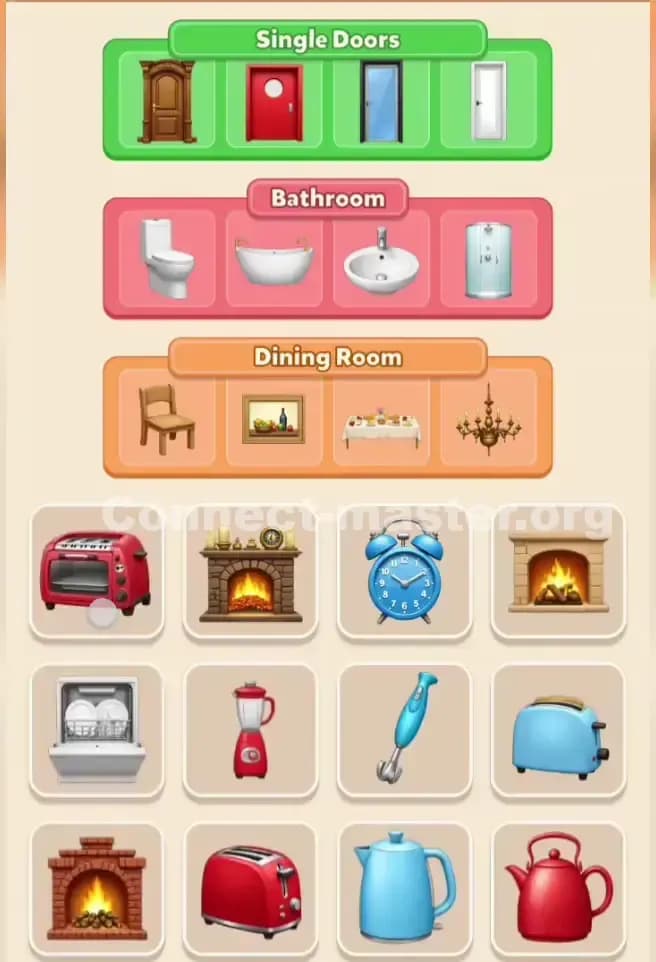
With the obvious sets gone, focus on Connect Master Level 314's remaining four categories. Look at Kitchen next: the stovetop, dishwasher, blender, and red refrigerator are all major kitchen appliances or tools. They're larger items, they're all used in food preparation, and they have a distinctly utilitarian design. Once you've locked Kitchen, you're left with Single Doors, Dining Room, and Blue House Appliances fighting for the remaining 12 tiles. This is where you slow down and compare fine details. Do the tiles in front of you look like kitchen prep items (small, blue, handheld)? If yes, they're probably Blue House Appliances. Do they look like room furnishings (a chair, artwork, table decor)? They're likely Dining Room. Do they look like entry points with distinct door designs? Single Doors is calling them.
A critical detail to notice: the Blue House Appliances set contains smaller, secondary items—think countertop and drawer essentials—whereas Kitchen contains the heavyweight appliances that dominate your kitchen layout. This functional distinction is your north star when you're narrowing down the middle tiles of Connect Master Level 314.
End-game: Pinning Down Dining Room and Single Doors
The last two sets often trip players up because both involve visual design variety. In Connect Master Level 314, Single Doors is simply four doors of different styles and colors: they're all entry mechanisms, and their differences (wood grain, red paint, blue frame, plain white) are purely aesthetic. Don't overthink it—if it's a door, it belongs here. Dining Room, by contrast, is about the atmosphere and furnishings of a formal eating space. The wooden chair invites you to sit; the wall art provides visual interest; the flower arrangement is a table centerpiece; and the chandelier hangs overhead to light your meal. These four items create an experience, not a functional set of identical objects.
When I worked through Connect Master Level 314 the first time, I almost threw the wooden chair into a "wooden furniture" set with the door—silly mistake. The moment I refocused on context (where would you find this, and what would you do with it?) instead of material, the correct grouping popped into focus.
The Logic Behind This Connect Master Level 314 Solution
The genius of Connect Master Level 314 lies in its deliberate mix of obvious and subtle categorization methods. The puzzle starts you off with visual no-brainers (fireplaces, bathrooms) to build your confidence, then introduces a color-based set (Blue House Appliances) to test whether you're thinking flexibly. By the time you reach the Dining Room versus Single Doors ambiguity, your brain has already practiced shifting between different classification systems. You've learned that "shared room" and "shared color" and "shared function" are all equally valid logic frameworks for Connect Master Level 314.
The systematic approach—clear the obvious, then narrow down by comparing fine details—works because it reduces cognitive load. You're not trying to hold six categories in your head simultaneously; you're progressively eliminating confirmed groups, which shrinks the search space and sharpens your focus on the remaining tiles. Naming each set internally (not just visually confirming it) is crucial for Connect Master Level 314 because the act of labeling locks your reasoning into place. When you say "Blue House Appliances" out loud or in your head, you're committing to a specific logic that prevents you from accidentally reassigning a blue tile to the wrong category later.
The final lesson from Connect Master Level 314 is that visual puzzles reward attention to both the big picture and the tiniest details. A door is a door, but which door matters. An appliance is an appliance, but where it lives and when you use it matter. That balance between broad categorization and granular observation is what makes Connect Master Level 314 challenging, rewarding, and ultimately fair—every tile has exactly one correct home once you know how to think about it.