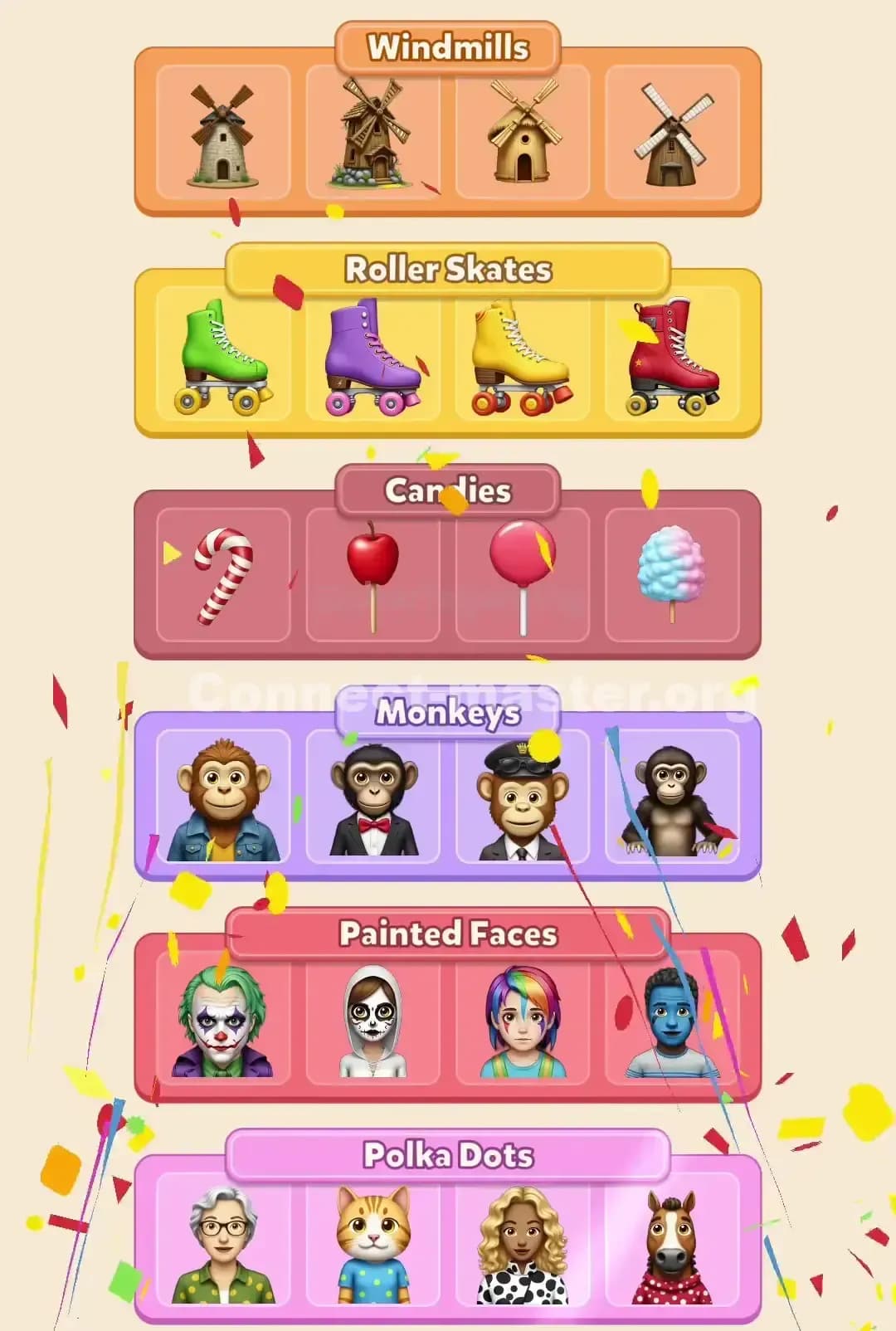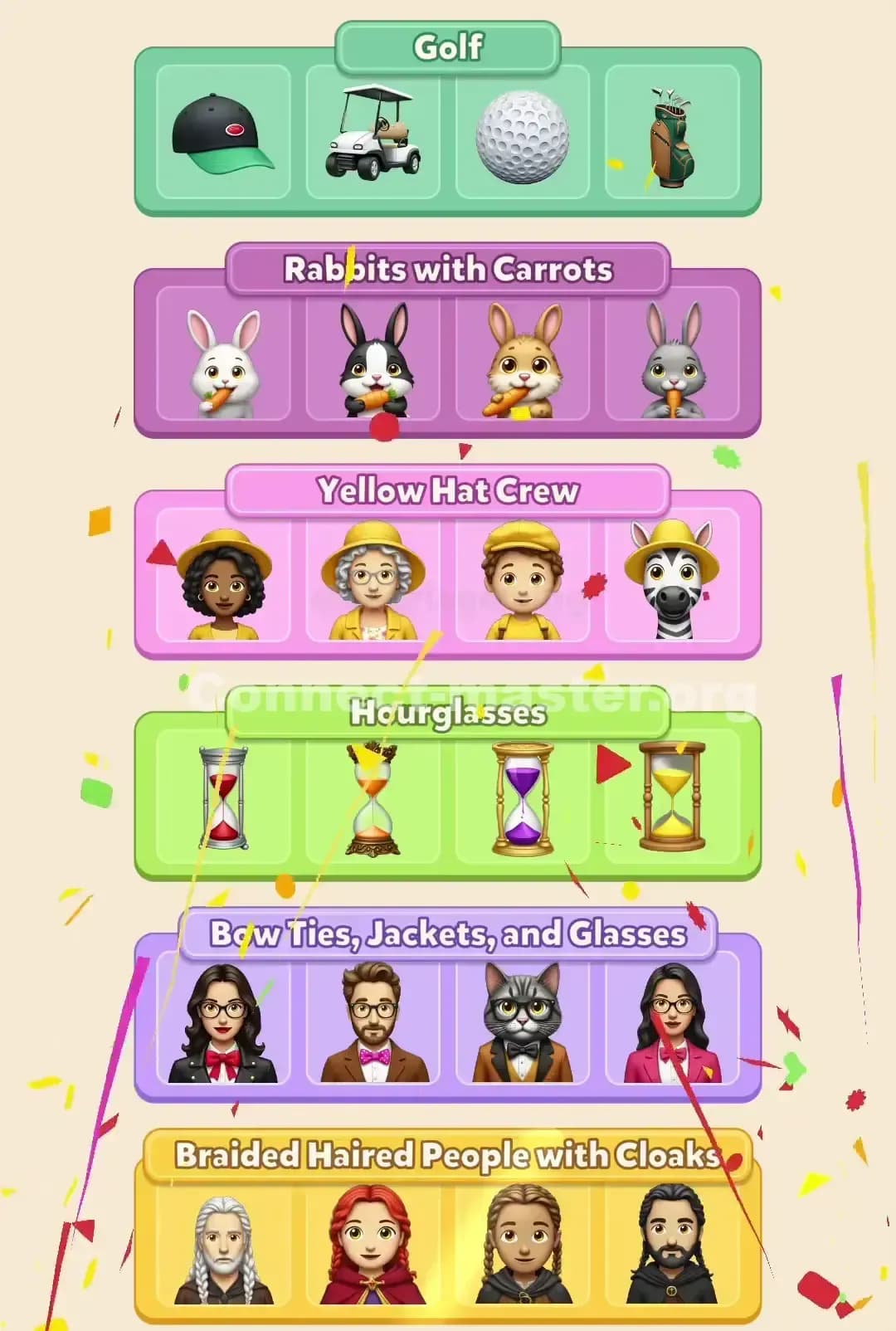
Connect Master Level 70 Solution Walkthrough & Answer
How to solve Connect Master level 70? Get instant solution & answer for Connect Master 70.
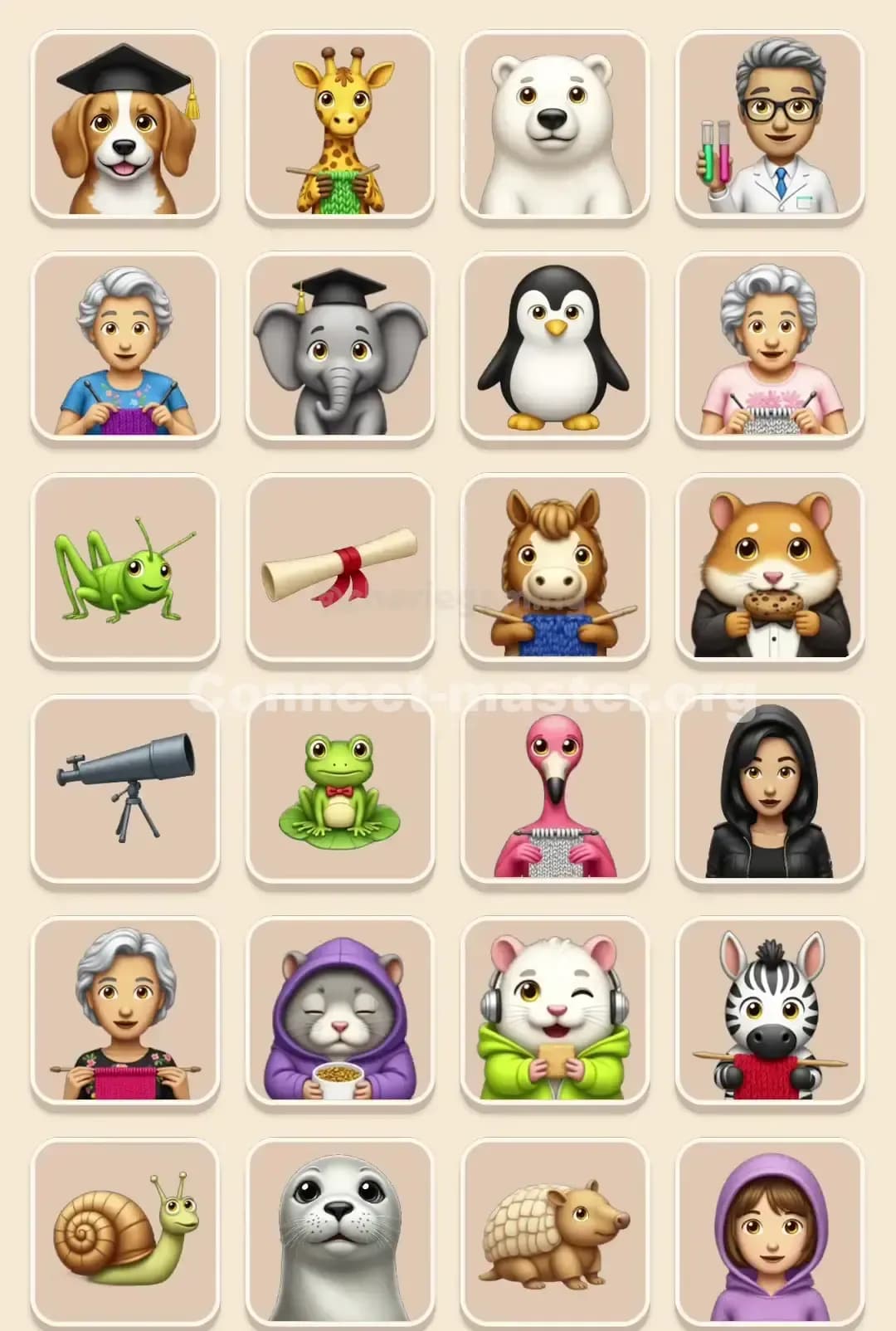
Connect Master Level 70 Pattern Overview
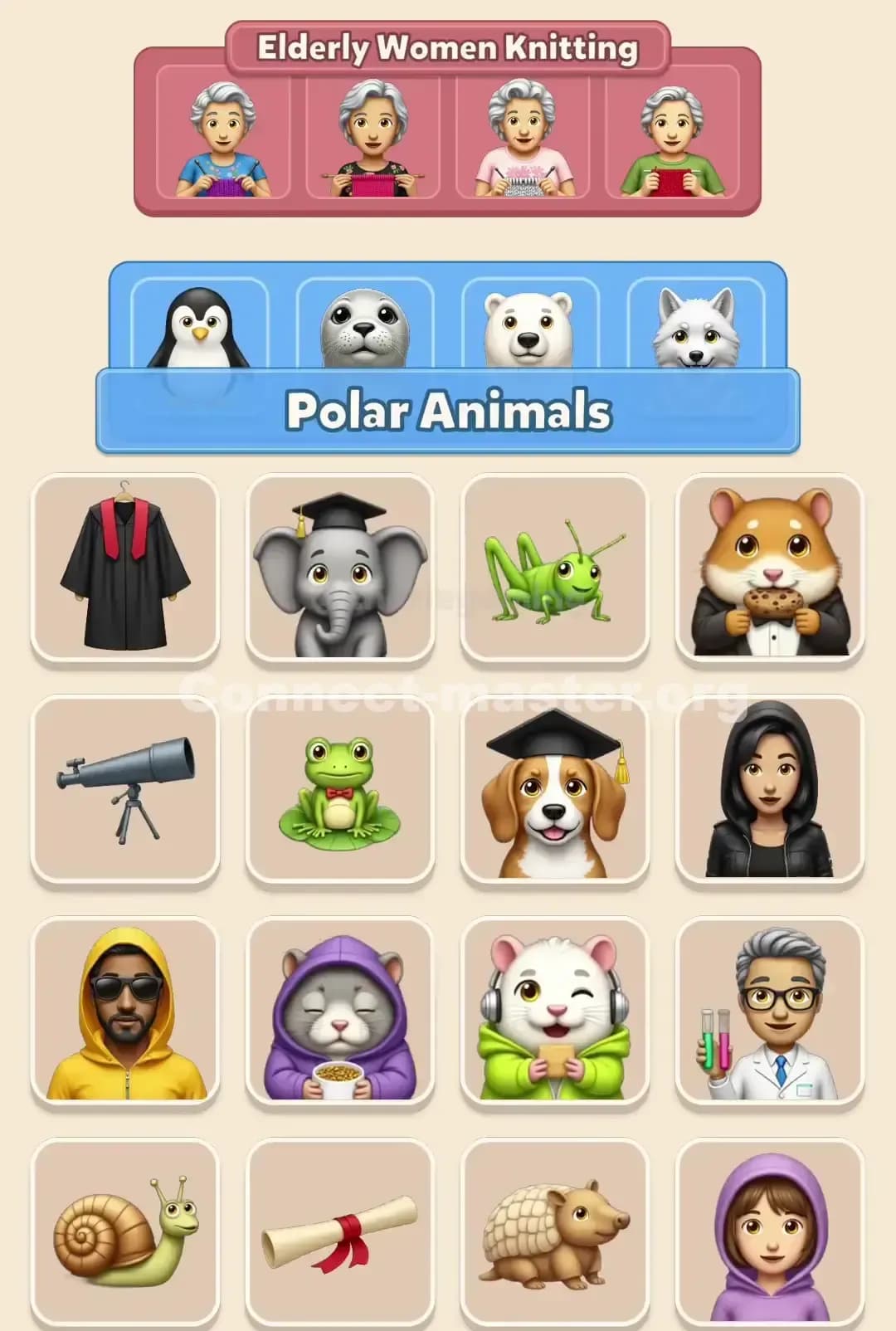
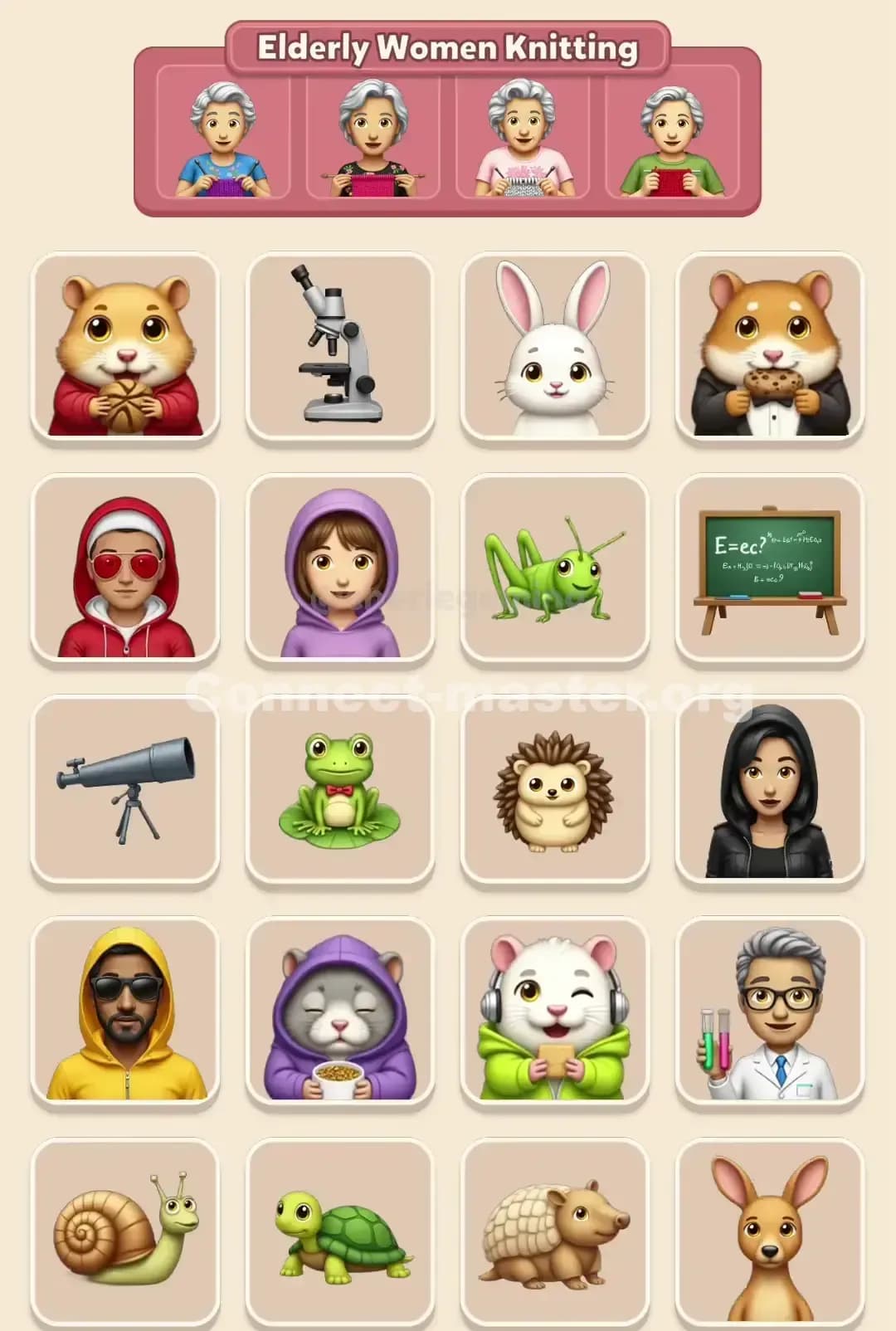
Connect Master Level 70 is a wonderfully themed puzzle that brings together seven distinct groups of four tiles, each with its own visual and conceptual identity. The board mixes human characters and animals in creative scenarios, so you'll need to look closely at details like clothing, props, and defining characteristics to sort everything correctly. The puzzle isn't overwhelmingly complex at first glance, but the real challenge lies in spotting the subtle differences between tiles that seem similar at first.
The Seven Sets in Connect Master Level 70
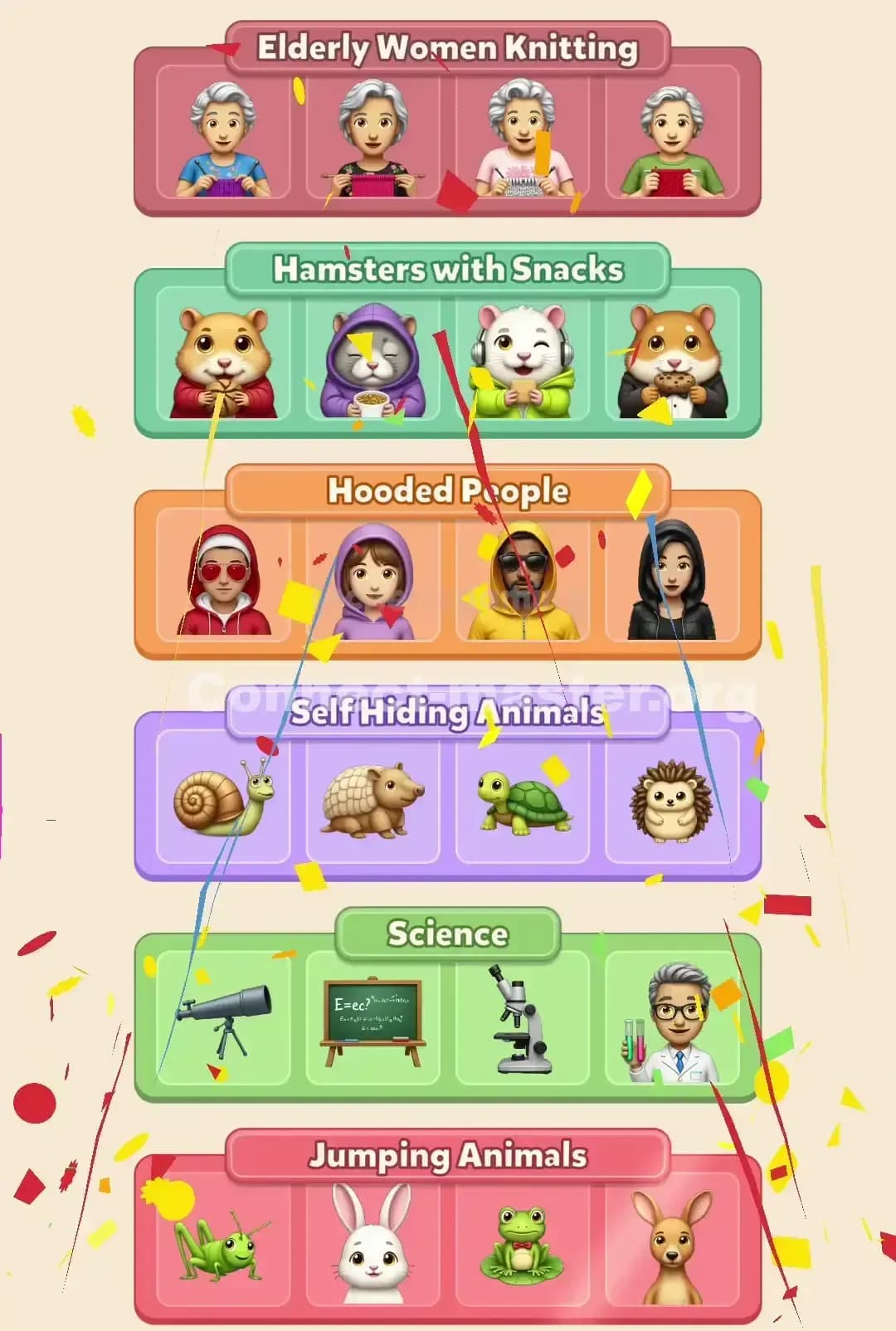
The first set is Elderly Women Knitting, where you'll find four gray-haired women holding knitting needles and yarn. These characters are unmistakable once you focus on their age, gray hair, and the crafting tools in their hands. Next is Hamsters with Snacks, a group of four adorable rodents, each one holding or enjoying a food item—notice how they're posed happily with their treats. The third set, Hooded People, features four humans wearing hoods of different colors and styles; they're all covered up in distinctive ways that set them apart from other characters. Self-Hiding Animals comes next, with four creatures naturally designed with protective shells or spines—think snail, tortoise, turtle, and hedgehog. Then you've got Science, a straightforward group of four items used in scientific work: a telescope, a chalkboard, a microscope, and a scientist figure. The sixth set is Jumping Animals, which includes four creatures known for their ability to leap: a grasshopper, a rabbit, a frog, and a deer. Finally, there's a wildcard set that ties the whole puzzle together with its own unique theme.
Why Connect Master Level 70 Feels So Tricky
The Most Overlooked Group
The Self-Hiding Animals set tends to trip up most players because it's easy to think these tiles belong with other animal groupings. You might initially assume the turtle or snail should go with Jumping Animals simply because they're both creatures, but the real trait here is protection—these animals have built-in defensive shells, spines, or coils. That distinction is crucial and easy to miss if you're scanning the board too quickly without analyzing what each animal actually represents.
Subtle Overlaps That Cause Confusion
One major area of confusion is distinguishing between Elderly Women Knitting and Hooded People. Both groups feature humans, but the elderly women are clearly distinguished by their gray or white hair, their age lines, and the fact that they're all actively holding knitting supplies. The hooded figures, by contrast, are younger and defined entirely by the hoods covering their heads—it's about the covering, not the crafting. Another tricky overlap happens when you're looking at Hamsters with Snacks versus other animal groups. Each hamster in that set is specifically shown enjoying food or holding treats in a clear, recognizable way. A casual glance might make you wonder if a hamster belongs with the jumping animals, but the snack element is what locks them into their own group. Finally, Science items can initially seem random—you might question whether the scientist figure truly belongs with the telescope and microscope—but once you realize they all relate to scientific observation and study, the connection becomes obvious.
My "Aha!" Moment on Connect Master Level 70
Honestly, I needed two retries here before I realized that Self-Hiding Animals wasn't about size or cuteness—it was specifically about creatures with natural defensive features. Once I named that category in my head, everything clicked, and I stopped trying to force a turtle into the jumping group just because both are animals.
Step-by-Step Solution for Connect Master Level 70
Opening: Lock in the Obvious Sets First
Start with Elderly Women Knitting because it's the most visually distinctive. All four tiles show older women with gray hair, and they're all holding yarn or knitting needles. There's almost no ambiguity here, so locking this in immediately frees up mental space. Next, go for Science because these four tiles—telescope, chalkboard, microscope, and scientist—are thematic and unrelated to any other group on the board. There's no risk of a science item fitting elsewhere, so secure this set early. Jumping Animals is also relatively clear once you mentally list the creatures: grasshopper, rabbit, frog, and deer are all known for their jumping or leaping ability. Locking these three sets in right away means you've cleared 12 tiles and you're left with just 4 sets to solve.
Mid-Game: Use Process of Elimination
Now you're working with Hooded People, Hamsters with Snacks, Self-Hiding Animals, and one remaining mystery set. Start by isolating Hooded People because the hood feature is visually obvious—look at each human figure and confirm they're wearing a head covering in red, purple, yellow, or black. Don't overthink this; the hoods are right there. Next, carefully examine the four hamster tiles. Each one should be recognizable as a hamster (check for the round body, small ears, and whiskers) and should be holding or eating food. A hamster without an obvious snack doesn't belong in this group. For Self-Hiding Animals, slow down and check each creature: does it have a shell, spines, or some natural protective feature? If yes, it belongs here. Use color and posture as secondary confirmations—the snail is coiled, the tortoise has a shell on its back, the turtle is low and shelled, and the hedgehog is spiky.
End-Game: The Final Sets
By this point, you've likely locked in most sets and are staring at the last few tiles wondering where they belong. Whatever set remains should now be obvious because you've eliminated everything else. The key to avoiding errors here is to resist the urge to force a tile somewhere. If you're unsure about a tile's category, re-examine the other tiles in that category and ask: "Do they all share the exact same trait?" If the answer is no, you've mis-grouped something, and it's time to reconsider.
The Logic Behind This Connect Master Level 70 Solution
From Big Traits to Tiny Details
The most powerful strategy for solving Connect Master Level 70 is starting with broad, obvious categories and then refining with microscopic details. Begin by asking, "Is this a person or an animal?" Then drill down: "Is this person old or young? Are they holding something?" For animals, ask, "Can this creature jump? Does it have a shell? Is it holding food?" This funnel approach ensures you're not comparing apples to oranges and that each tile ends up in the right group.
Why Naming Each Set Keeps You Honest
When you give each group a short, descriptive name—like Elderly Women Knitting instead of just "group 1"—you're creating a mental rule that you can't violate. If you call a set "Hooded People," then every tile in that set must wear a hood. If you find a tile that doesn't fit that rule, you immediately know something's wrong. This naming technique prevents you from accidentally double-using a tile or chasing vague categories. I've found that once I named the groups out loud while solving Connect Master Level 70, my accuracy shot up significantly because I wasn't relying on fuzzy visual impressions anymore—I was checking against explicit rules.
By following this methodical approach, Connect Master Level 70 becomes a satisfying puzzle that rewards careful observation. You'll find that the solution isn't about luck; it's about systematically eliminating possibilities until every tile finds its perfect home.