Connect Master Level 78 Solution Walkthrough & Answer
How to solve Connect Master level 78? Get instant solution & answer for Connect Master 78.
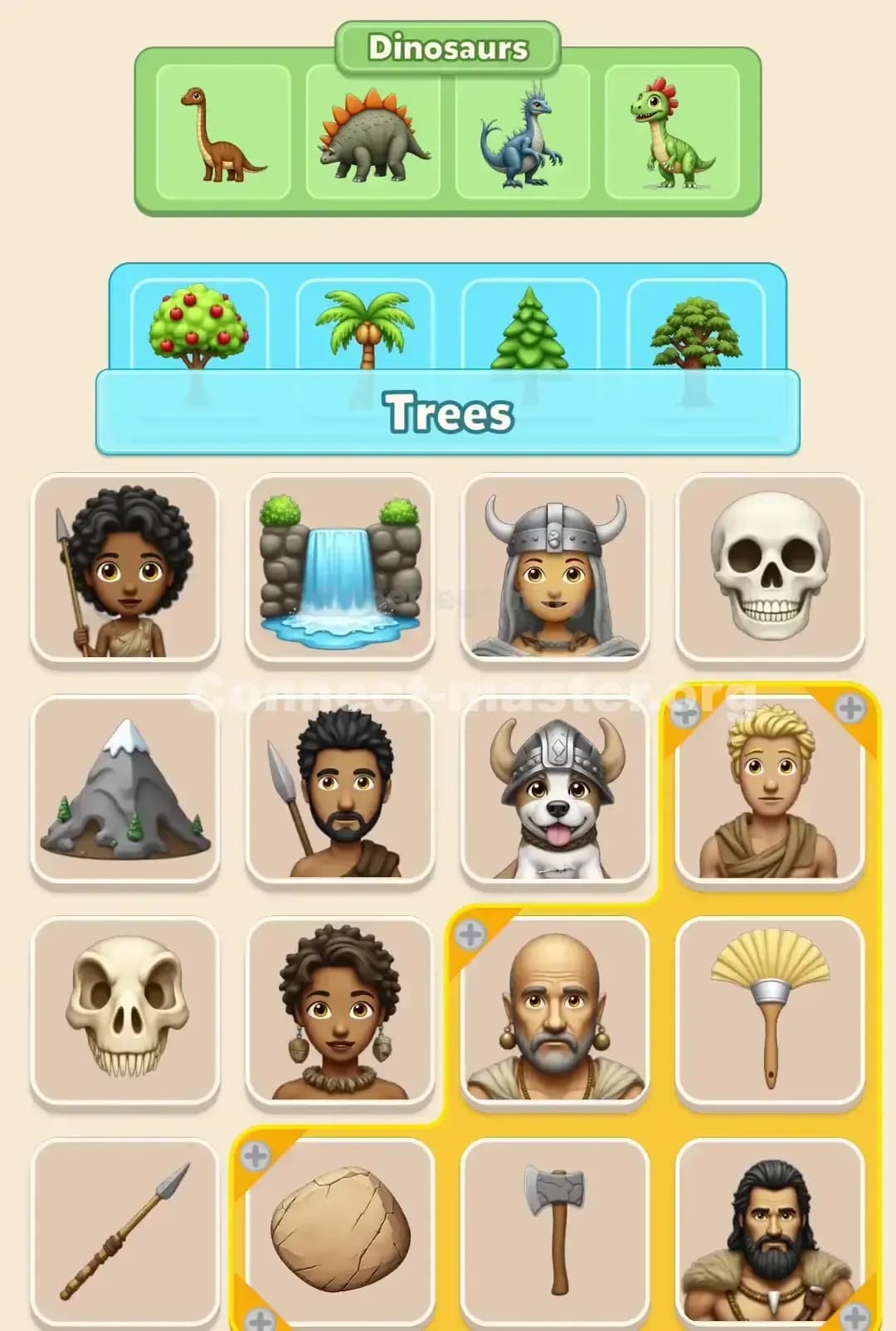
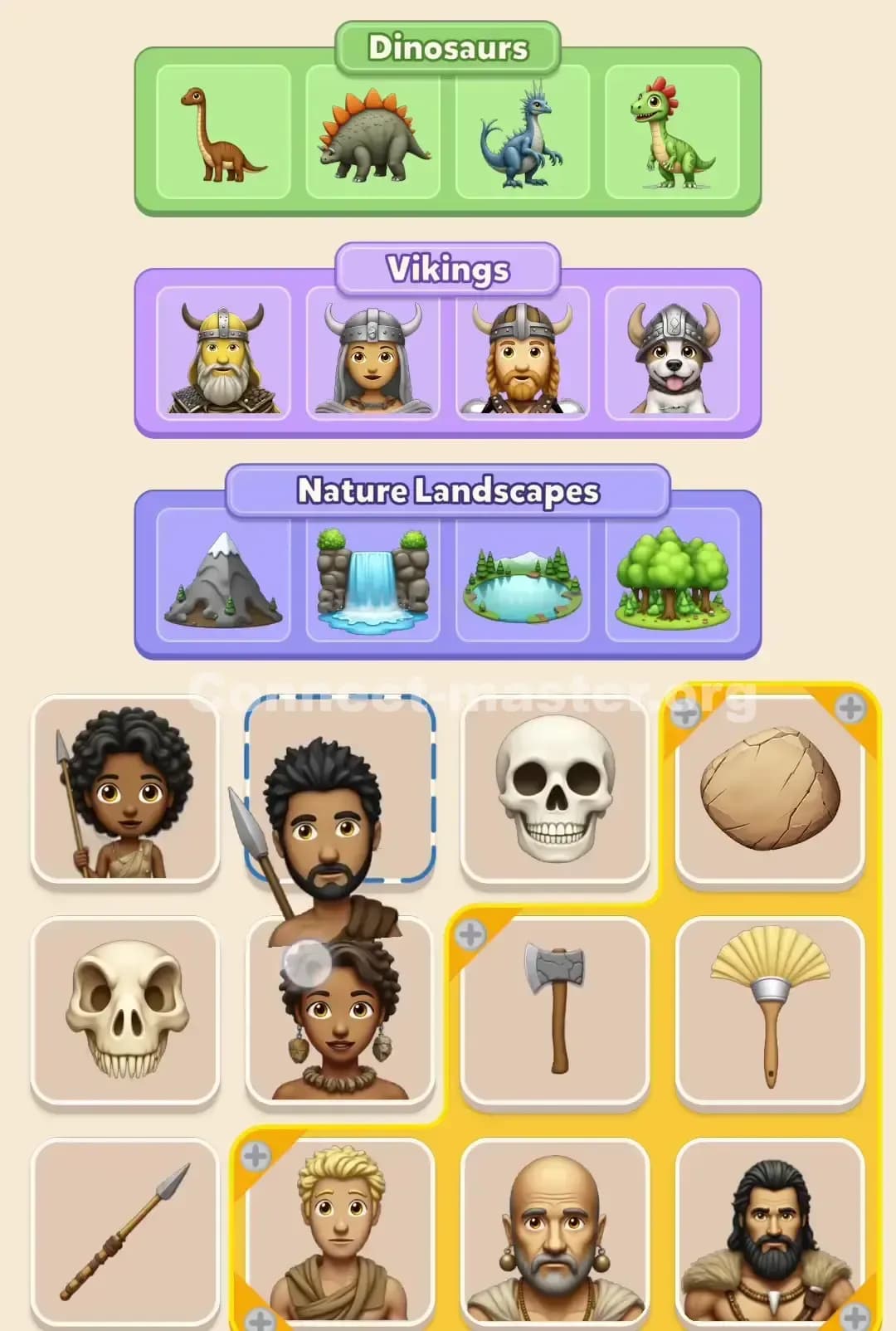
Connect Master Level 78 Pattern Overview
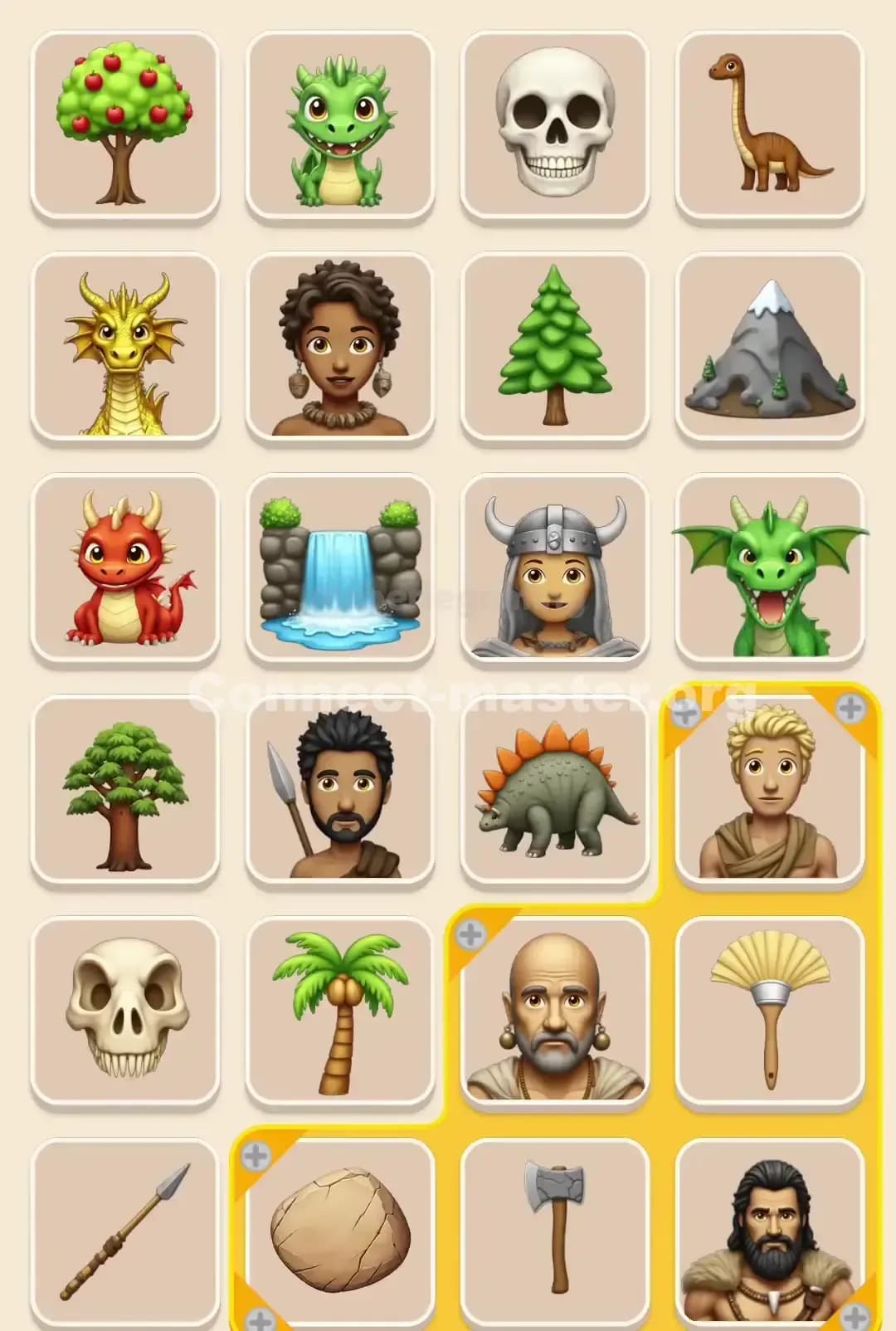
Connect Master Level 78 is a wonderfully themed puzzle that pulls together prehistoric and ancient civilization aesthetics into one cohesive board. You're working with exactly six sets of four tiles each, and the themes span from natural history to mythology to archaeology. The board feels crowded at first glance because several tiles share visual similarities—think horned helmets and stone-age tones—but once you identify the core category for each group, the logic snaps into place quickly.
The Six Sets in Connect Master Level 78
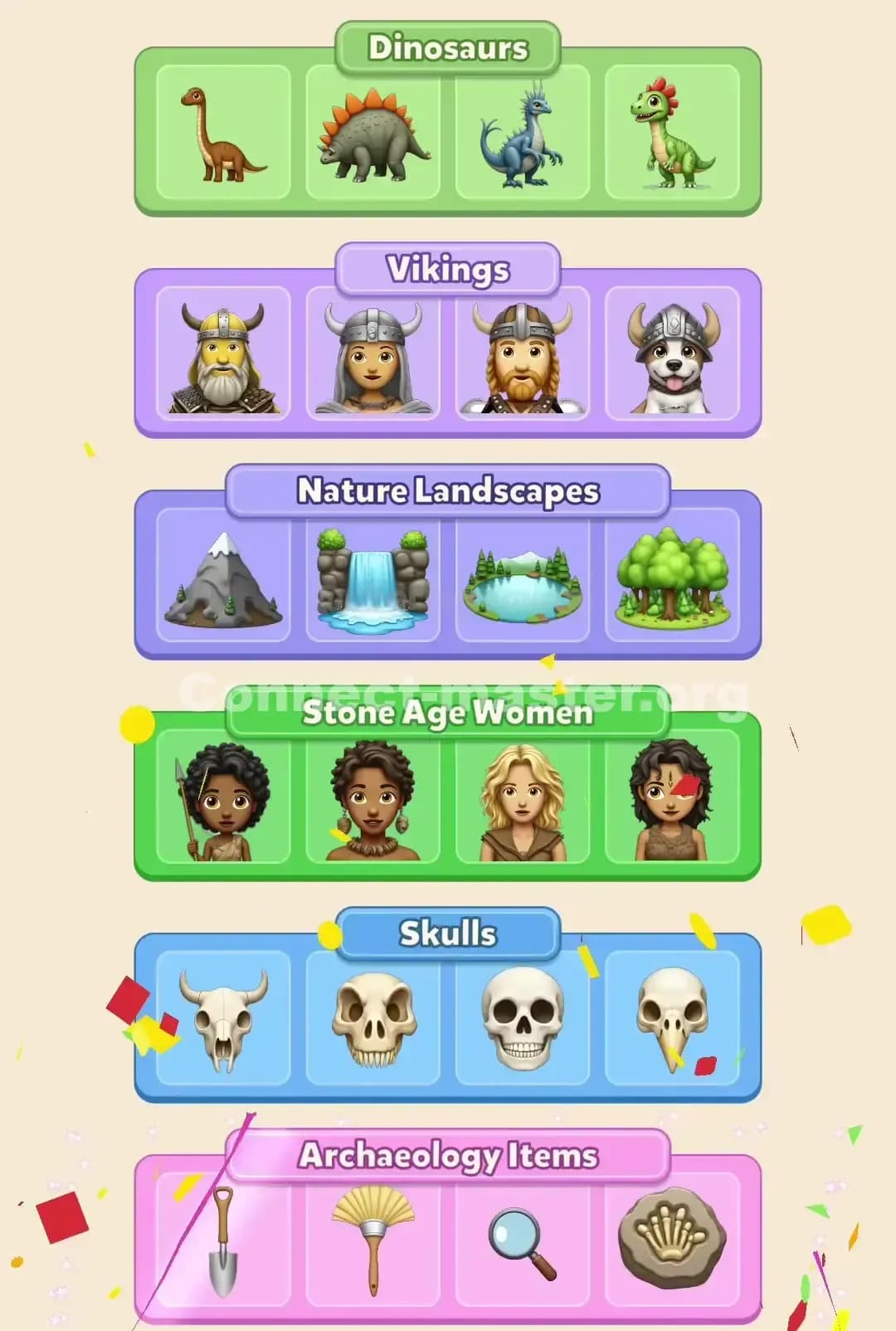
The solution breaks down into these six distinct groups: Dinosaurs (four prehistoric creatures), Vikings (four horned-helmet warriors), Nature Landscapes (four outdoor environments), Stone Age Women (four female characters from ancient times), Skulls (four different skull types), and Archaeology Items (four digging and discovery tools). Each set has a crystal-clear unifying trait, though some tiles will initially feel like they could belong to more than one category if you're not paying close attention to the details.
Why Connect Master Level 78 Feels So Tricky
The Most Confusing Set: Vikings vs. Stone Age Women
I'll be honest—the Vikings set stumped me longer than it should have. The horned helmets are iconic, sure, but the Stone Age Women tiles also have brownish, earth-toned clothing and primitive styling that made my brain want to lump them together as "ancient people." The key difference that finally clicked for me? The Vikings are specifically warriors with metal helmets and armor, while the Stone Age Women are unarmored female characters wearing simple furs and tribal accessories. Once you lock in that distinction, the Vikings set becomes unmistakable, and the Stone Age Women emerge as their own clearly defined group.
The Subtle Overlaps That Trip Players Up
The Dinosaurs and Skulls sets can feel thematically close because prehistoric imagery loves a good skull motif. However, the Dinosaurs are living creatures with complete bodies—a long-necked sauropod, a spiky stegosaurus, a blue theropod, and a small green dinosaur—while the Skulls are isolated bone structures with no body attached. This distinction is straightforward once you say it aloud, but scanning quickly, you might second-guess whether a dino head belongs with the skull group.
Another deceptive overlap appears between Nature Landscapes and the environment-adjacent visual complexity. The mountain, waterfall, lake, and forest are all outdoor scenes, but they're unmistakably natural geography—not tools, not creatures, not people. The Archaeology Items (shovel, brush, magnifying glass, and fossil seal) all relate to discovering or studying ancient things, whereas the landscapes are just the settings where that discovery might happen.
The Stone Age Women group is also easy to misread if you conflate "ancient appearance" with "Viking." I needed two careful passes to separate them: Vikings have metal helmets and warrior bearing; Stone Age Women have tribal jewelry, varied hairstyles, and casual tribal garb without the militant aesthetic.
My "Finally Got It" Moment
The turning point for me was realizing that Connect Master Level 78 respects functional categories, not just visual similarities. A Viking isn't just "someone from ancient times"—they're specifically a horned-helmet warrior. A Stone Age Woman isn't just "primitive looking"—she's a female character with tribal styling and no armor. That mental shift—moving from "these look old" to "these do the same thing"—cracked the puzzle open.
Step-by-Step Solution for Connect Master Level 78
Opening: Lock in the Obvious
Start with Dinosaurs and Archaeology Items. These two sets have almost no overlap with anything else on the board. The dinosaurs are unmistakable creatures, and the archaeology tools (shovel, brush, magnifying glass, fossil seal) are clearly purpose-built implements for excavation and study. Confirming these two sets early removes eight tiles from your mental load and gives you immediate confidence.
Next, tackle Nature Landscapes—the mountain, waterfall, lake, and forest. These four are environmental scenes with no characters or tools, making them visually distinct from the rest. Once you've locked these in, you're down to just three sets and twelve tiles, which feels way more manageable.
Mid-Game: Process of Elimination Clears Confusion
With half the board solved, you're left with Vikings, Stone Age Women, and Skulls. Now you can use elimination strategically. Look at the horned-helmet characters: if they're wearing metal armor and have that warrior aesthetic, they're Vikings. The female-presenting characters in tribal wear without armor belong to Stone Age Women. This filtering works because you've already removed all the other categories, so any humanoid figure left must fit into one of these two groups.
For the Skulls, compare the bone structure carefully. You'll see four distinct skull types—one with curved horns (bovine), one with a more rounded human-like structure, one standard rounded skull, and one with a pointed beak or protruding jaw. They're all skulls, but their morphology varies, which is fine; the unifying trait is simply "skull" as an object category.
End-Game: Separating Stone Age Women from Vikings
This is where the puzzle either clicks or loops you back for another attempt. Look at each horned-helmet figure: are they human warriors in armor, or are they something else? The Vikings are specifically humanoid characters wearing metal helmets with horns and body armor. Meanwhile, the Stone Age Women are female characters in tribal clothing—some have curly hair, some have straight blonde hair, some wear red paint or accessories, but none have the military aesthetic. A Viking is a warrior type; a Stone Age Woman is a character type from a specific era.
If you're stuck on a tile, ask: "Is this figure dressed for battle, or dressed for tribal life?" That distinction locks in the entire end-game set.
The Logic Behind This Connect Master Level 78 Solution
From Broad Traits to Microscopic Details
The winning strategy for Connect Master Level 78 is a top-down filtering process. You start with the broadest, most obvious traits: "Is this a creature, a person, a tool, or a landscape?" Once you've separated those macro categories, you zoom in. Among creatures, you distinguish living dinosaurs from dead skulls. Among people, you separate warriors from civilians. Among tools, you confirm they're all archaeological in nature. This methodical narrowing ensures you never force a tile into the wrong group just because it almost fits.
Naming Each Set Keeps Your Logic Organized
I cannot overstate how much it helps to give each group a short, memorable name in your head. By thinking of "Dinosaurs," "Vikings," "Nature Landscapes," "Stone Age Women," "Skulls," and "Archaeology Items," you create mental anchors that prevent double-counting or chasing phantom categories. When you're unsure where a tile belongs, you ask, "Could this be a Dinosaur? A Viking? An Archaeology Item?" in rapid succession, and the answer becomes obvious.
Connect Master Level 78 rewards patience and systematic thinking. There are no tricks or hidden details that contradict the primary category name. Every tile truly belongs exactly where the set definition says it should. Take your time separating Vikings from Stone Age Women, double-check that your Skulls are complete and distinct, and trust that once you've locked in four sets, the final two will practically solve themselves. You've got this—and on your next run, this level will feel infinitely simpler now that you know the six-set structure.