Connect Master Level 56 Solution Walkthrough & Answer
How to solve Connect Master level 56? Get instant solution & answer for Connect Master 56.
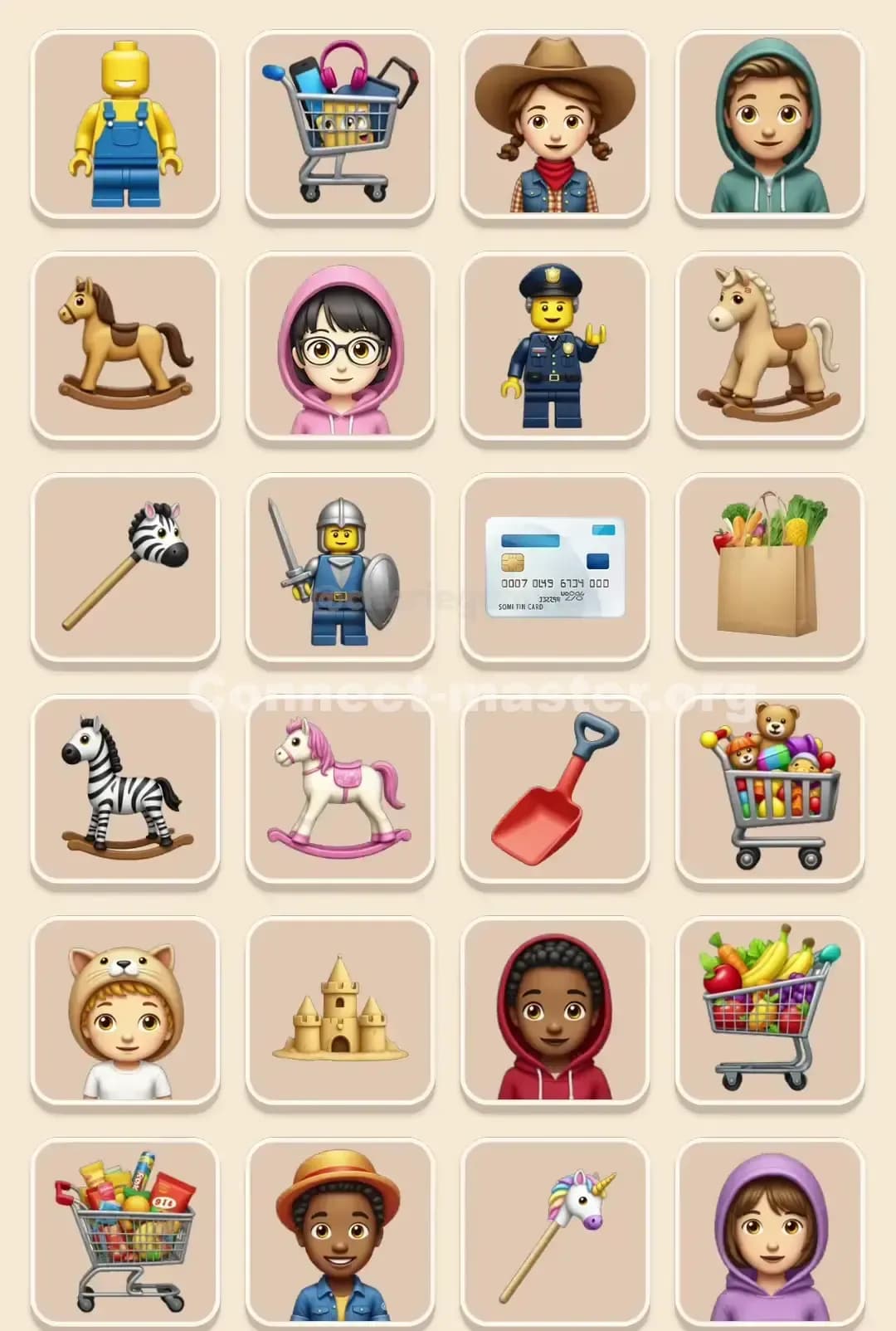
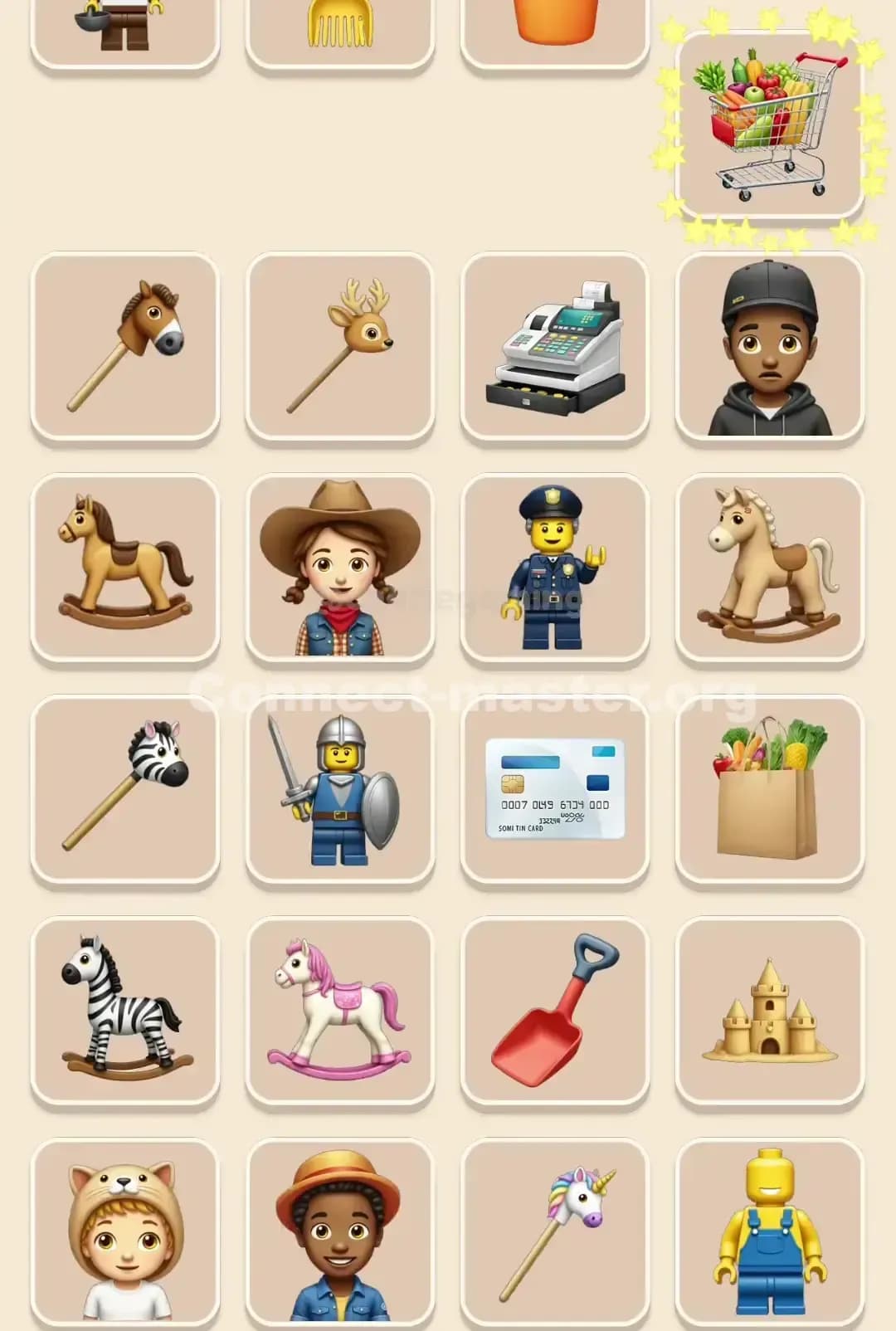
Connect Master Level 56 Pattern Overview
What You're Looking At in Connect Master Level 56
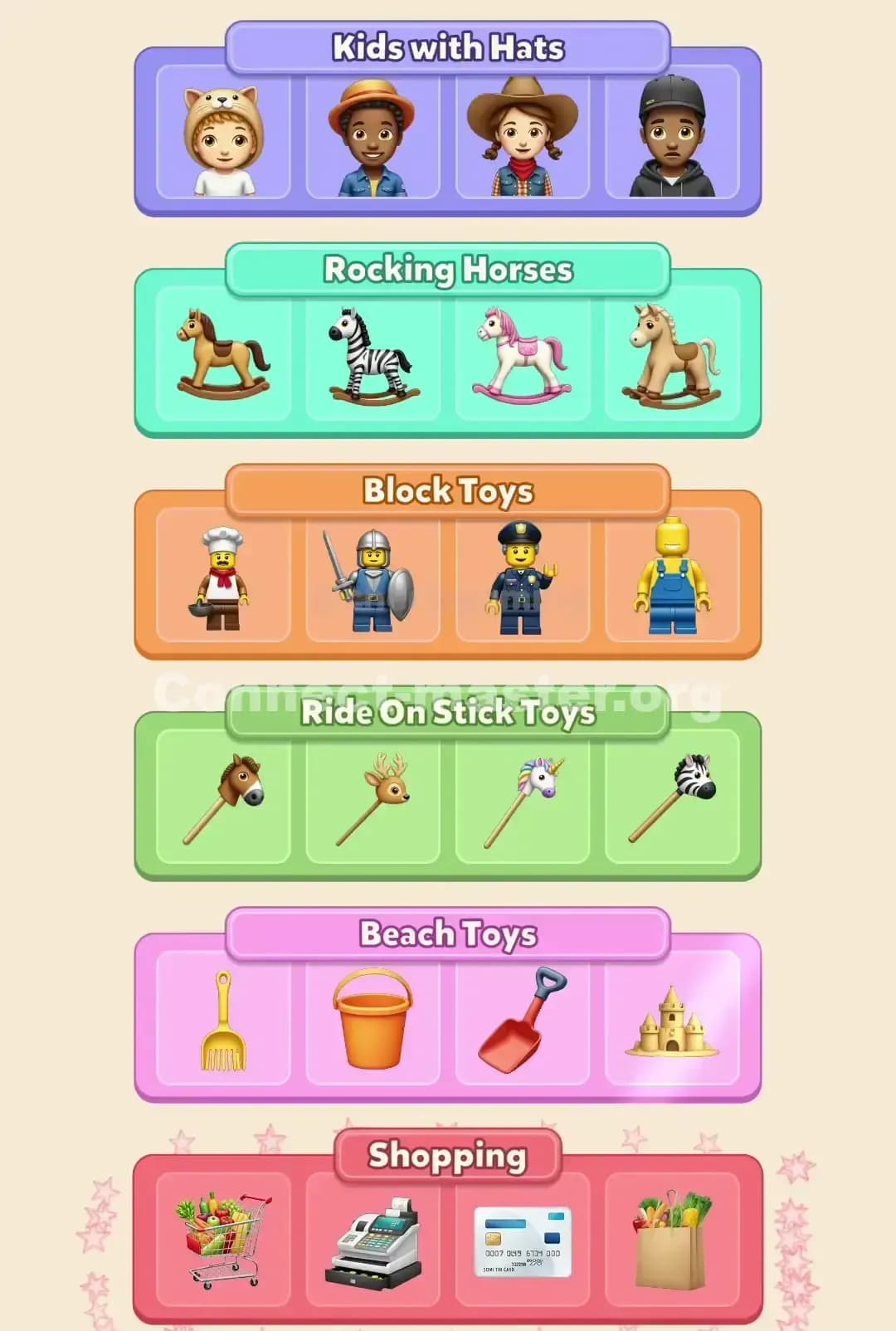
Connect Master Level 56 is a satisfying puzzle that mixes childhood nostalgia with everyday objects, pulling tiles from toys, accessories, and activities. You'll spot 28 tiles organized into seven groups of four, each representing a distinct category. The level feels playful at first glance—who doesn't recognize a rocking horse or a beach bucket?—but the real challenge emerges when you start comparing tiles that almost belong together. The puzzle rewards careful observation: you need to spot that a knight minifigure isn't just any "block toy," and that a purple unicorn stick toy has something specific in common with three other stick-mounted creatures.
The Seven Sets That Build Connect Master Level 56
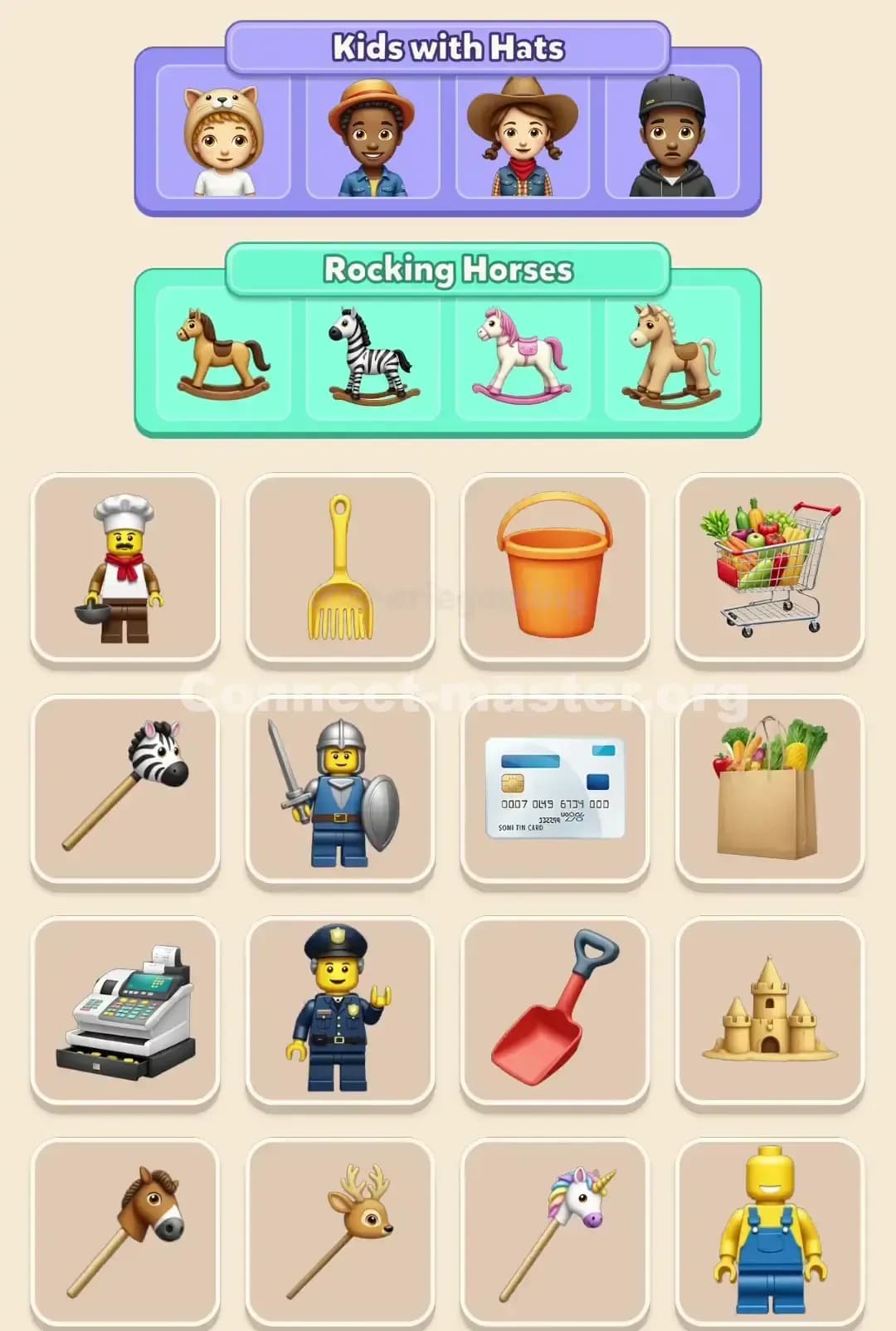
Kids with Hats brings together four children, each wearing a different headpiece: a cat-eared hood, an orange fedora, a brown cowboy hat, and a black baseball cap. What ties them together isn't age or gender—it's that each child's defining visual feature is the hat they're wearing.
Rocking Horses features four classic toy horses mounted on rockers, each with a different color scheme: a brown standard rocking horse, a black-and-white striped version, a pink rocking horse, and a tan rocking horse. They're all stationary toys designed for gentle back-and-forth motion.
Block Toys shows four yellow minifigures in different occupations and outfits: a chef with a white hat, a knight with armor and helmet, a police officer in blue, and a farmer in overalls. These are rigid, stackable toy figures.
Ride-On Stick Toys presents four animal-headed stick toys meant to be ridden: a brown horse head, a tan reindeer head, a purple unicorn head, and a zebra head. Each sits atop a wooden stick handle.
Beach Toys collects sand and sand-adjacent play items: a yellow brush, an orange bucket with a handle, a red shovel, and a sandy castle. These are quintessential items you'd bring to the shore.
Shopping groups together the tools and items of retail: a basket full of groceries, a payment terminal (register), a receipt or transaction card, and a paper grocery bag. They all relate to the act of buying and carrying goods.
Each set in Connect Master Level 56 has a crystal-clear purpose once you see it, but getting there requires discipline.
Why Connect Master Level 56 Feels So Tricky
The Block Toys Set Is Where Most Players Stumble
Here's the thing: when you first look at Connect Master Level 56, you might assume those four minifigures belong together simply because they're toy people. But that's too broad. The real connection is that they're all minifigures with different job roles, each featuring a distinct colored outfit and accessory combo. A chef figure looks completely different from a knight figure; a farmer looks nothing like a police officer. The trap is thinking "minifigure = minifigure" when you really need to confirm they're all that specific toy construction type—rigid, yellow-bodied, interchangeable-part figures. If you're not careful, you might get distracted by comparing their individual jobs instead of their shared nature as building-block figures.
Subtle Overlaps That Cause Second-Guessing
The rocking horses and ride-on stick toys look deceptively similar at first. Both categories contain animal figures on stands. However, rocking horses are four-legged creatures mounted on curved rockers designed for stationary rocking motion, while stick toys are animal heads attached to wooden sticks meant to be carried and "ridden" by hand. Once you lock in that difference—fixed rocker versus handheld stick—confusion melts away.
Another near-miss in Connect Master Level 56 is the overlap between beach toys and shopping items. A bucket appears in both contexts: you use buckets at the beach, but you also use them for carrying groceries. The key is that in this puzzle, the orange bucket sits alone in the Beach Toys set alongside a brush, shovel, and castle—all distinctly sandy-play items. Meanwhile, the shopping category focuses on retail transactions: a cart, a terminal, a receipt, and a grocery bag. The bucket here represents vacation leisure, not commerce.
My "Aha!" Moment With Connect Master Level 56
I'll admit, I needed two retries on this level before I truly saw the ride-on stick toys as their own category. My brain kept wanting to lump them with rocking horses because, hey, both are toys kids play with. But then I looked closer at the handles: that wooden stick poking out from each animal head changed everything. Suddenly, "Ride-On Stick Toys" became obvious. That's when I realized Connect Master Level 56's elegance: it rewards players who look past the surface category (toys) and dig into the specific function or construction method. It was a satisfying shift from "toy" thinking to "toy type" thinking.
Step-by-Step Solution for Connect Master Level 56
Opening: Lock in the Obvious Sets First
Start by securing the sets that leap off the screen immediately. Kids with Hats is your first lock-in: four children, four different hats, zero ambiguity. Next, go for Beach Toys—a brush, bucket, shovel, and castle belong nowhere else, and they're instantly recognizable as sandy-play essentials. These two quick wins shrink your working board and build confidence.
From there, target Shopping, which features a grocery basket, payment terminal, receipt, and paper bag. These are unmistakably retail-related, and once you've removed the beach items and kids, there's no overlap. Three sets locked, 16 tiles remaining—you're already more than halfway through the logic.
Mid-Game: Eliminate Through Details and Comparison
Now things get tighter. You have horses, stick toys, minifigures, and a couple of stray items. This is where you slow down and compare. Look at Rocking Horses: all four have curved rockers underneath, and they're all full-bodied animals. If a tile doesn't have that rocker base, it's not in this group. Conversely, Ride-On Stick Toys are heads only—no bodies—mounted on sticks. That distinction is everything.
For Block Toys, examine outfit colors and accessories. You're looking for minifigures with distinct job-based clothing: chef's whites, knight's armor, police blues, farmer's overalls. These aren't random figures; they're themed characters. Once you've mentally grouped them, make sure none of those four tiles have sneaked into another category—and they won't, because they're visually unique to the toy-construction category.
End-Game: The Final Two Sets and Why They Click
By now, only the minifigures and stick toys remain unsorted. This is where careful observation wins. The four stick toys all share a wooden handle and an animal head at the top: horse, reindeer, unicorn, zebra. No construction elements, no outfits—just animal heads on sticks. The four minifigures, by contrast, are solid toy figures with painted-on details, distinct clothing, and accessories like swords or helmets. They feel weighty and buildable; the stick toys feel lightweight and whimsical.
One final check: make sure you haven't accidentally duplicated a tile across two sets. Each of the four rocking horses should be different from the four stick horses in both color and construction. Each minifigure should have a unique job outfit. If everything checks out, Connect Master Level 56 is solved.
The Logic Behind This Connect Master Level 56 Solution
From Broad Categories to Specific Traits
The secret to conquering Connect Master Level 56 is understanding that "toy" isn't specific enough. Instead, you move through layers: from "toy" to "toy type" (rocking horse, minifigure, stick toy) to "specific variant" (brown rocking horse, zebra stick toy, police minifigure). This hierarchical thinking prevents you from mis-grouping tiles that superficially look similar. A rocking horse and a stick-toy horse both have a horse head, sure—but one is a full-bodied rocker, and one is just a head on a stick. Naming each set in your head ("Rocking Horses" versus "Ride-On Stick Toys") enforces that distinction.
Why Naming Your Sets Keeps You Organized
Throughout Connect Master Level 56, assigning each group a descriptive label—not just "horses" but "rocking horses" and "ride-on stick toys"—acts like a mental anchor. When you're tempted to move a tile, you ask yourself: "Does this tile fit the exact description I gave this set?" If it doesn't check every box (full body on rocker, or animal head on stick), it doesn't belong. This naming strategy transforms a murky visual puzzle into a logical checklist, and checklists are how you guarantee every tile ends up in one and only one set. By the time you finish Connect Master Level 56, you'll have internalized a framework that makes future levels feel easier too.