Connect Master Level 627 Solution Walkthrough & Answer
How to solve Connect Master level 627? Get instant solution & answer for Connect Master 627.
Connect Master Level 627 Pattern Overview
The Overall Theme and Structure
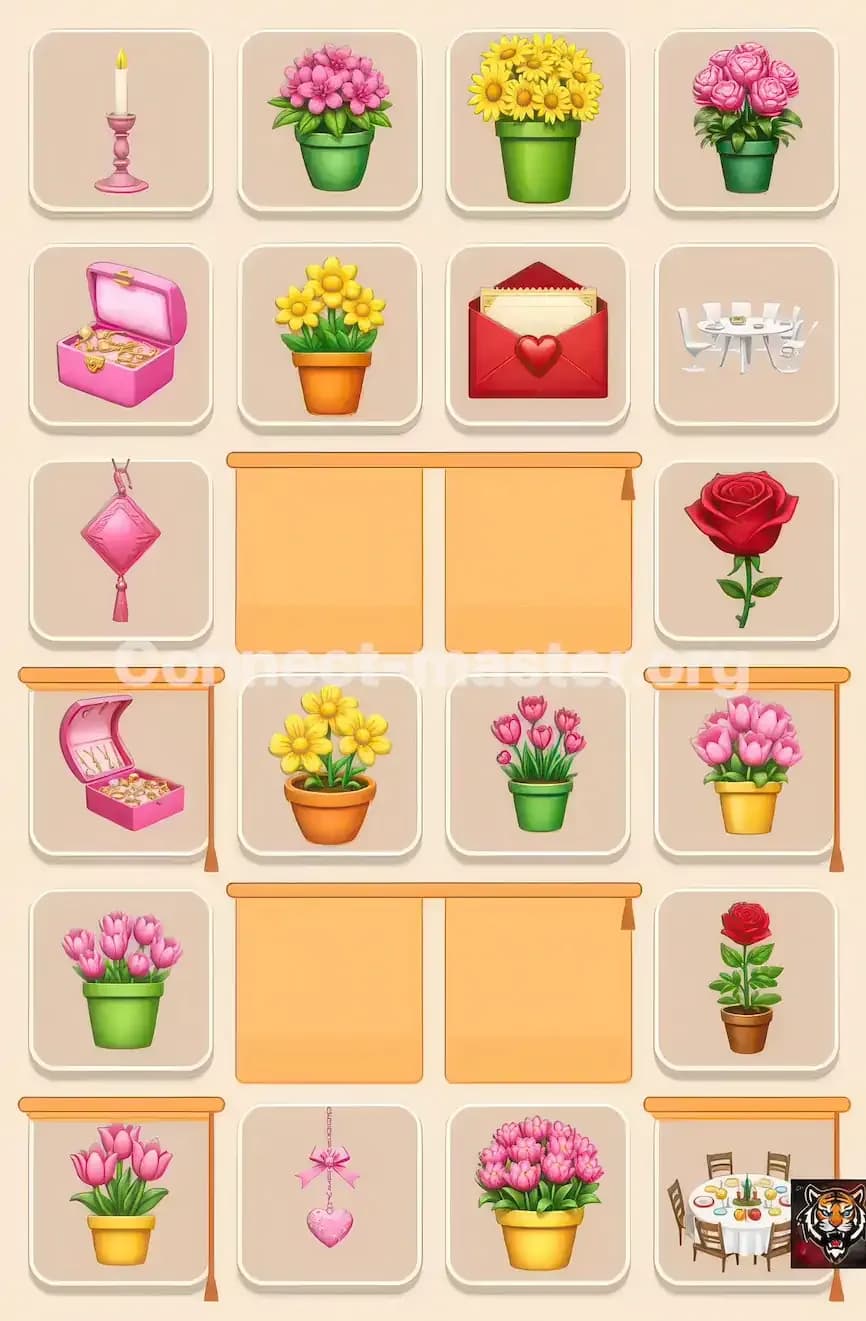
Connect Master Level 627 is a beautifully themed puzzle centered around romantic and decorative home elements. You're working with six distinct sets, each containing exactly four tiles that share a clear visual or categorical trait. The puzzle blends flowers, candles, jewelry charms, and dining setups into a cohesive challenge that looks deceptively simple at first glance but rewards careful observation. The color palette—turquoise, purple, coral, green, and orange—helps visually separate the groups, but don't let that fool you into thinking the puzzle is straightforward.
The Six Sets of Connect Master Level 627
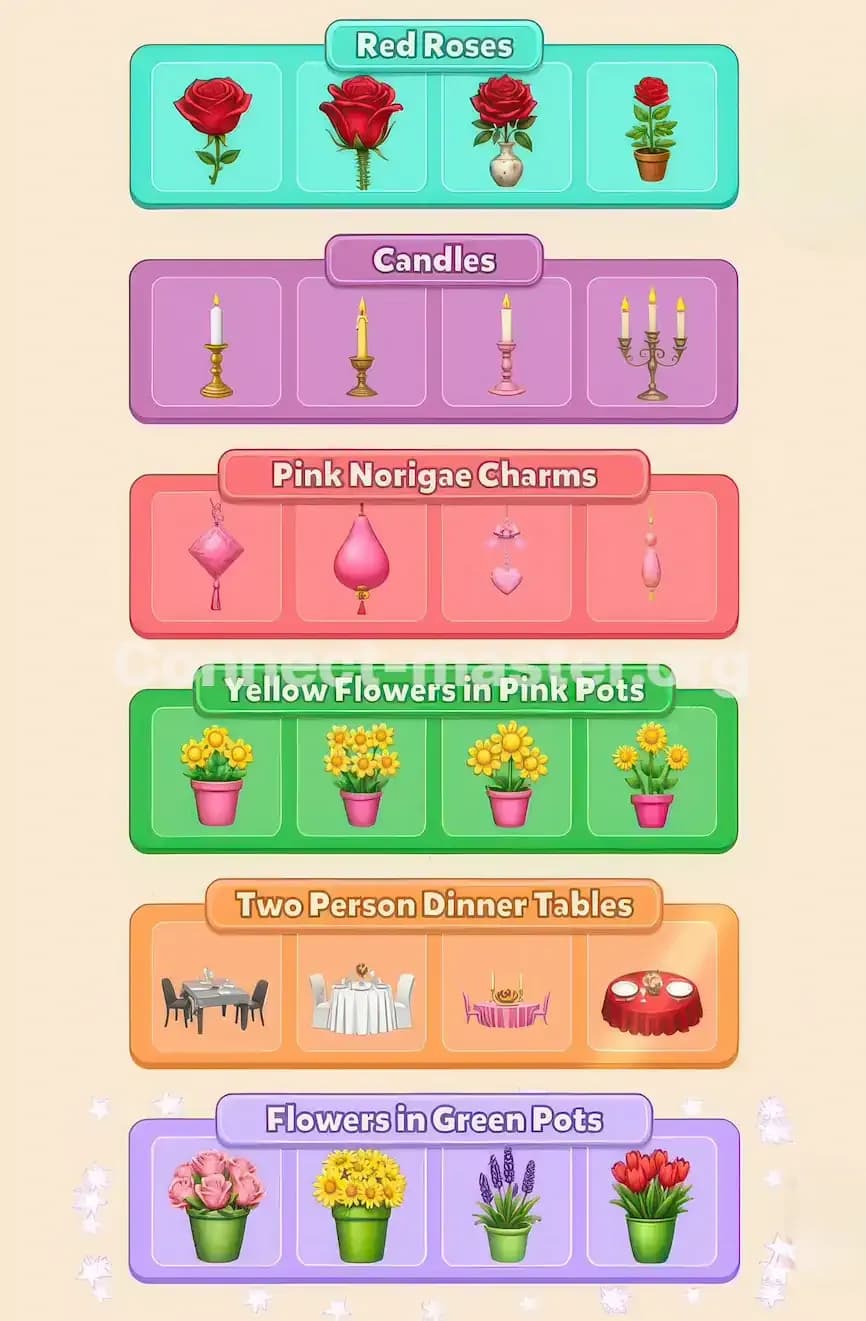
Red Roses brings together four variations of the classic red rose: a single stem with leaves, a rose held upright, a rose in a vase, and a potted rose plant. Each tile features the same vibrant red bloom, but in different presentations and containers.
Candles groups four candlestick arrangements, each with a lit candle in a decorative holder. You'll spot single candles in brass stands, a tall tapered candle, a pink candle in an ornate holder, and a three-candle candelabra—all sharing that warm, glowing flame aesthetic.
Pink Norigae Charms collects four delicate pink hanging ornaments inspired by traditional Korean jewelry. These include a diamond-shaped charm, a teardrop charm, a small heart charm, and an elongated pearl-like charm—all rendered in soft pink tones and designed to dangle.
Yellow Flowers in Pink Pots unites four potted plants, each featuring bright yellow blooms (daisies, chrysanthemums, or similar flowers) planted in matching pink containers. The consistency of the pot color and flower brightness makes this set feel cohesive once you spot it.
Two Person Dinner Tables assembles four intimate dining setups, each designed for two people. You'll find a dark table with black chairs, a round table with white linens, a purple-draped table with gold accents, and a red velvet-covered table—all romantic and formal in nature.
Flowers in Green Pots features four potted flowers in green containers, but with varied flower types: pink roses, yellow blooms, purple lavender, and red tulips. The green pot is the unifying trait here, not the flower color or type.
Why Connect Master Level 627 Feels So Tricky
The Most Confusing Set
The Pink Norigae Charms set is where most players stumble. These four tiles look like abstract, decorative objects at first—some might even seem like they belong with the candles or other ornaments. The challenge is recognizing that they're all specifically Korean-inspired hanging charms in the same color family. Without that cultural or design knowledge, you might waste time trying to fit them into other categories. I needed two retries here before I realized these weren't just random pink decorations but a unified jewelry concept.
Subtle Overlaps and Decoys
The Red Roses and Flowers in Green Pots sets create real confusion because both contain flowers in containers. The key difference? Red Roses are always red and often in varied container types (vase, pot, stem), while Flowers in Green Pots are always in green pots but feature different flower colors and species. If you're not paying attention to the pot color and flower consistency, you'll accidentally mix tiles from these two sets.
Another tricky overlap exists between Candles and other decorative objects. Some candle holders are ornate and might look like they could belong with jewelry or other decor, but the presence of the lit flame is the defining trait. Look for that yellow or orange glow at the top of each tile—it's your confirmation that you're looking at a candle, not just a fancy holder.
The Two Person Dinner Tables set also has a subtle challenge: each table looks completely different in style and color. You might think they belong to separate categories (formal tables, casual tables, colorful tables), but the unifying trait is that every single one seats exactly two people. Count the chairs or place settings on each tile, and the pattern clicks into place.
The "Finally Saw It!" Moment
What really struck me about Connect Master Level 627 is how the puzzle forces you to shift between broad categories and hyper-specific details. At first, you see "flowers" and "decorations" and "tables." But then you realize you need to distinguish between red flowers and yellow flowers, between pink pots and green pots, between single candles and multi-candle arrangements. That mental shift from general to granular is what makes this level feel challenging—and satisfying once you crack it.
Step-by-Step Solution for Connect Master Level 627
Opening: Lock In the Obvious Sets First
Start by identifying Yellow Flowers in Pink Pots immediately. This set is visually distinct because the combination of bright yellow blooms and matching pink containers is unmistakable. All four tiles share this exact color pairing, and there's no ambiguity here. Locking this in early removes four tiles from consideration and simplifies the board significantly.
Next, tackle Red Roses. Even though roses appear in other sets, the Red Roses group is unified by the flower color alone—every single tile features a red rose, regardless of whether it's a stem, a vase arrangement, or a potted plant. This clarity makes it a safe second choice. Once you've confirmed these two flower-based sets, you've eliminated eight tiles and can focus on the remaining decorative and furniture items.
Mid-Game: Process of Elimination and Visual Comparison
Now you're left with Candles, Pink Norigae Charms, Two Person Dinner Tables, and Flowers in Green Pots. Here's where careful observation matters. Look at the Candles set: every tile must have a visible flame or a lit candle. If you see a holder without a flame, it doesn't belong here. This distinction helps you avoid confusing ornate candle holders with other decorative objects.
For Flowers in Green Pots, compare the pot color across all remaining flower tiles. If the pot is green, it belongs here—regardless of whether the flower is pink, yellow, purple, or red. This is the opposite of the Yellow Flowers in Pink Pots logic, so don't let your brain default to matching flower colors. The pot color is the key.
The Pink Norigae Charms set requires you to recognize that all four tiles are hanging ornaments in shades of pink. They're not candles, not flowers, not furniture—they're jewelry-inspired decorative charms. If a tile looks like it could hang from a string or chain and is predominantly pink, it likely belongs here. Compare the shapes: diamond, teardrop, heart, and pearl-like forms all fit this category.
End-Game: The Final Two Sets
By now, you should have Two Person Dinner Tables and possibly one or two stragglers left. The dinner tables set is your final confirmation. Each tile shows a complete dining setup for two people. Count the chairs, place settings, or visual indicators of seating capacity. A table with four chairs doesn't belong here; a table with two chairs or two place settings does. This set is actually quite straightforward once you've eliminated everything else, because there's no other category that could reasonably contain furniture.
If you've correctly identified all five previous sets, the remaining four tiles will automatically form Flowers in Green Pots. But don't skip the verification step—look at each tile and confirm that the pot is green and the flower is present. This final check prevents you from accidentally mis-grouping a tile that looked like it might belong elsewhere.
The Logic Behind This Connect Master Level 627 Solution
From Broad Traits to Specific Details
The systematic approach to Connect Master Level 627 works because you're progressively narrowing your focus. Start with the most obvious shared traits: flower color, container type, or object category. Red Roses and Yellow Flowers in Pink Pots are easy because they have two obvious unifying traits (flower color and pot color). Once those are locked in, you're forced to look at more subtle distinctions—the presence of a flame for candles, the specific shape and color of charms, the seating capacity of tables.
This progression prevents decision fatigue and reduces the chance of mis-grouping. You're not trying to solve all six sets simultaneously; you're solving the easiest ones first, which automatically clarifies the harder ones through elimination.
Naming Each Set Keeps Logic Organized
Throughout this Connect Master Level 627 guide, I've used consistent category names: Red Roses, Candles, Pink Norigae Charms, Yellow Flowers in Pink Pots, Two Person Dinner Tables, and Flowers in Green Pots. These names aren't just labels—they're mental anchors that prevent you from double-using a tile or chasing the wrong category. When you see a pink flower in a green pot, your brain immediately knows it belongs in Flowers in Green Pots, not Yellow Flowers in Pink Pots, because the name itself specifies the pot color.
By naming each set descriptively and using those names consistently as you work through Connect Master Level 627, you create a mental filing system that makes the puzzle feel less chaotic and more like a logical progression. You're not juggling abstract groups; you're organizing items into clearly labeled categories. That clarity is what transforms a tricky puzzle into a solvable one.