Connect Master Level 537 Solution Walkthrough & Answer
How to solve Connect Master level 537? Get instant solution & answer for Connect Master 537.
Connect Master Level 537 Pattern Overview
The Theme and Set Breakdown
Connect Master Level 537 is a food and kitchenware puzzle that splits into six distinct categories of items you'd find in a cook's workspace or dining area. The board presents a delightful mix of decorative objects, serving utensils, and prepared dishes—all with their own visual signatures. What makes Connect Master Level 537 particularly interesting is that the items don't share obvious colors or shapes; instead, they share functional or categorical traits that require you to think about what each item is used for, not just how it looks at first glance.
The Six Sets in Connect Master Level 537
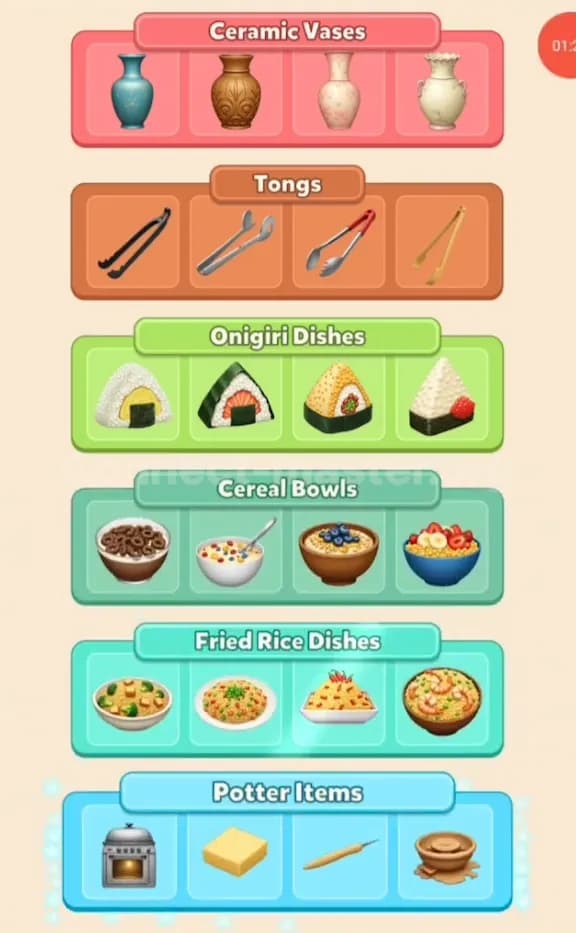
Ceramic Vases bring together four decorative vessels: a turquoise vase with a narrow neck, a brown ornate vase, a cream-colored smooth vase, and a pale green vase. These are all about form and elegance—they're non-functional decorative pieces meant for display.
Tongs group four utensils designed for gripping and serving: black tongs, gray metal tongs, burgundy tongs, and golden tongs. The unifying trait here is their function as kitchen grabbing tools, regardless of color or handle style.
Onigiri Dishes consist of four triangular or pyramid-shaped rice parcels: a white onigiri, a green seaweed-wrapped onigiri, a yellow corn onigiri, and a pink strawberry onigiri. They're all Japanese rice balls, and their distinct fillings and colors are just visual variety within the same category.
Cereal Bowls showcase four breakfast vessels filled with different toppings: chocolate cereal in a brown bowl, colorful cereal in a white bowl, blueberries and granola in a tan bowl, and fruit and granola in a navy bowl. The common thread is that each bowl contains a breakfast-style cereal or grain mixture.
Fried Rice Dishes display four Asian rice preparations: a yellow curry-style fried rice, an orange pumpkin fried rice, a triangular fried rice cake, and a brown bowl of fried rice. All are cooked rice dishes served as meals, even though the shapes and garnishes vary.
Potter Items round out the set with four pottery-workshop or artisan objects: a ceramic oven or kiln, a yellow block of clay, a wooden stirring stick, and a finished clay bowl. These represent the tools and materials used in pottery crafting.
Why Connect Master Level 537 Feels So Tricky
The Most Overlooked Set: Potter Items
I found that the Potter Items set trips up most players because it's the only group that isn't directly food-related, yet it sits among six categories dominated by dishes, bowls, and serving tools. When you're in a "food puzzle" mindset, your brain naturally glosses over the ceramic oven, clay block, and stick because they don't immediately register as meal components. The challenge is remembering that Connect Master Level 537 mixes themes—it's not all about eating; some tiles are about making tableware or craft items. The moment you stop assuming every group is food-based, that set becomes obvious.
Subtle Overlaps That Create Confusion
The biggest visual trap in Connect Master Level 537 is the overlap between Onigiri Dishes and Cereal Bowls. Both groups contain items that could go in a bowl or on a plate, and both are triangle or round-shaped. However, the key difference is structure: onigiri are self-contained rice parcels (you eat the whole thing as one unit), while cereal bowls are liquid-based or granola-heavy preparations served in a vessel. Looking closely at the tiles, onigiri never have a rim or bowl edge—they're standalone. Cereal bowls always show the bowl's edge, whether it's brown ceramic, white porcelain, or navy blue.
Another sneaky overlap appears between Fried Rice Dishes and Cereal Bowls. Both contain rice as the base ingredient, and visually they can look similar if you're glancing quickly. I needed two retries here before I realized the distinction: cereal bowls have lighter, airier toppings (granola, fruit, light-colored cereal), while fried rice dishes have a darker, more oil-based, savory appearance with eggs, vegetables, or pumpkin visible in the rice itself. Fried rice looks "cooked" and glossy; cereal looks "sprinkled" and fresh.
The third tricky overlap is between Tongs and other metallic objects. Some of the tong handles catch light and might momentarily look like they belong with pottery sticks or utensil handles. The distinction is that tongs always have two gripping arms that come together at a hinge point—they're functional grabbing tools. A single stick or stirrer is just one rigid piece.
The "Finally Saw It" Moment
When I finally locked in Connect Master Level 537, the breakthrough came when I stopped grouping by color and started grouping by purpose. The ceramic vases aren't linked because they're all cream or brown; they're linked because they're decorative vessels with no food purpose. Once I reframed the puzzle that way, everything else cascaded into place.
Step-by-Step Solution for Connect Master Level 537
Opening: Identify the Safest Sets First
Start by locking in Ceramic Vases immediately—this is your gimme set. All four are clearly decorative pottery with no food, no utensil function, and no kitchen purpose. This eliminates 25% of the board in one confident move.
Next, tackle Tongs with full certainty. Even if the colors differ wildly, tongs are unmistakable once you look for the two-pronged, hinged design. Whether they're black, gray, burgundy, or gold, every single one is a serving or cooking tool with that signature grip-and-release mechanism.
These two sets are your anchor points for Connect Master Level 537, and locking them in early removes obvious tiles from competing categories, which reduces mental load significantly.
Mid-Game: Process of Elimination with Visual Comparison
With Ceramic Vases and Tongs removed, you're left with four food groups and Potter Items. Now compare Onigiri Dishes against Cereal Bowls side-by-side. Ask yourself: "Is this item standing alone, or is it inside a container?" Onigiri stand alone with visible nori seaweed wrapping and distinct shapes. Cereal bowls show a curved rim and are filled with toppings that are scattered or submerged.
Once Onigiri is confirmed, you can lock it in. Now focus on the remaining three: Cereal Bowls, Fried Rice Dishes, and Potter Items.
For Cereal Bowls, look for the telltale lightness and crispness of breakfast toppings—you'll see granola, berries, and cereal pieces that appear almost airy. For Fried Rice Dishes, hunt for the oily, cooked appearance; the rice grains should look glossy and mingled with egg, vegetables, or pumpkin. Compare the texture: does it look like it was cooked together (fried rice), or was the topping scattered on top (cereal)?
End-Game: Isolating Potter Items and Final Confirmation
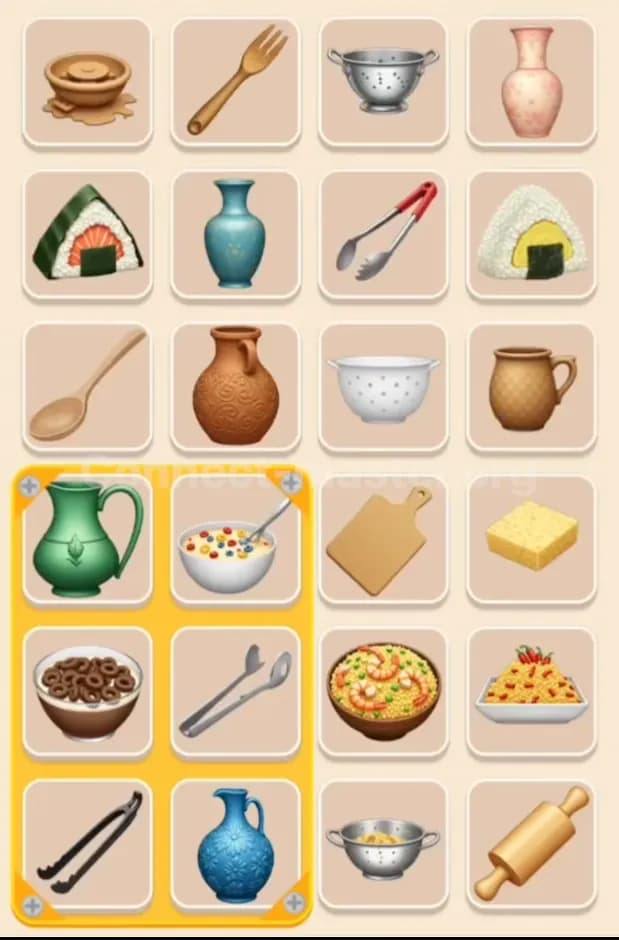
By the end of Connect Master Level 537, you should have only four tiles left: the ceramic oven, clay block, wooden stick, and clay bowl. These tiles represent making pottery, not using pottery for food. The oven fires clay; the block and stick are raw materials or tools; the finished bowl is the output. This is your final set, and it'll click once you've eliminated the other five.
Double-check that no fried rice bowl snuck into this group—the pottery bowl looks finished and smooth, while rice bowls often show food inside. If you're unsure about any tile in the final four, trace back: has this tile already appeared in another set? If not, it belongs in Potter Items by default.
The Logic Behind This Connect Master Level 537 Solution
Moving from Obvious to Subtle
The systematic approach to Connect Master Level 537 works because you collapse the possibilities layer by layer. First, you remove items with a single, obvious defining trait (decorative vs. functional; grouped by function rather than appearance). Then, you use process of elimination to separate near-identical categories. By the time you reach the final set, there's no guessing—it's the only group left, and you've confirmed each of the other five through elimination and visual comparison.
This method prevents the paralyzing moment where you stare at the board and see overlaps everywhere. Instead, you're actively asking yes-or-no questions: "Is this a decorative vessel?" "Does this have a hinge?" "Is this sitting in a bowl?" Each answer narrows your options exponentially.
The Power of Naming Your Sets
When you give each group a clear, descriptive name—like "Ceramic Vases," "Tongs," or "Potter Items"—you create mental scaffolding that keeps every tile anchored. I noticed that when I was vague ("bowl group" or "rice group"), I second-guessed myself and mixed up categories. But when I said, "Potter Items are about making things, not using them," Connect Master Level 537 became almost logical rather than visual-puzzle chaos.
Naming also helps you spot decoys and near-misses. If you're looking for "Fried Rice Dishes," a soup bowl won't fit no matter how much it looks like it might, because you've already defined the category by appearance and purpose. That discipline is what transforms Connect Master Level 537 from a frustrating game of trial-and-error into a solvable puzzle.