Connect Master Level 1166 Solution Walkthrough & Answer
How to solve Connect Master level 1166? Get instant solution & answer for Connect Master 1166.
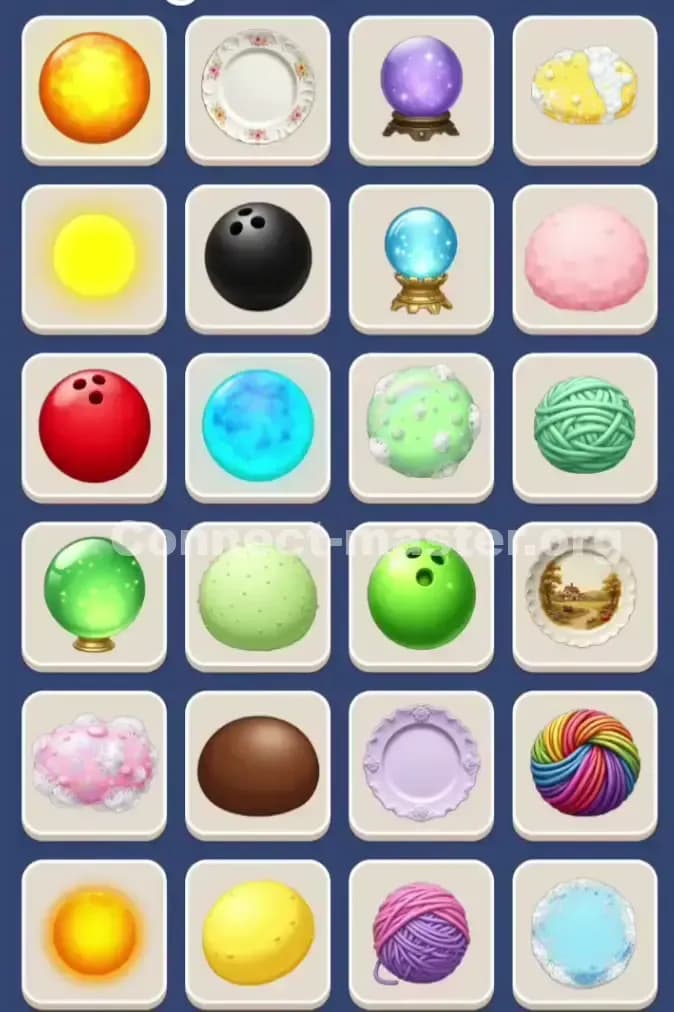
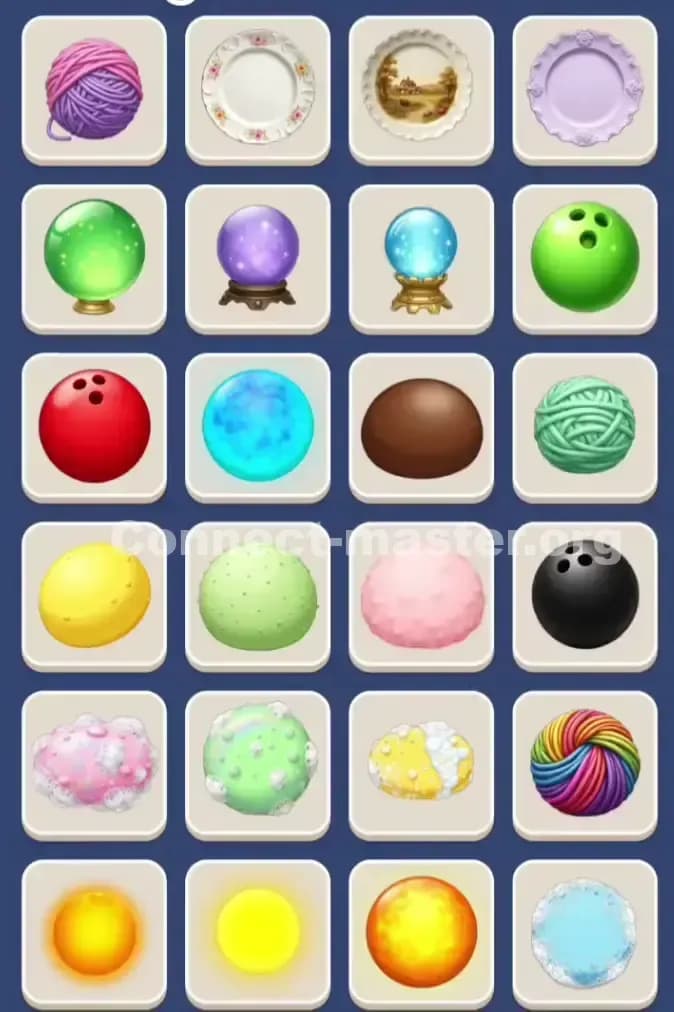
Connect Master Level 1166 Pattern Overview
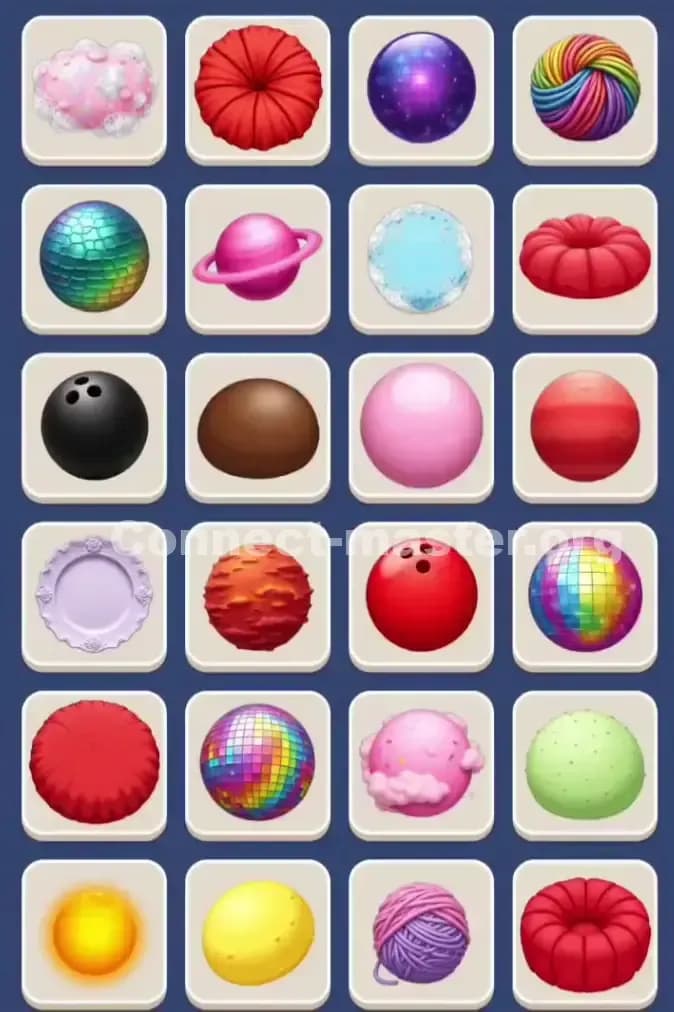
Welcome to the walkthrough for Connect Master Level 1166! If you're staring at a screen full of colorful round objects and feeling a little lost, you've come to the right place. This level is a fantastic example of how the game uses similar shapes and colors to create clever decoys. The entire board is composed of spherical or circular items, forcing you to look beyond the obvious to find the real connections. Let's break down exactly what you're looking at.
The Theme of the Board
The theme for Connect Master 1166 is "All Things Round." You’re dealing with a total of 24 tiles, which means you need to identify six distinct sets of four. The items range from food and hobby supplies to decorative objects, but their shared circular shape is designed to make you second-guess every move. Success on this level depends on spotting the one unique detail that defines each group.
All Six Sets at a Glance
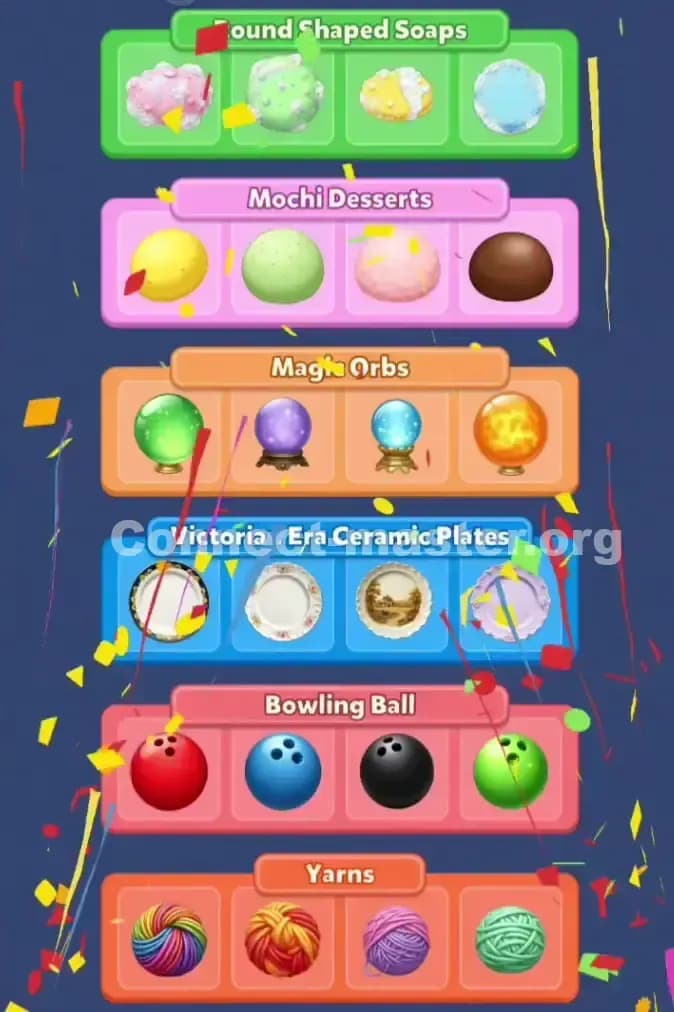
Before we dive into strategy, let's identify the six categories you need to find on the Connect Master Level 1166 board. Knowing what you’re looking for is half the battle.
- Bowling Balls: This is a set of four shiny bowling balls, each distinguished by the classic three finger holes.
- Magic Orbs: You'll find four mystical-looking crystal balls, and the key identifier here is that each one rests on a small wooden stand.
- Yarns: This group consists of four balls of yarn. Their defining feature is the stringy, wound texture that sets them apart from the other smooth spheres.
- Ceramic Plates: These are four decorative plates. Unlike the other items, they are flat and circular, often with ornate rims or painted designs.
- Mochi Desserts: This is a set of four soft, smooth, round desserts. They have a matte, doughy-looking texture.
- Round-Shaped Soaps: The trickiest set! These are four lumps of artisanal soap that look almost like clouds or bath bombs. Their texture is lumpy, foamy, or crystalline—definitely not smooth.
Why Connect Master Level 1166 Feels So Tricky
If this level is giving you trouble, you're not alone. I needed a couple of retries before the patterns clicked into place. The designers did a masterful job of creating visual overlaps that lead you down the wrong path. The difficulty isn’t in the individual tiles but in how they relate to one another.
The Most Confusing Set: Round-Shaped Soaps
The single biggest obstacle in Connect Master Level 1166 is, without a doubt, the Round-Shaped Soaps. Let's be honest, they don't immediately scream "soap." The pink one looks like a fluffy cloud, the green one looks like a bumpy alien rock, and the others look like bath bombs or strange mineral formations. Because they don’t fit a conventional image of soap, players often leave them for last and struggle to figure out what they have in common. Their shared trait is their irregular, lumpy, and non-edible texture, which is a subtle category to pinpoint.
Subtle Overlaps and Decoys
The true challenge of Connect Master 1166 lies in the decoy tiles. The board is littered with items that look like they could belong to two different groups, especially when you're just looking at color.
The most common mistake is mixing up the Mochi Desserts and the Round-Shaped Soaps. You have a pink mochi and a pink soap. You have a light green mochi and a light green soap. If you try to group by color, you'll get stuck. The secret is to compare their textures side-by-side. The mochi are perfectly smooth and matte, like soft dough. The soaps, by contrast, are bumpy, foamy, or crystalline. One set looks edible; the other absolutely does not.
Another potential trap involves all the shiny spheres. At a quick glance, the Bowling Balls and Magic Orbs are just colorful, glossy balls. You must focus on the details. Do you see three little holes? It's a Bowling Ball. Do you see a wooden stand at the base? It's a Magic Orb. The props are the key to separating them.
My "Aha!" Moment
I spent way too long trying to make a "pink items" group or a "green items" group work. It was a total dead end. My breakthrough came when I stopped looking at color and focused entirely on texture. I mentally separated the remaining tiles into two piles: "smooth and yummy-looking" versus "lumpy and weird-looking." Suddenly, the Mochi and Soap sets became perfectly clear. That was the moment I realized the puzzle wasn't about color at all—it was a test of differentiating surface textures.
Step-by-Step Solution for Connect Master Level 1166
Ready to clear this board? The best approach is to move from the most obvious sets to the most subtle. This strategy, known as "cornering," systematically reduces the number of tiles and makes the final, tricky decisions much easier.
Opening Moves: Clear the Obvious Sets First
Start your game by locking in the two easiest sets to identify. This will immediately clear eight tiles from the board, giving you much more clarity.
- Find the Bowling Balls: Scan the grid for the four tiles with three distinct finger holes. You'll find a red, blue, black, and bright green one. Their unique feature makes them impossible to confuse with anything else. Group them and get them out of the way.
- Find the Magic Orbs: Next, look for the four crystal balls sitting on wooden stands. The stands are a dead giveaway. You’ll have a green, purple, light blue, and fiery orange orb. Match them up to clear the second set.
Mid-Game Strategy: Tackle the Yarns and Plates
With the most distinct spheres gone, the board should feel less cluttered. Now, let’s target the groups defined by unique textures and shapes.
- Group the Yarns: The four balls of yarn are your next target. Their stringy, wound texture is completely different from the remaining smooth or lumpy items. Find the rainbow, yellow/orange, purple, and green yarns and complete the set.
- Isolate the Ceramic Plates: Now, look for the flat items. The four Ceramic Plates are the only non-spherical objects here. You'll see one with a landscape painting, one with a red and gold rim, one with a blue and gold rim, and a solid purple one with a scalloped edge. Grouping these should be straightforward.
End-Game: The Final Showdown Between Soaps and Mochi
You should now be left with eight tiles. This is the final hurdle of Connect Master Level 1166. You'll see a pink, light green, yellow, and brown sphere, along with four other lumpy, colorful items. Do not try to match by color! The solution lies in texture.
- Identify the Mochi Desserts: First, pull out the four tiles that look smooth, soft, and edible. This is your Mochi set. The group consists of the yellow, light green, pink, and brown pieces. Their texture is consistently matte and uniform.
- Lock in the Round-Shaped Soaps: The four tiles that remain are the Round-Shaped Soaps. Look at them: the fluffy pink one, the bumpy green one, the frosty blue one, and the yellow-and-white one. Their shared trait is that they are all lumpy, textured, and irregular. Congratulations, you've just solved the trickiest part of the level!
The Logic Behind This Connect Master Level 1166 Solution
Every Connect Master level has an internal logic, and understanding it is the key to solving future puzzles faster. Connect Master 1166 is a masterclass in misdirection.
From Obvious Props to Subtle Textures
The puzzle is designed to be solved in a specific order of thinking. It forces you to move from broad, obvious characteristics to tiny, specific details. You start with "things with holes" (Bowling Balls) and "things on stands" (Magic Orbs)—these are categories defined by props. Then you move to "things with a stringy texture" (Yarns) and "things that are flat" (Ceramic Plates). The final solution requires you to make the most subtle distinction of all: "smooth texture" (Mochi Desserts) versus "lumpy texture" (Round-Shaped Soaps). By systematically reducing the board, you make that final, difficult choice much simpler.
The Power of Naming Your Sets
A great mental habit for a level like Connect Master 1166 is to actively name each set in your head as you identify it. When you mentally label a group "The Bowling Balls," you create a firm rule for what belongs. This prevents you from getting distracted. When you’re down to the final eight tiles, labeling one group "Smooth Desserts" and the other "Lumpy Soaps" provides the logical framework you need to avoid making a mistake based on color. This organizational technique helps you see the patterns the designers intended and solve the puzzle with confidence.