Connect Master Level 1412 Solution Walkthrough & Answer
How to solve Connect Master level 1412? Get instant solution & answer for Connect Master 1412.
Connect Master Level 1412 Pattern Overview
The overall theme and board structure
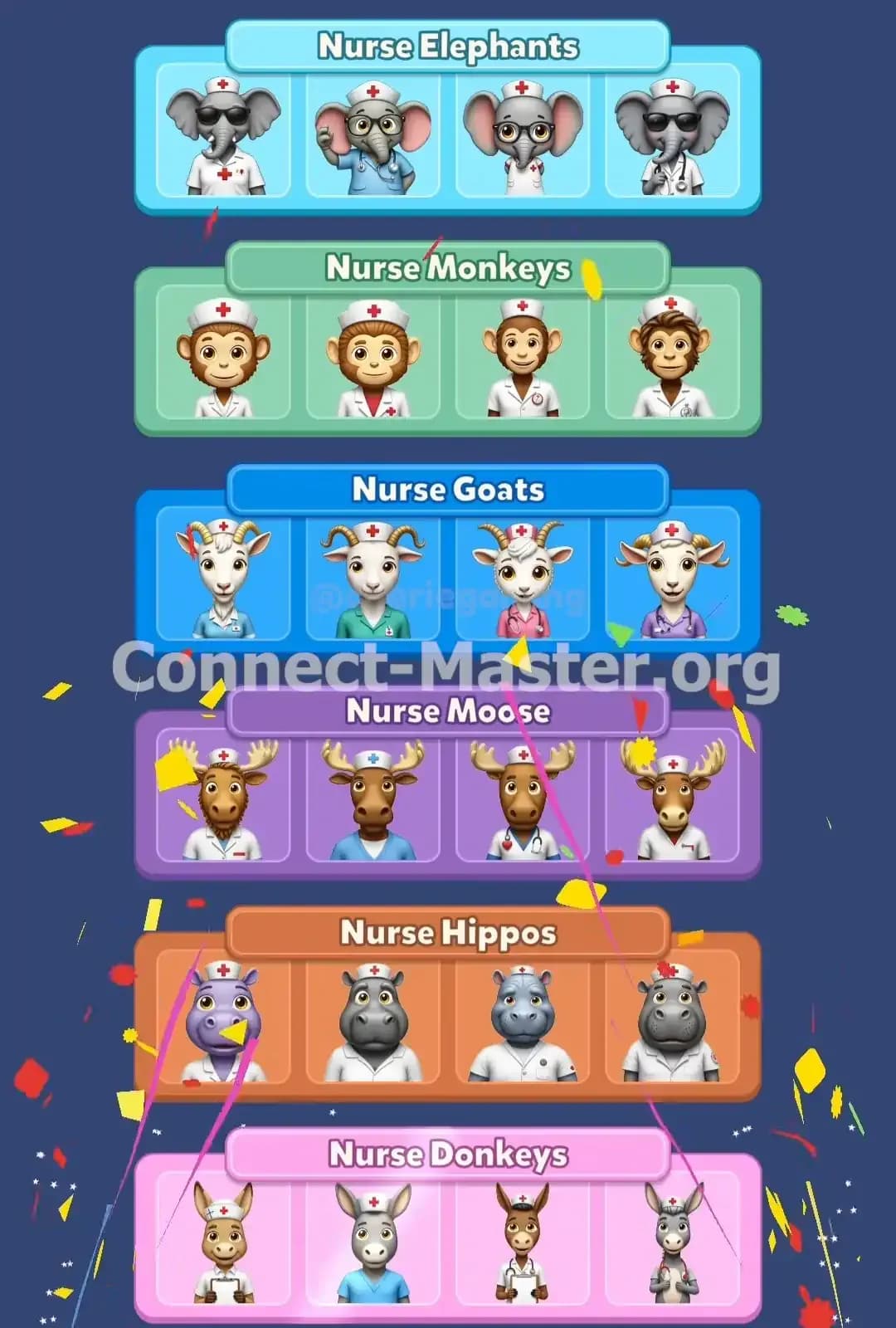
Connect Master Level 1412 uses a cheerful animal-and-medical theme. Every tile shows an animal dressed as a nurse or medical worker, so the broad visual clue is intentionally shared across the entire board. That means you can’t solve this level by simply spotting the nurse caps or white coats.
There are six groups of four tiles, making 24 tiles in total. The animals are elephants, monkeys, goats, moose, hippos, and donkeys. Most characters carry medical details such as nurse hats, scrubs, lab coats, stethoscopes, clipboards, or visible red crosses. The real task is to identify the animal species while ignoring clothing that appears across several groups.
The six sets in Connect Master Level 1412
- Nurse Elephants: Four elephant characters with trunks, large ears, and nurse or doctor clothing. Their glasses, stethoscopes, and different uniforms are decoys; the trunk and elephant ears are the reliable clues.
- Nurse Monkeys: Four monkey nurses with rounded ears, expressive humanlike faces, and brown or tan fur. Some have short fur while another has a fuller, shaggy appearance, but all belong to the monkey group.
- Nurse Goats: Four goat nurses identified by horns, pointed ears, and narrow goat-like faces. Their colored uniforms vary between blue, green, pink, and purple.
- Nurse Mooses: Four moose medical workers with broad antlers and long, heavy faces. Their shirts and coats differ, but the large antlers make this category distinct.
- Nurse Hippos: Four hippo nurses with wide muzzles, rounded heads, and thick gray or purple bodies. The hippos have smaller ears and no antlers or horns.
- Nurse Donkeys: Four donkey nurses with long upright ears, elongated faces, and gray, brown, or dark coloring. Clipboard poses and clothing changes make this set easier to miss than it first appears.
Why Connect Master Level 1412 Feels So Tricky
The most confusing set: Nurse Donkeys
The Nurse Donkeys group is probably the easiest one to overlook in Connect Master 1412. Donkeys can resemble several other animals when you only glance at the faces, especially the gray hippos and the darker moose. Their medical uniforms also vary enough that they don’t immediately look like a single matching set.
Focus on the ears first. The donkeys have long, pointed ears that stand clearly above the nurse caps. Their faces are also narrower and longer than the broad muzzle of a hippo. Once you notice those two features, the four donkey tiles become much easier to lock together.
Small overlaps that create false matches
The first major overlap is between Nurse Elephants and Nurse Hippos. Both groups can have gray skin, rounded heads, and large-looking ears. However, an elephant always has a visible trunk extending from the center of the face. Hippos have a broad, flat muzzle instead, with nostrils and a heavy rounded jaw. Don’t let sunglasses or white coats distract you from that central facial feature.
The second overlap appears between Nurse Goats and Nurse Mooses. Both animals have horns or antler-like shapes above their heads, and both appear in several different colored uniforms. Goats have shorter, curved horns and slimmer faces, while moose characters have enormous branching antlers and much longer, heavier muzzles. If the headgear looks wide and branching, it belongs with the moose; if it looks compact and curled, check the goats.
The third overlap is between Nurse Monkeys and Nurse Donkeys. Several monkey tiles have brown fur and friendly, upright faces, while some donkeys are also brown. Compare the ears and muzzle rather than the fur color. Monkeys have small rounded ears at the sides of the head, whereas donkeys have unmistakably long ears. The monkey face is also more compact and humanlike.
My reaction to the puzzle
I initially wanted to sort the tiles by uniform color, but that approach quickly created too many almost-groups. I needed two retries before the animal silhouettes became the main clue instead of the medical outfits. The “I finally saw it!” moment came with the donkey set: once I compared ear length rather than coat color, four tiles snapped into place immediately.
Step-by-Step Solution for Connect Master Level 1412
Opening: lock in the clearest animal traits
Start Connect Master Level 1412 by scanning for the most unmistakable silhouettes. The Nurse Elephants should be an early group because the trunks are impossible to confuse once you deliberately look at the center of each face. Select the four elephant tiles together, regardless of whether they wear glasses, a stethoscope, or different nurse uniforms.
Next, locate Nurse Mooses. Their broad antlers are the strongest repeated shape on the board, and the antlers are much more informative than the shirt colors. Select the four moose characters only after confirming that each has the same large antler structure.
The Nurse Goats are also a good early target. Look for four slim faces with compact, curved horns and pointed ears. The blue, green, pink, and purple clothing is a helpful visual variation, but the horns and face shape are what guarantee the match.
Mid-game: remove broad categories and compare details
After clearing the elephants, moose, and goats, the remaining board becomes much easier to read. Now work on the Nurse Monkeys. Compare the ears, cheeks, and furline instead of the medical accessories. The four monkeys have rounded ears and compact faces, even though one may look shaggier or have a different coat style than the others.
At this stage, avoid grouping based on nurse hats. Every set contains characters wearing similar caps, and several hats show the same red cross. The hats establish the theme of Connect Master 1412, not the category. Likewise, a white coat can appear on elephants, monkeys, moose, hippos, and donkeys.
If you see a gray animal and feel tempted to pair it with another gray animal, pause and check the whole head. A gray character with a trunk is an elephant, a gray character with a broad flat muzzle is a hippo, and a gray character with long ears is a donkey. Species-specific facial structure matters more than color.
End-game: separate the hippos and donkeys
The last two sets are usually Nurse Hippos and Nurse Donkeys. For the hippos, search for the four very broad heads and thick, rounded muzzles. Their ears are small, their noses sit prominently on the muzzle, and their bodies look heavier than the other animals. Some hippos may appear purple or bluish-gray, so don’t require an exact skin color match.
Then place the remaining four long-eared characters into Nurse Donkeys. Check that each has tall ears and a long, narrow face. One donkey may be brown, another gray, and another dressed in blue or white, but those differences are cosmetic. The shared trait is the donkey head shape, not the uniform.
Before confirming the final group, make sure you haven’t borrowed a monkey with dark fur or a hippo with gray skin. A clean solution requires exactly four tiles in each set, with no tile doing double duty. If one candidate looks uncertain, compare its ears and muzzle against all three confirmed members rather than judging it in isolation.
The Logic Behind This Connect Master Level 1412 Solution
Move from obvious traits to specific details
The safest strategy for Connect Master Level 1412 is to solve from large, unmistakable traits toward smaller distinctions. Trunks identify elephants, branching antlers identify moose, and compact horns identify goats. These strong categories remove 12 tiles and reduce the number of possible false matches.
Once the obvious sets are gone, use facial details to finish the board. Rounded ears and compact faces point to monkeys, broad muzzles point to hippos, and long upright ears point to donkeys. This progression systematically reduces confusion because each solved group removes distractions from the remaining groups.
Use category names to keep the board organized
I recommend naming every group in your head: Nurse Elephants, Nurse Monkeys, Nurse Goats, Nurse Mooses, Nurse Hippos, and Nurse Donkeys. These short labels make it easier to remember why a tile belongs somewhere.
For example, if a gray animal seems suitable for both Nurse Hippos and Nurse Donkeys, ask which category matches its defining feature: broad muzzle or long ears? Naming the groups also prevents accidental double-use. Once a tile is mentally assigned to Nurse Elephants, you stop reconsidering it as part of another gray-animal group.
That combination of visual anchors, elimination, and clear category names makes Connect Master 1412 manageable. Ignore the shared nurse theme, identify the animal first, and every tile will eventually fit into one precise group of four.