
Connect Master Level 1471 Solution Walkthrough & Answer
How to solve Connect Master level 1471? Get instant solution & answer for Connect Master 1471.
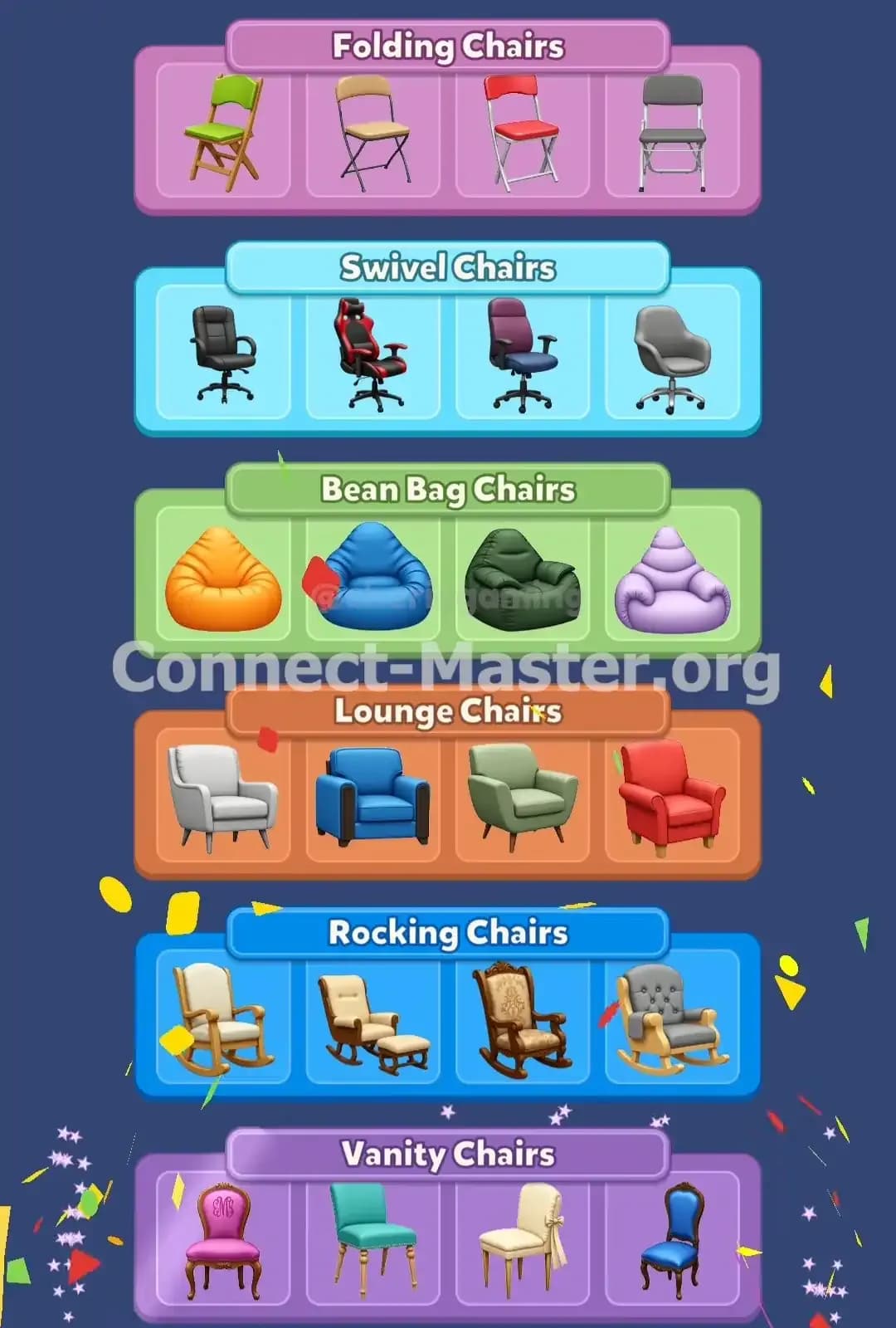
Connect Master Level 1471 Pattern Overview
The overall theme and board layout
Connect Master Level 1471 is built around one clear object family: chairs. The challenge isn’t recognizing the general theme; it’s separating six different chair styles that share similar shapes, colors, and furniture details. There are 24 tiles altogether, divided into six correct sets of four.
The six groups are Folding Chairs, Swivel Chairs, Bean Bag Chairs, Lounge Chairs, Rocking Chairs, and Vanity Chairs. The board mixes practical seating, office-style furniture, soft casual chairs, decorative armchairs, and elegant bedroom or dressing-room chairs. Because color is not enough to solve the level, you’ll need to focus on construction and function.
The six correct sets
- Folding Chairs: These four chairs have lightweight frames that fold inward, with simple fabric or padded seats and backs. Their crossed support legs are the key giveaway.
- Swivel Chairs: These four chairs stand on wheeled or multi-legged bases and are designed to rotate. Armrests and adjustable-looking office or task-chair shapes help confirm the group.
- Bean Bag Chairs: These are soft, oversized, cushion-like seats with no rigid frame or normal legs. Their rounded, collapsed shapes make this set distinctive.
- Lounge Chairs: These four are conventional upholstered armchairs with broad seats, solid arms, and short legs. They look comfortable and living-room ready rather than portable or mechanical.
- Rocking Chairs: Each chair has curved runners beneath it, allowing the chair to rock back and forth. The upholstery and wood styles vary, but the rocker base is decisive.
- Vanity Chairs: These decorative upright chairs have slim legs, elegant upholstery, and ornamental designs suited to a dressing table or bedroom. Their formal appearance separates them from ordinary lounge chairs.
Why Connect Master Level 1471 Feels So Tricky
The most confusing set: Vanity Chairs
The Vanity Chairs set is the one I’d expect many players to overlook. These chairs don’t all share one color or one exact silhouette, and some look like ordinary dining chairs at first glance. Their real connection is the decorative, refined design: narrow legs, high backs, bright upholstery, and ornamental details.
The pink chair has an especially formal, carved appearance, while the turquoise, cream, and blue chairs look more varied. Still, they all have an elegant vertical profile instead of the deep, relaxed shape seen in the Lounge Chairs. Look for presentation and decoration rather than comfort or mechanical features.
Subtle overlaps between the chair groups
The first overlap is between Lounge Chairs and Vanity Chairs. Both groups can include upholstered seats with backs and sometimes armrests. To separate them, check the proportions. Lounge Chairs are wider and deeper, with substantial arms and short supporting legs. Vanity Chairs are slimmer, taller, and more decorative, often showing ornate upholstery, carved legs, or a formal high back.
The second overlap is between Swivel Chairs and Lounge Chairs. A modern lounge chair may look like an office chair if you only notice its arms and padded back. The detail to inspect is underneath: every Swivel Chair has a central support with a wheeled or star-shaped base. The Lounge Chairs instead rest on four short legs or solid supports and have no rotating pedestal.
The third overlap is between Folding Chairs and Rocking Chairs. Both can have visible wooden or metal frames, and a folding chair’s crossed legs may initially resemble a curved rocker support. Check the bottom carefully. Folding Chairs have straight, crossing legs that form a collapsible frame, while Rocking Chairs have unmistakable curved runners extending along the floor.
My pattern-recognition moment
I found Connect Master 1471 much easier once I stopped sorting by color. The green folding chair and green lounge chair naturally pull your attention together, but that’s a trap. The moment I focused on bases and leg structures, the board suddenly became organized: wheels meant Swivel Chairs, runners meant Rocking Chairs, and no rigid legs meant Bean Bag Chairs. That “I finally saw it” moment is the main key to this level.
Step-by-Step Solution for Connect Master Level 1471
Opening: lock in the obvious structural sets
Start with Bean Bag Chairs. These four tiles are the safest opening group because their soft, shapeless bodies have no normal chair frame, legs, wheels, or runners. Their colors range from bright orange and blue to dark green and light purple, so don’t worry about matching shades. The shared trait is the oversized cushion construction.
Next, identify Rocking Chairs. Search for the four chairs with curved runners at the bottom. Some have traditional wooden frames, while others are padded or upholstered, but the curved base is impossible to fake. Lock these in immediately because removing them clears several visually similar wooden chairs from the board.
Then collect Swivel Chairs. Look beneath the seat for a central post and a rolling base. These include more traditional padded office designs as well as a red-and-black gaming-style chair and a rounded gray chair. Their colors and back shapes differ, but the rotating pedestal and wheels unite the set.
Mid-game: use construction instead of color
With three groups removed, turn to Folding Chairs. Compare the legs rather than the upholstery. Each one has a simple folding frame with crossed supports and a relatively thin seat or back. The colors include green, tan, red, and gray, so color-based grouping would create several false matches. A chair that sits on straight folding braces belongs here even if its padding resembles another category.
At this point, the remaining conventional armchairs should point toward Lounge Chairs. These chairs have broad upholstered seats, sturdy arms, and short legs. Their silhouettes are relaxed and substantial. The white, blue, green, and red examples may look unrelated by color, but they all have the same living-room armchair function and solid four-legged construction.
Before committing, check that none of the candidates has wheels, curved runners, or a narrow decorative frame. This verification step prevents you from accidentally using a Vanity Chair as a lounge chair.
End-game: separate the final decorative chairs
The final set is Vanity Chairs, and the exact trait to follow is formal decorative styling. Look for tall or elegant backs, slender legs, ornate trim, and upholstery that feels designed for a dressing area rather than a casual sitting room. The pink, turquoise, cream, and blue chairs belong together despite their different colors.
Keep them separate from Lounge Chairs by asking one practical question: does the chair look deep and relaxed, or upright and ornamental? Deep seats and broad arms indicate Lounge Chairs. Slim proportions, decorative backs, and refined legs indicate Vanity Chairs.
Once these four are identified, all 24 tiles are accounted for: four Folding Chairs, four Swivel Chairs, four Bean Bag Chairs, four Lounge Chairs, four Rocking Chairs, and four Vanity Chairs. That completes Connect Master Level 1471.
The Logic Behind This Connect Master Level 1471 Solution
Move from major traits to tiny details
The most reliable method for Connect Master 1471 is to solve from broad physical traits to specific design details. Start with the categories that have unique structures: Bean Bag Chairs have no rigid frame, Swivel Chairs have rolling bases, and Rocking Chairs have curved runners. These groups can be confirmed without relying on color or upholstery.
After removing them, compare the remaining supports and silhouettes. Folding Chairs use crossed collapsible frames, while Lounge Chairs use sturdy legs and deep armchair bodies. The final distinction between Lounge Chairs and Vanity Chairs depends on smaller details such as back height, leg style, arm width, and decorative trim.
This process systematically reduces confusion. Every time you lock a confirmed group, you remove four possible distractions from the board. Since every tile belongs to exactly one set, the remaining tiles become increasingly informative.
Use category names to prevent double-using tiles
Naming each group in your head is also extremely useful. I’d mentally label the categories as “folding frame,” “rolling base,” “soft cushion,” “living-room armchair,” “curved runner,” and “decorative upright chair.” These short descriptions make it easier to test a suspected group without mixing categories.
If one tile seems to fit two groups, don’t force it immediately. Set it aside and compare the other three candidates. A true set should have one consistent defining trait, not merely a shared color or general chair shape. By keeping the six category names separate, you avoid double-using a tile and make the final deductions in Connect Master Level 1471 much more confidently.