Connect Master Level 1502 Solution Walkthrough & Answer
How to solve Connect Master level 1502? Get instant solution & answer for Connect Master 1502.
Connect Master Level 1502 Pattern Overview
The overall theme and board layout
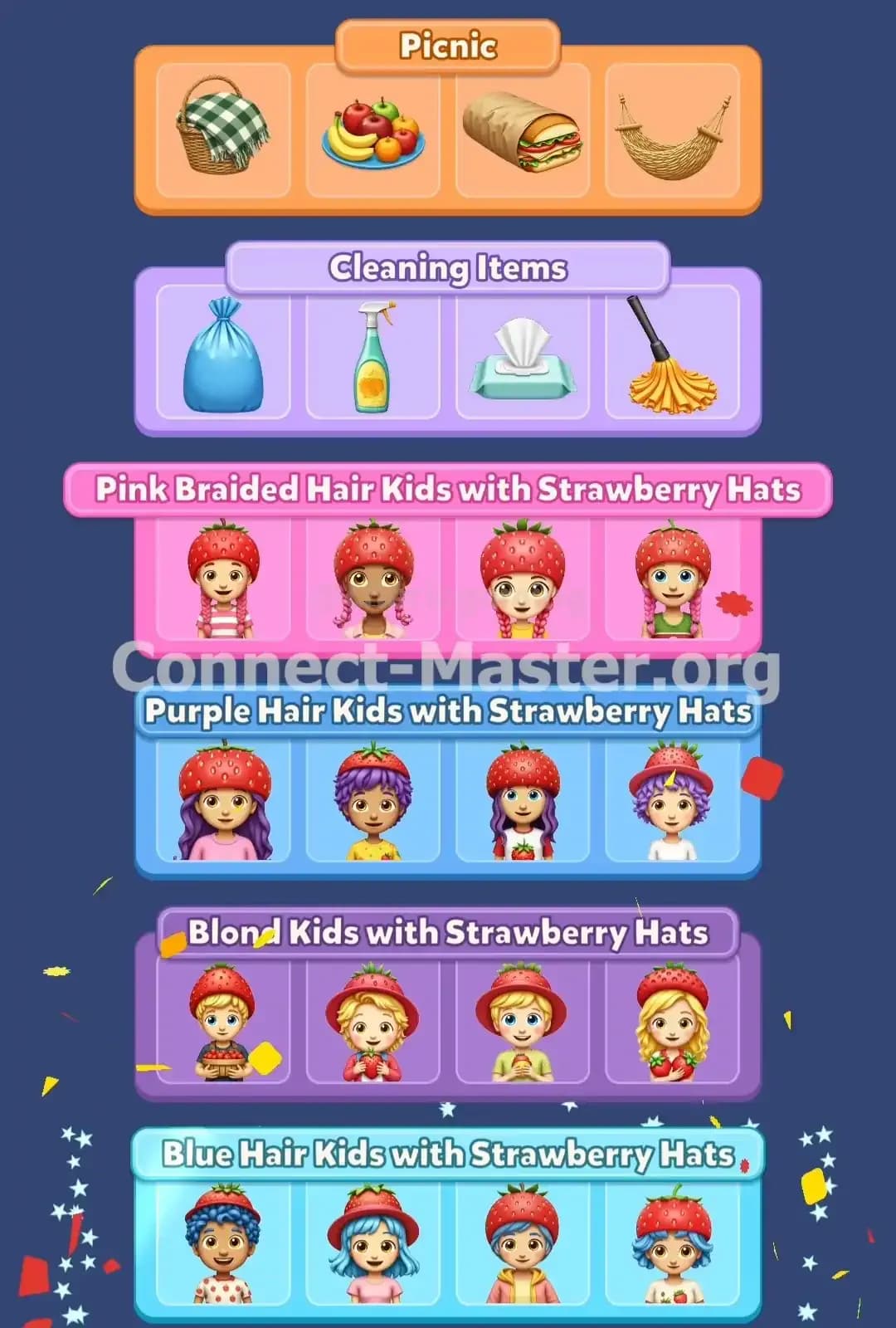
Connect Master Level 1502 uses a bright picnic-and-cleanup theme, mixed with groups of children wearing strawberry-shaped hats. The board contains six complete sets, with every set made up of exactly four tiles. Two groups contain ordinary objects, while the other four groups contain character portraits separated by hair color and hairstyle details.
At first, the children can look interchangeable because nearly everyone wears a strawberry hat. That repeated accessory is the main distraction in Connect Master 1502. The safest approach is to treat the hat as a secondary clue and focus on hair color, hair texture, braids, and clothing.
The six sets in Connect Master 1502
- Picnic Items: a checkered picnic basket, a plate of assorted fruit, a wrapped sandwich, and a woven hammock. These all belong to a relaxed outdoor picnic setting.
- Cleaning Items: a blue garbage bag, a spray-cleaner bottle, a tissue box, and a mop. Each is a recognizable household cleaning or tidying item.
- Pink-Braided Hair Kids with Strawberry Hats: four children with strawberry hats and clearly visible pink or rosy braided hair. Their clothing and skin tones vary, but the braids are the shared clue.
- Purple-Haired Kids with Strawberry Hats: four children with purple hair under strawberry hats. Hair shade and texture matter more than their shirts or facial expressions.
- Blond Kids with Strawberry Hats: four blond or golden-haired children wearing strawberry hats. This group includes different hat shapes and outfits, so the hair color is the anchor.
- Blue-Haired Kids with Strawberry Hats: four children with blue or blue-toned hair and strawberry hats. Some have short hair, some have longer hair, but the cool blue hair color connects them.
Why Connect Master Level 1502 Feels So Tricky
The most confusing set: Pink-Braided Hair Kids
The Pink-Braided Hair Kids with Strawberry Hats set is the easiest group to overlook in Connect Master Level 1502. The characters don’t all have exactly the same pink shade, and their braids may be partly hidden beside the face or shoulders. Because every child wears a strawberry hat, it’s tempting to sort them by shirt color, skin tone, or eye color instead.
Look below the hat and inspect both sides of the head. The deciding trait is the pink-toned braided hairstyle, not the design of the shirt. Once you identify one or two clear examples, search for the remaining characters with the same braid pattern instead of comparing their faces.
Subtle overlaps between the character groups
The first overlap is between the Pink-Braided Hair Kids and the Purple-Haired Kids. Both groups use vivid cool or rosy hair colors, and the strawberry hats make the portraits appear more similar than they really are. Pink-braided children show distinct plaits hanging beside the face, while the purple-haired children have loose, curly, short, or flowing purple hair. Check the hair structure, not just the general color.
The second overlap appears between the Blond Kids and the Pink-Braided Hair Kids. A blond child may have a pink or red hat brim, and a pink-haired character may have pale highlights that look blond at a quick glance. Focus on the hair emerging underneath the hat. Blond hair is yellow or golden from root to tip, while the pink-braided group has rosy strands and visible braids.
The third overlap involves the Blue-Haired Kids and the Purple-Haired Kids. Some artwork uses blue-purple shading, especially in curls and shadows. Look at the dominant color around the whole hairstyle. Blue-haired characters have a clear blue, cyan, or navy impression, while purple-haired characters remain violet even where the hair is darker. Eye color and shirt color are decoys here; they don’t define either set.
My reaction to the level
I found Connect Master Level 1502 deceptively busy rather than genuinely random. The picnic and cleaning groups become obvious quickly, but the character rows made me hesitate because the same strawberry hat appears everywhere. The “I finally saw it” moment came when I stopped treating the hats as the main category and separated the children by hair first. After that, the board felt much more orderly.
Step-by-Step Solution for Connect Master Level 1502
Opening: lock in the obvious object sets
Start Connect Master 1502 by identifying the two non-character groups. The Picnic Items set is especially clear: the checkered basket, fruit plate, sandwich, and hammock all suggest an outdoor meal or leisure scene. Lock these four together, but don’t let the hammock’s unusual shape distract you; it still fits the picnic theme better than any character category.
Next, select the Cleaning Items set. The garbage bag, spray bottle, tissue box, and mop are direct functional matches. These tiles have almost no serious competition, so removing them early is useful. Once both object groups are set aside, the remaining board consists entirely of strawberry-hat children, making the next comparisons much easier.
Mid-game: sort the children by dominant hair color
With the object tiles removed, make four mental piles: pink-braided, purple, blond, and blue. Don’t commit immediately based on one portrait. Instead, compare the visible hair around the hat, ears, cheeks, and shoulders.
For the Blond Kids with Strawberry Hats, look for unmistakable yellow or golden hair. Their hats may differ in brim color or shape, and their outfits include different colors, so don’t require matching clothing. The hair is enough.
Then locate the Blue-Haired Kids with Strawberry Hats. Look for blue curls, blue bangs, or blue flowing hair. A character with a blue shirt but brown or blond hair does not belong here. This is a common mis-grouping in Connect Master Level 1502: players follow the clothing color instead of the hair.
After that, compare the remaining rosy and violet hairstyles. Place the clearly purple characters into Purple-Haired Kids with Strawberry Hats, and reserve the visibly braided pink-haired portraits for the final pink group. If a character seems to fit both, zoom in mentally on the sides of the face and inspect whether the hair is braided or loose.
End-game: separate the final two hair groups
The final challenge is usually the separation between Pink-Braided Hair Kids and Purple-Haired Kids. The exact trait for the pink group is two-part: rosy pink hair plus recognizable braids. The purple group is defined by purple hair, whether it is curly, short, wavy, or long.
Avoid using eyes, skin tone, or clothing to decide these sets. A brown-eyed child can belong to either group, and a pink shirt is not evidence of pink hair. Also watch for strawberry leaves and red hat brims, which can create extra color noise around the head.
Before confirming either set, count four tiles in each mental pile. If you have only three clear purple characters, one of the uncertain tiles probably belongs there rather than forcing a fifth pink-looking match. Every tile must belong to one and only one set, so the four-tile count is an excellent safeguard.
The Logic Behind This Connect Master Level 1502 Solution
Move from broad traits to specific details
The solution for Connect Master Level 1502 works because it progresses from the strongest visual categories to the weakest. Picnic objects and cleaning tools are broad, functional matches that can be recognized immediately. Removing them reduces the board without risking much confusion.
The character groups require a narrower strategy. First use the repeated strawberry hat to recognize the general character pool, then ignore that shared feature and compare hair color. Finally, use hairstyle details—especially braids versus loose hair—to resolve the near-match between pink and purple. Moving from obvious traits to tiny details systematically reduces the number of possible explanations.
Use category names to prevent double-using tiles
I recommend naming every group in your head: Picnic Items, Cleaning Items, Pink-Braided Hair Kids, Purple-Haired Kids, Blond Kids, and Blue-Haired Kids. These short labels keep the logic organized while you scan the board.
For example, once you assign a child to Blue-Haired Kids, stop reconsidering that tile when checking the purple group. Likewise, after the basket is confirmed as part of Picnic Items, there’s no reason to compare it with the cleaning set. This mental bookkeeping prevents double-use, exposes missing tiles, and helps you finish Connect Master 1502 confidently rather than relying on a lucky guess.