Connect Master Level 1521 Solution Walkthrough & Answer
How to solve Connect Master level 1521? Get instant solution & answer for Connect Master 1521.
Connect Master Level 1521 Pattern Overview
The overall theme and board structure
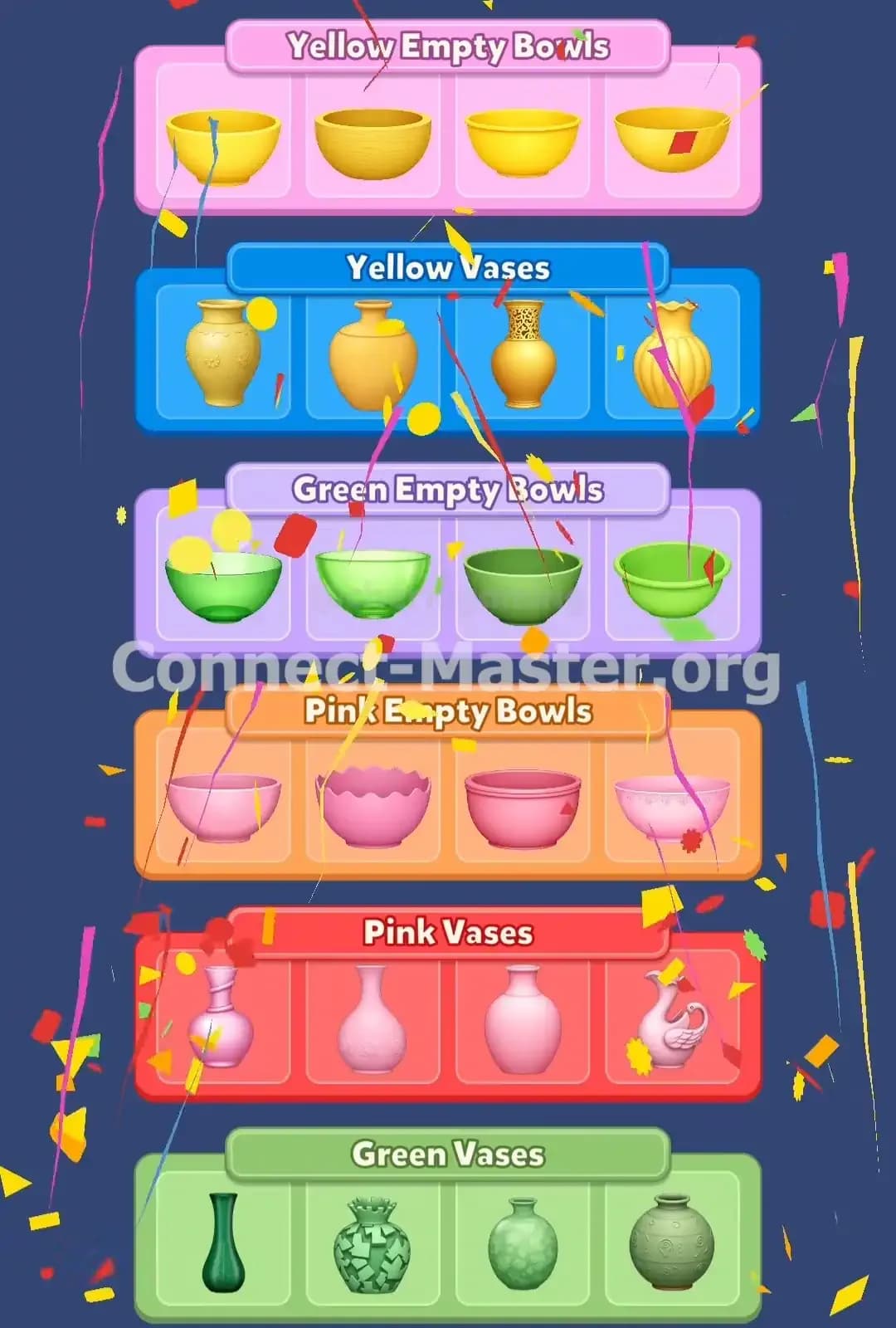
Connect Master Level 1521 is built around one deceptively simple visual idea: ceramic containers sorted by both color and object type. Every correct group contains exactly four tiles, and the full board has six sets, giving you 24 tiles in total.
The main split is between bowls and vases. The bowls are further divided into yellow, green, and pink versions, while the vases use the same three-color pattern. That means color alone isn’t enough to solve Connect Master 1521—you must also check the silhouette, opening, neck, base, and decorative details.
The six categories are:
Yellow Empty Bowls
These four tiles are all yellow bowls with open, bowl-like bodies. Their rims are wide compared with their height, and none has the narrow neck or tall profile associated with the vase groups. Even though their yellow shades vary slightly, the shared shape is the important clue.
Yellow Vases
The four yellow vase tiles have taller, more upright forms than the yellow bowls. Look for a defined neck, smaller opening, and vase-style base. One has a patterned upper section, while another has a ribbed body, but their structure still clearly places them together.
Green Empty Bowls
These four green bowls have broad openings and low, rounded bodies. Some are pale green and translucent-looking, while others are darker or more saturated. Their differences in shading are decoys; the open bowl shape and green color identify the set.
Pink Empty Bowls
The pink bowl group includes four open containers with relatively wide rims. Their designs are not identical: one has a wavy edge, another has a thicker ring around the top, and another appears lighter and more transparent. Their low profile and pink color connect them.
Pink Vases
These four pink tiles are all vases with narrow openings or necks and taller bodies. The set includes both smooth and highly decorative shapes, including a distinctive swan-like vase. Ignore the unusual ornament and focus on the vase silhouette and pink coloring.
Green Vases
The green vase group contains four tall or upright green containers. Their surfaces range from smooth to cracked, textured, and patterned. The dark green bottle-shaped piece is especially easy to overlook, but its narrow neck and vase body make it a clear member of this set.
Why Connect Master Level 1521 Feels So Tricky
The most confusing set: Green Vases
The Green Vases set is probably the easiest group to miss in Connect Master Level 1521. Its four tiles don’t share one obvious shade of green or one consistent decoration. One is sleek and dark, one looks cracked, one has a rounded textured body, and one carries a more decorative circular pattern.
Players often separate these tiles because they look like different kinds of pottery. However, the defining trait isn’t surface decoration—it’s the vase construction. Each has a narrower opening, a raised neck or lip, and a body designed to stand vertically rather than hold contents like a shallow bowl.
Subtle overlaps between bowls and vases
The first overlap is between the Yellow Empty Bowls and Yellow Vases. Both groups contain warm golden tiles, and some yellow vases have rounded bodies that can initially resemble bowls. To separate them, compare the opening to the body: bowls have broad, exposed openings, while vases taper toward a smaller mouth and usually show a neck.
The second overlap occurs between Green Empty Bowls and Green Vases. Green shades are particularly varied, so a dark green bowl can look more substantial than a pale green vase. Check the height and rim instead of relying on color. The bowls sit low and spread outward; the vases rise upward and narrow near the top.
The third overlap is between Pink Empty Bowls and Pink Vases. Several pink tiles have rounded bodies, and the decorative pink vase can distract you from the basic category. Look at the top edge carefully. A bowl has a clearly open, wide rim, while a vase has a smaller opening, a neck, or a bottle-like transition into the body.
My reaction to the pattern
At first, Connect Master Level 1521 feels like a collection of nearly interchangeable pottery tiles. I needed to stop judging them by their exact shade and instead ask a simpler question: “Is this meant to sit low like a bowl, or stand tall like a vase?” Once I saw that every color had one bowl group and one vase group, the board became much more manageable.
Step-by-Step Solution for Connect Master Level 1521
Opening: lock in the obvious bowl groups
Start with the Yellow Empty Bowls, Green Empty Bowls, and Pink Empty Bowls. These are the best opening groups because their wide openings and low profiles make them easier to recognize than the vases.
For the Yellow Empty Bowls, select the four yellow containers with broad, open tops. Don’t be distracted by differences in bowl depth or surface shading. Next, find the Green Empty Bowls by selecting the four green pieces that spread outward from the base and lack a narrow neck. Finish this phase with the Pink Empty Bowls, checking for wide rims and short, rounded bodies.
Locking in these three groups removes half the board and prevents you from repeatedly comparing every yellow, green, or pink tile against every other tile.
Mid-game: sort the remaining tiles by structure
After the three bowl groups are removed, the remaining tiles should all be vases. Now separate them by color: yellow, pink, and green.
For Yellow Vases, look for the golden containers with vertical bodies, smaller openings, or obvious neck sections. Their decorative patterns are not required to match. A vase with a ribbed body still belongs with a smoother yellow vase because the overall form is the same.
For Pink Vases, compare the pink tones only after confirming the shape. The group includes pieces with different silhouettes, so the small opening and upright body are more reliable than exact color. The unusual swan-like design belongs here because it is still functioning visually as a pink vase rather than a bowl.
The final mid-game group is Green Vases. Use elimination carefully, but don’t place a tile here simply because it is green. Confirm that each remaining piece has a vase-like profile. If a green tile has a wide, open rim and a low body, revisit the Green Empty Bowls instead.
End-game: resolve the near-matches
The last tricky comparison is usually between Green Vases and Green Empty Bowls, especially when a rounded green vase has a wide-looking body. Focus on the top third of each tile. A vase normally has a neck, lip, or reduced opening, while a bowl opens broadly from the body.
The other final check is between Pink Vases and Pink Empty Bowls. The pink bowl with a decorative or uneven rim can look vase-like at a glance, but its opening remains wide and its body remains low. Conversely, the pink vase tiles rise from a smaller mouth into a taller body. Once those structural details are clear, place the last four tiles into their correct category.
The Logic Behind This Connect Master Level 1521 Solution
Move from broad traits to precise details
The reliable way to solve Connect Master 1521 is to work from the largest visual distinction to the smallest. First separate bowls from vases. Then divide each object type by color. Finally, use details such as rim width, neck shape, body height, texture, and decoration to confirm borderline tiles.
This order matters because starting with tiny details can create false categories. A cracked vase and a patterned vase may look unrelated, but their shared upright structure is stronger evidence than their surface designs. Likewise, two bowls can have different rims while still belonging to the same color-and-shape group.
Use category names to organize the board
I recommend naming each set in your head as soon as you recognize it: Yellow Empty Bowls, Yellow Vases, Green Empty Bowls, Pink Empty Bowls, Pink Vases, and Green Vases. These names act like mental labels and stop you from using one tile twice.
When a tile seems to fit two groups, ask which category still needs it after your strongest matches are removed. This process of elimination works because Connect Master Level 1521 has no leftovers: every tile belongs to one and only one set. By combining color with container shape, you can solve the level systematically instead of guessing from decoration alone.