Connect Master Level 1520 Solution Walkthrough & Answer
How to solve Connect Master level 1520? Get instant solution & answer for Connect Master 1520.
Connect Master Level 1520 Pattern Overview
The overall theme and board structure
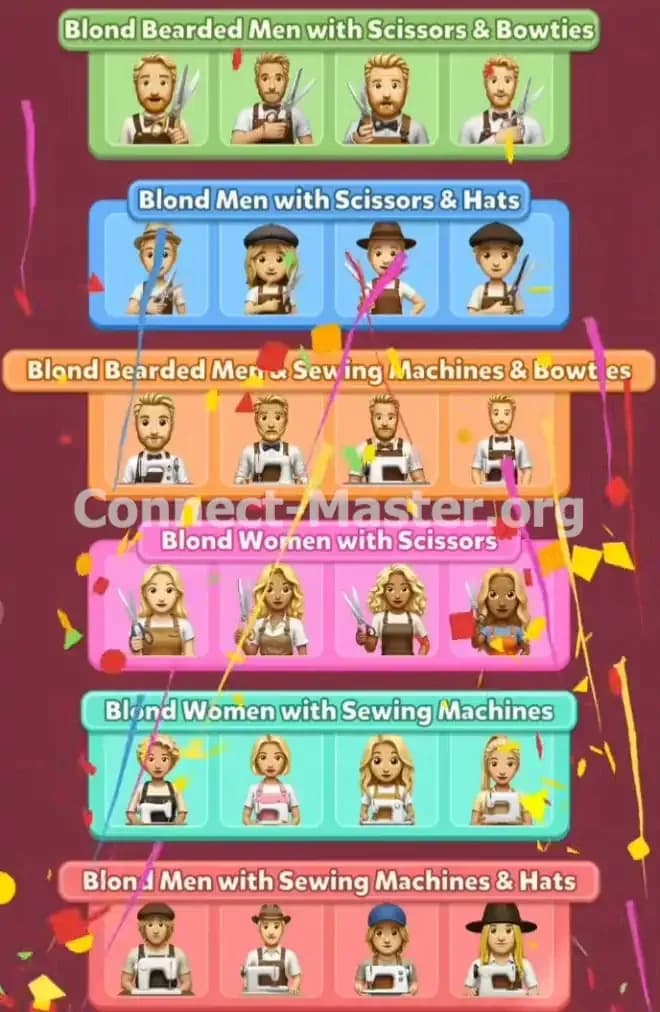
Connect Master Level 1520 uses a character-and-workshop theme built around blond characters, scissors, sewing machines, hats, bowties, and gender-based visual details. The board contains six sets of four tiles, so every one of the 24 tiles must be assigned exactly once.
At first, many characters appear interchangeable because several of them hold sewing tools or wear similar white shirts. The reliable approach is to sort the board by the biggest traits first: character type, tool, and clothing accessory. Once those broad clues are separated, smaller details such as facial hair, hats, and bowties finish the puzzle.
The six sets in Connect Master Level 1520
- Bearded Men with Scissors & Bowties: Four blond, bearded male characters holding scissors and wearing bowties.
- Hatted Men with Scissors: Four blond male characters with scissors and hats or caps.
- Bearded Men with Sewing Machines & Bowties: Four blond, bearded men using sewing machines while wearing bowties.
- Women with Scissors: Four blond female characters holding scissors, without the matching sewing-machine setup.
- Women with Sewing Machines: Four blond female characters positioned with sewing machines.
- Hatted Men with Sewing Machines: Four blond male characters using sewing machines while wearing hats.
These category names are intentionally practical. In Connect Master 1520, naming a group by its tool plus its most distinctive accessory makes it much easier to avoid accidentally borrowing a similar-looking tile.
Why Connect Master Level 1520 Feels So Tricky
The most confusing set
The hardest group is usually Hatted Men with Sewing Machines. Players often notice the hats first and try to combine these characters with the hatted men holding scissors. That move feels reasonable, but the tool is the deciding clue: one group has scissors, while the other has sewing machines.
The sewing-machine men can also resemble the Bearded Men with Sewing Machines & Bowties group because they share the same general workspace and clothing style. Look below the character’s hands instead of focusing only on the face. If the tile shows a hat and a sewing machine, it belongs with Hatted Men with Sewing Machines, even if the character’s shirt resembles another set.
Subtle overlaps and how to separate them
The first overlap is between Bearded Men with Scissors & Bowties and Hatted Men with Scissors. Both groups contain male characters with scissors, and the blond hair makes the faces look especially similar. Check the neck and lower face: a bowtie and beard point to the first group, while a hat or cap with no matching bowtie points to the second.
The second overlap is between Bearded Men with Sewing Machines & Bowties and Hatted Men with Sewing Machines. Both sets use sewing machines, white work shirts, and male characters. Compare the headwear and neck area carefully. A visible hat places the tile in Hatted Men with Sewing Machines; a beard combined with a bowtie places it in Bearded Men with Sewing Machines & Bowties.
The third overlap involves Women with Scissors and Women with Sewing Machines. The women share similar blond hairstyles and workshop clothing, so hair color alone tells you almost nothing. Focus on the object in front of the character: scissors are the key for Women with Scissors, while the larger sewing-machine base identifies Women with Sewing Machines.
I found this level deceptively satisfying because the tiles initially looked like variations of the same tailor character. Then the pattern suddenly clicked: the board is really crossing three ideas—scissors or sewing machines, men or women, and hats or bowties. Once I saw those layers, the solution became much more controlled.
Step-by-Step Solution for Connect Master Level 1520
Opening: lock in the clearest groups
Start with Women with Scissors. This is one of the safest groups because the four female characters are easy to recognize, and the scissors are clearly visible. Before selecting them, quickly confirm that each tile actually shows scissors rather than a sewing-machine setup. Locking in this group removes four tiles with very little risk.
Next, find Women with Sewing Machines. The remaining female characters should display the larger machine or sewing workstation in front of them. This is an excellent second group because it uses the same gender clue but changes the tool. Completing both women’s groups immediately reduces the visual clutter and leaves only the male characters.
Now inspect the male tiles holding scissors. Separate them into Bearded Men with Scissors & Bowties and Hatted Men with Scissors. Do not group all four scissors tiles together automatically. Check each character’s face, neck, and head: beards and bowties belong together, while hats and caps identify the other set.
Mid-game: sort the remaining men by tool
After the scissors groups are removed, the remaining male tiles should all be associated with sewing machines. At this point, use the same two-way comparison: beard and bowtie versus hat.
Select the four tiles in Bearded Men with Sewing Machines & Bowties by checking for the combination of facial hair, bowtie, and sewing machine. The bowtie is particularly useful because it sits lower than the face and can be missed when you’re scanning hairstyles. If a character has a sewing machine but no bowtie, leave it unselected until you compare the hats.
For the other four, identify Hatted Men with Sewing Machines. Each tile should show a hat or cap and a sewing machine. Look for the machine’s visible base, needle area, or colored body rather than relying only on the character’s hand position. Some poses make the tool less obvious, but the machine remains a larger and more structured object than the scissors.
End-game: keep the final two sets separate
The last tricky decision usually comes down to the two male sewing-machine groups. Keep Bearded Men with Sewing Machines & Bowties separate from Hatted Men with Sewing Machines by checking two details in order.
First, inspect the head. A hat or cap is enough to favor Hatted Men with Sewing Machines. Second, inspect the neck and face. A beard paired with a bowtie belongs to Bearded Men with Sewing Machines & Bowties. Don’t let a similar shirt or machine color override those clues.
If you reach the end with three tiles in one group and two possible candidates for the fourth, stop and audit the unused tiles. Connect Master Level 1520 guarantees that every tile belongs somewhere, so the missing tile may be hiding in the apparent opposite group. The correct choice should make both remaining sets contain exactly four tiles without forcing an exception.
The Logic Behind This Connect Master Level 1520 Solution
Move from broad traits to specific details
The solution works because it progresses from obvious traits to subtle ones. Begin with gender and tool type, since those features divide the board quickly. The scissors and sewing machines create the first major split, while men and women create the second.
After that, use accessories and facial details to resolve the decoys. Hats, bowties, and beards are more specific than general clothing, so they should be used only after the broad groups are visible. This prevents you from grouping characters based on a shared white shirt or similar blond hairstyle.
The process also guarantees full coverage. Every time you identify a set of four, remove those tiles mentally and reconsider the remaining board. If a proposed group leaves an awkward combination of three or five, it probably used a decoy tile.
Use category names to prevent double-counting
Keep the six labels in your head: Bearded Men with Scissors & Bowties, Hatted Men with Scissors, Bearded Men with Sewing Machines & Bowties, Women with Scissors, Women with Sewing Machines, and Hatted Men with Sewing Machines.
These names act like a checklist. For every tile, ask, “Which label describes the tool, character type, and accessory at the same time?” That question stops you from using one character in two imagined groups. In Connect Master 1520, the winning habit is not guessing the most attractive match; it’s proving that all four tiles share the same complete pattern.