Connect Master Level 1517 Solution Walkthrough & Answer
How to solve Connect Master level 1517? Get instant solution & answer for Connect Master 1517.
Connect Master Level 1517 Pattern Overview
A food-and-grocery theme with six complete sets
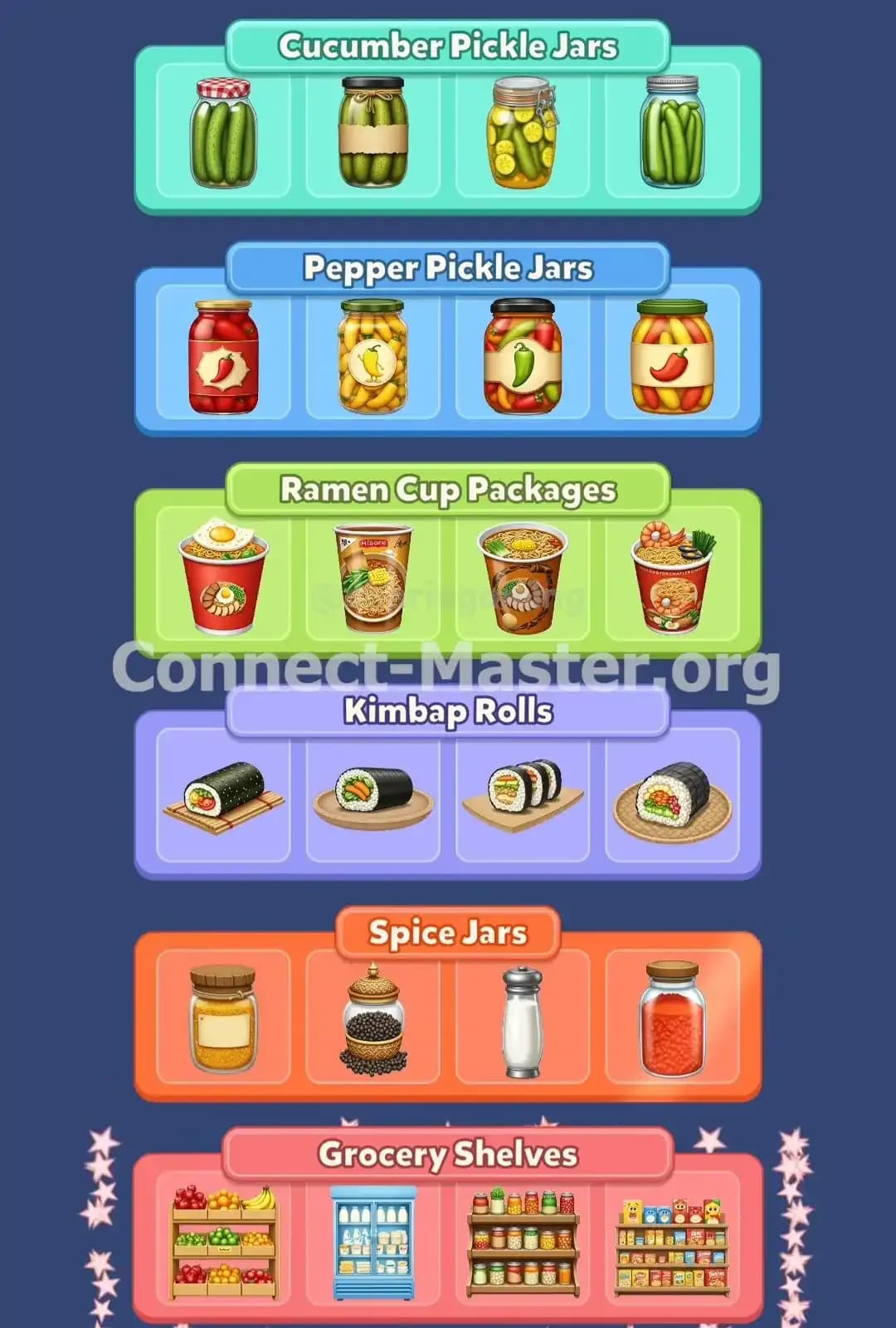
Connect Master Level 1517 uses a clear food-storage and grocery theme, but the tiles are arranged to make similar objects compete for your attention. There are six sets of four tiles, giving you 24 tiles in total. The board mixes jars, prepared foods, packaged meals, rolls, spice containers, and larger store displays.
The strongest strategy for Connect Master 1517 is to avoid grouping items merely because they are edible or come in containers. Instead, look at the full visual identity of each tile: the food inside, the type of packaging, the label, the lid, and the way the item is presented. Once you recognize the broad categories, the remaining decoys become much easier to separate.
The six categories in Connect Master Level 1517
- Cucumber Pickle Jars: Four jars containing whole or sliced cucumbers, including jars with different lids, labels, and brine styles.
- Pepper Pickle Jars: Four jars filled with red, yellow, green, or mixed peppers, each using pepper imagery or visible pepper contents to establish the group.
- Ramen Cup Packages: Four individual noodle cups or ramen-style packages, with noodles and toppings visible on the packaging or inside the cup.
- Kimbap Rolls: Four seaweed-wrapped rice rolls shown whole or sliced, usually displayed on plates, trays, or bamboo mats.
- Spice Jars: Four containers holding dry seasonings, including ground spices, peppercorns, salt, and red seasoning grains.
- Grocery Shelves: Four larger shop-display scenes, such as produce racks, refrigerated cases, pantry shelving, and snack shelves.
Each category in Connect Master Level 1517 contains exactly four tiles, so a correct group should feel both visually consistent and complete. If a proposed group has a fifth tempting candidate, that candidate probably belongs somewhere else.
Why Connect Master Level 1517 Feels So Tricky
The most confusing set: Grocery Shelves
The Grocery Shelves set is the one players are most likely to overlook. These tiles don’t resemble the jars, cups, or plated foods because they show an entire retail display rather than one product. Their contents can also imitate other categories: a shelf may contain jars, vegetables, bottles, or colorful packaged foods.
The key is to focus on scale and presentation. In Connect Master 1517, the four Grocery Shelves tiles show multiple products arranged on shelving or inside a store fixture. They are not individual spice jars, pickle jars, or food packages. Once you notice the larger scene and the repeated shelves, this set becomes a reliable group to lock in.
Subtle overlaps between the categories
The first overlap is between Cucumber Pickle Jars and Pepper Pickle Jars. Both sets use glass jars, brine, labels, and colorful contents, so the container shape alone isn’t enough. Check the actual contents carefully: whole or sliced green cucumbers belong to Cucumber Pickle Jars, while red, yellow, or green peppers identify Pepper Pickle Jars. A pepper illustration on the label is also a strong clue, even when the jar contains mixed vegetables.
The second overlap occurs between Spice Jars and the shelves in Grocery Shelves. A shelf tile may show several small seasoning containers, but it still belongs to Grocery Shelves because the tile depicts a complete display. The Spice Jars category contains four standalone containers, including the jar of ground seasoning, the decorative peppercorn jar, the salt shaker, and the jar of red spice grains.
The third overlap is between Ramen Cup Packages and Kimbap Rolls, since both can show noodles, rice, vegetables, and egg toppings. Look at the silhouette first. Ramen Cup Packages are individual cups or printed noodle containers, while Kimbap Rolls are cylindrical seaweed-wrapped rolls, often cut to reveal their rice and filling. The serving plate or bamboo mat helps confirm a kimbap tile, but the round cross-section is the most dependable clue.
I found this level satisfying rather than unfair. My “I finally saw it!” moment came when I stopped judging the grocery tiles by their contents and noticed that their true shared trait was the entire retail display. That shift made the six categories fall into place quickly.
Step-by-Step Solution for Connect Master Level 1517
Opening: lock in the clearest food groups
Start Connect Master Level 1517 by scanning for the most distinctive shapes. The four Kimbap Rolls tiles are usually a strong opening group because the seaweed exterior, rice centers, and roll presentation are difficult to confuse with the other categories. Select those four together, paying attention to both whole rolls and sliced pieces.
Next, identify the four Ramen Cup Packages tiles. Look for the recognizable cup shape, noodle imagery, printed package designs, and toppings such as egg, vegetables, or meat. Don’t reject a ramen tile simply because the cup artwork varies; the important trait is individual packaged ramen rather than a loose bowl or a shelf display.
After these two groups are removed, the board becomes much less crowded. You should now have the jars and the larger grocery scenes left, which makes the container-based categories easier to compare.
Mid-game: separate the pickle and spice containers
Now sort the remaining standalone jars into three visual groups. Begin with Cucumber Pickle Jars, looking for cucumbers that are clearly whole, stacked, or sliced in brine. The lids and labels vary, so don’t require all four jars to have the same design. Their shared ingredient is more important than their decoration.
Then collect the four Pepper Pickle Jars. Use the visible pepper shapes and pepper-themed labels to confirm them. Some jars contain several colors, so judge them by the dominant pepper identity rather than looking only for red peppers. Also, don’t accidentally use a grocery-shelf tile just because it displays jars or vegetables; it must show one individual jar to qualify.
The four remaining standalone seasoning containers form Spice Jars. Compare the contents instead of the glass shape: dry powder, peppercorns, salt, and red grains are all clues. These are shelf-stable seasonings rather than wet pickled vegetables. A blank label or unusual lid doesn’t disqualify a tile when the contents clearly identify it as a spice container.
End-game: finish with the large display scenes
The final four tiles are Grocery Shelves. They are connected by the structure around the products: shelving, racks, a refrigerated cabinet, or a multi-level store display. Their products may look unrelated, but the presentation is identical in concept. This is the exact trait that separates them from every jar and package already used.
Before committing, perform a full four-tile check. Each candidate should show a retail fixture containing several products, not just a single item placed near other objects. If one tile depicts a lone jar or cup, move it back and review the pickle, spice, or ramen groups. Connect Master 1517 is designed so that the last category becomes certain once all individual food items have been assigned.
The Logic Behind This Connect Master Level 1517 Solution
Move from broad shapes to specific details
The solution works because it follows a hierarchy of visual clues. First, use large, obvious traits: rolls, cups, jars, and shelves. These broad forms quickly isolate Kimbap Rolls, Ramen Cup Packages, and Grocery Shelves. Next, inspect the smaller details inside the jars, separating wet cucumber pickles from pepper pickles and dry spices.
This approach systematically reduces confusion. Instead of comparing every tile with every other tile, you narrow the possibilities after each confirmed group. A jar can only be one of three likely categories, and its contents then provide the deciding evidence. Likewise, a food scene with many products is automatically more likely to be Grocery Shelves than any single-item category.
Use category names to avoid double-using tiles
Naming each group in your head is especially useful in Connect Master Level 1517. I’d mentally label the sets Cucumber Pickle Jars, Pepper Pickle Jars, Ramen Cup Packages, Kimbap Rolls, Spice Jars, and Grocery Shelves before making uncertain selections.
These names act like checkpoints. When a tile seems to fit two groups, ask which category describes its defining feature rather than a secondary detail. A jar on a shelf is still part of Grocery Shelves if the whole tile shows a retail display, while a standalone jar must be classified by its contents. With every tile assigned to exactly one named set, the completed Connect Master 1517 solution becomes logical, orderly, and easy to verify.