Connect Master Level 1356 Solution Walkthrough & Answer
How to solve Connect Master level 1356? Get instant solution & answer for Connect Master 1356.
Connect Master Level 1356 Pattern Overview
The overall laundry theme and six-set structure
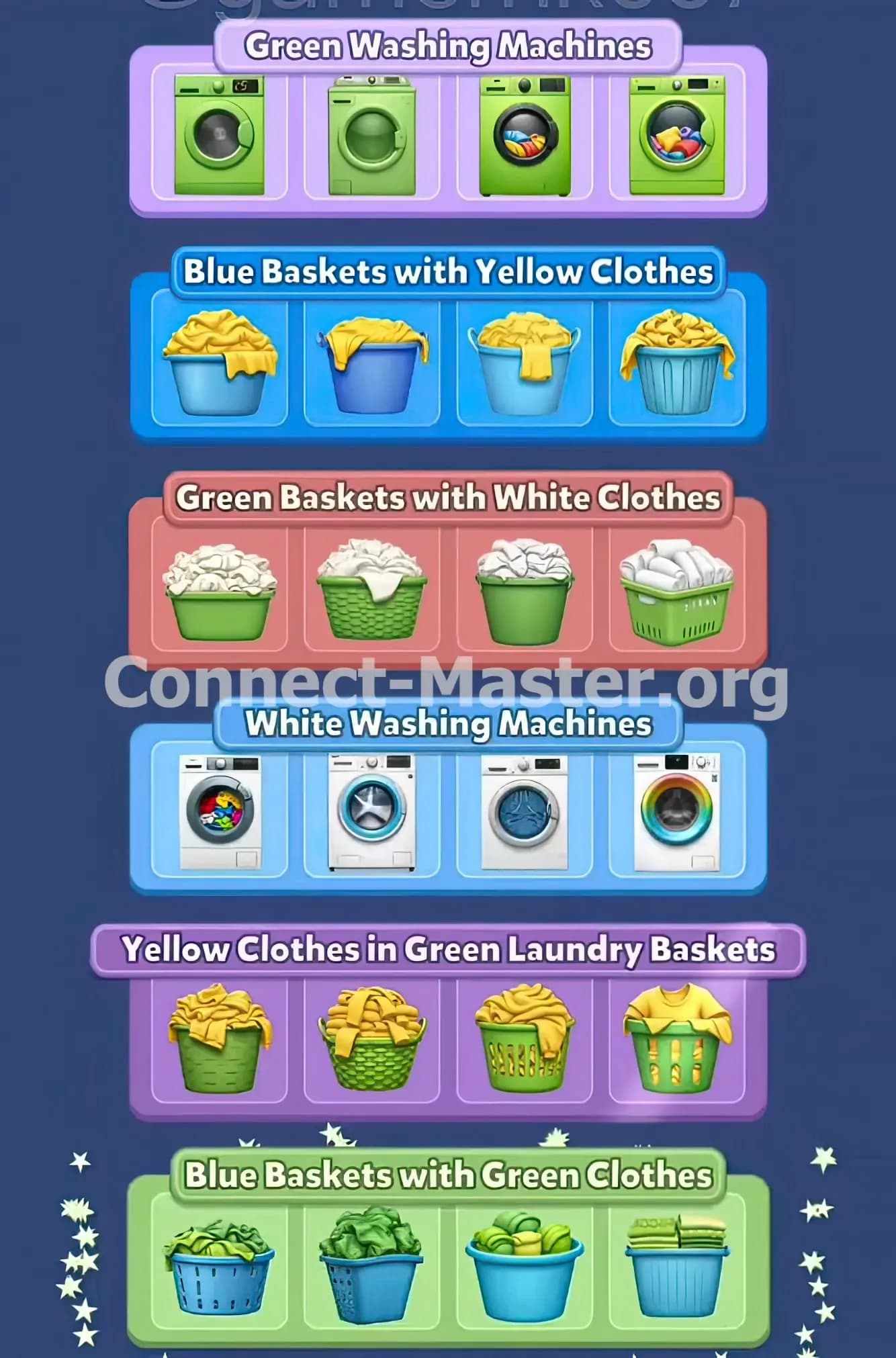
Connect Master Level 1356 uses a consistent laundry-room theme. Instead of characters, the board is filled with washing machines, laundry baskets, and containers holding folded or crumpled clothes. The puzzle contains six sets of four tiles, for a total of 24 tiles.
The main challenge is that several groups reuse the same colors. Green appears on both machines and baskets, while yellow and white clothes appear in multiple container types. The safest approach in Connect Master 1356 is to compare the whole tile rather than focusing on one bright color. Ask yourself what is being shown, what color the container is, and what color the laundry inside it has.
The six groups in Connect Master Level 1356
- Green Washing Machines: Four green washing machines with different front doors, control panels, and laundry details.
- Blue Baskets with Yellow Clothes: Four blue or blue-toned laundry baskets filled with yellow clothing.
- Green Baskets with White Clothes: Four green baskets containing white laundry.
- White Washing Machines: Four white washing machines, each with a distinct door rim or interior appearance.
- Yellow Clothes in Green Laundry Baskets: Four green laundry baskets filled with yellow clothes.
- Blue Baskets with Green Clothes: Four blue baskets containing green clothing or green fabric items.
These category names are deliberately specific. “Green baskets” alone isn’t enough, because both Green Baskets with White Clothes and Yellow Clothes in Green Laundry Baskets use green containers. The clothing color completes the rule.
Why Connect Master Level 1356 Feels So Tricky
The most confusing set: yellow clothes in green laundry baskets
The set most players overlook in Connect Master Level 1356 is Yellow Clothes in Green Laundry Baskets. It looks extremely similar to Blue Baskets with Yellow Clothes, because both groups are dominated by yellow fabric. If you notice the clothes first, you may accidentally combine tiles from both categories.
The key is to ignore the laundry for a moment and inspect the basket. The correct four for Yellow Clothes in Green Laundry Baskets all use green laundry baskets, even though the basket shapes vary. Some are smooth tubs, some have woven textures, and others have open slats. The yellow clothing is the shared secondary clue.
Subtle overlaps and how to separate them
The first overlap is between Blue Baskets with Yellow Clothes and Yellow Clothes in Green Laundry Baskets. Both feature yellow garments, but the container colors are different. Blue baskets belong in the first group; green baskets belong in the second. Don’t let a visible sleeve, towel, or shirt hanging over the edge distract you from the basket itself.
The second overlap is between Green Baskets with White Clothes and Yellow Clothes in Green Laundry Baskets. These groups share the same green container color, but the laundry separates them completely. White shirts, towels, and sheets belong to Green Baskets with White Clothes. Yellow garments belong to Yellow Clothes in Green Laundry Baskets. If a tile has a green basket and pale clothing, check whether the fabric is truly white or simply a light yellow shade.
The third overlap involves Blue Baskets with Yellow Clothes and Blue Baskets with Green Clothes. Both have blue containers, so the fabric color is essential. Yellow fabric goes into Blue Baskets with Yellow Clothes, while darker green fabric goes into Blue Baskets with Green Clothes. The different basket designs are decoys; the color pairing is the real rule.
The washing machines create a separate visual trap. Green Washing Machines and White Washing Machines may show similar circular doors, black control strips, or colorful laundry behind the glass. The casing color matters more than the door contents. A green outer body belongs to Green Washing Machines, and a white outer body belongs to White Washing Machines.
I found this level deceptively satisfying. At first, the baskets seemed like one large collection of nearly identical laundry tiles. Then I noticed the color pairings—blue with yellow, green with white, green with yellow, and blue with green—and the whole board suddenly became organized.
Step-by-Step Solution for Connect Master Level 1356
Opening: lock in the obvious machine groups
Start Connect Master Level 1356 by scanning for the two washing-machine categories. These are usually easier to identify because the appliance casing is larger and more visually consistent than the basket designs.
First, collect the four Green Washing Machines. Check the main body of each appliance, not merely the door trim or the laundry visible inside. Some machines have dark circular doors, some have brighter rims, and the control panels are not identical. The common trait is the green machine casing.
Next, find the four White Washing Machines. Again, focus on the outside frame. A white machine may have a blue, silver, black, or rainbow-colored door ring, but it still belongs to White Washing Machines if the appliance body is white. Locking both machine sets removes eight tiles and leaves only the basket logic.
Mid-game: sort baskets by container color and fabric color
With the machines removed, sort the remaining tiles into broad container-color piles. Make one mental pile for blue baskets and another for green baskets. Then inspect the clothes inside each pile.
For the blue containers, separate the tiles into Blue Baskets with Yellow Clothes and Blue Baskets with Green Clothes. Look at the dominant fabric color, including clothing draped over the rim. A blue basket with yellow material cannot be exchanged with a blue basket containing green material, even if both baskets have similar handles or perforations.
For the green containers, separate Green Baskets with White Clothes from Yellow Clothes in Green Laundry Baskets. This is where careful comparison matters most. Check the entire visible load instead of judging a single highlight. White laundry tends to appear as white towels, sheets, or pale garments, while the yellow group has clearly warm yellow clothing. Basket texture is not the deciding factor.
When you think you have a possible group of four, verify all four tiles against the same two-part description. For example, every tile in Blue Baskets with Green Clothes must have both a blue basket and green laundry. If one tile only matches one half of the name, leave it uncommitted.
End-game: resolve the near-matches without guessing
The last tricky groups are normally Green Baskets with White Clothes and Yellow Clothes in Green Laundry Baskets, since both use green containers. Lay those tiles side by side mentally and compare the laundry color first. The green basket is only the shared background clue; white versus yellow clothing is the exact separator.
If one tile seems ambiguous, compare it with the confirmed examples rather than forcing it into a set. Look for the strongest visible garment: a white towel, a yellow shirt, or a bright fold of fabric. Once the four yellow-filled green baskets are identified, the remaining green baskets should form Green Baskets with White Clothes automatically.
Finally, recheck every category name before submitting. Connect Master 1356 has no leftovers, so each tile must be accounted for exactly once. If a group works only because you borrowed a tile from another category, the earlier group needs to be reconsidered.
The Logic Behind This Connect Master Level 1356 Solution
Move from broad traits to precise combinations
The reliable method for Connect Master Level 1356 is to start with large, unmistakable traits and then narrow the rules. The washing-machine casing gives you the broadest separation: green appliances versus white appliances. After those are removed, the baskets can be sorted by container color, and finally by clothing color.
This progression reduces confusion because you aren’t comparing all 24 tiles at once. You first remove the two appliance groups, then divide the remaining objects into blue and green baskets, and only afterward examine the laundry inside them. The result is a systematic path where every tile has a clear destination.
Use category names to prevent double-counting
Naming each set in your head is especially useful in this level. Instead of thinking “these look like the other blue ones,” say Blue Baskets with Yellow Clothes or Blue Baskets with Green Clothes. The longer label forces you to check both the container and its contents.
The same technique protects you from double-using a tile. Once a basket is assigned to Yellow Clothes in Green Laundry Baskets, it cannot also be used for Green Baskets with White Clothes. By tracking the complete category name, you keep the logic organized, avoid chasing color-only matches, and guarantee that all six groups of four are solved cleanly.