Connect Master Level 1398 Solution Walkthrough & Answer
How to solve Connect Master level 1398? Get instant solution & answer for Connect Master 1398.
Connect Master Level 1398 Pattern Overview
The overall theme and board structure
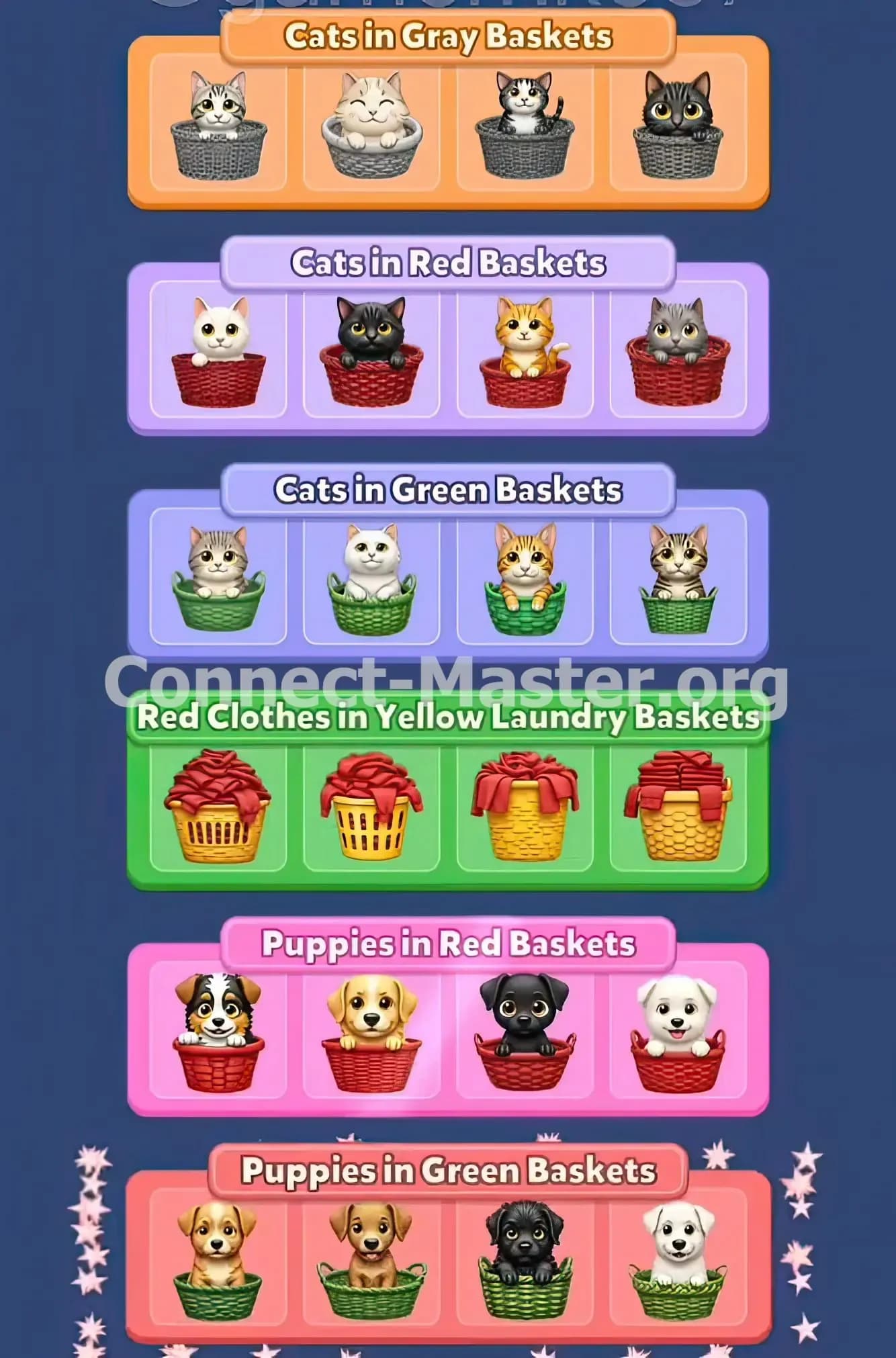
Connect Master Level 1398 uses a cheerful basket-and-animal theme. The board contains 24 tiles divided into six correct sets of four. Most tiles show either cats or puppies sitting in colored baskets, while one group replaces animals with yellow laundry baskets filled with red clothing.
The main challenge in Connect Master 1398 isn’t recognizing the individual pictures. It’s noticing which visual trait is meant to control the grouping. Several baskets use similar weaving patterns, and some animals share colors or facial features. You’ll solve the level much more reliably by checking the basket color and the subject type before judging fur color, eyes, or expression.
The six sets are:
- Cats in Gray Baskets: Four cat tiles placed in gray baskets.
- Cats in Red Baskets: Four cat tiles placed in red baskets.
- Cats in Green Baskets: Four cat tiles placed in green baskets.
- Red Clothes in Yellow Laundry Baskets: Four yellow laundry baskets containing red garments.
- Puppies in Red Baskets: Four puppy tiles placed in red baskets.
- Puppies in Green Baskets: Four puppy tiles placed in green baskets.
That gives Connect Master Level 1398 three cat groups, two puppy groups, and one object-only laundry group. The repeated red and green basket colors are the main source of misdirection, so keep the animal type in mind whenever a color seems to match more than one category.
Why Connect Master Level 1398 Feels So Tricky
The most confusing set
The most confusing group is Red Clothes in Yellow Laundry Baskets. It’s easy to overlook because the tiles don’t feature cats or puppies, and the red clothing can initially resemble the red baskets used elsewhere. However, the basket itself is yellow, taller, and shaped like a laundry hamper. The contents are folded or draped red garments rather than an animal sitting inside.
Players sometimes focus on the red color first and accidentally compare these tiles with Cats in Red Baskets or Puppies in Red Baskets. Don’t do that. The correct anchor is the combination of a yellow laundry basket and red clothing. Once you spot one or two, the remaining laundry tiles become much easier to confirm.
Subtle overlaps between near-matches
The first overlap is between Cats in Red Baskets and Puppies in Red Baskets. Both groups use red containers, so basket color alone cannot finish the match. Look at the face, ears, and muzzle: cats have pointed ears and a distinctly feline face, while puppies have floppy ears, rounder muzzles, and more dog-like eyes. A black or white animal can still belong to either group, so species matters more than fur color.
The second overlap appears between Cats in Red Baskets and Cats in Green Baskets. The cat designs may share similar stripes, eye colors, or cheerful expressions. Check the full rim and woven body of the basket rather than looking only at the tile background. Red baskets belong to the red cat group, while green baskets belong to the green cat group, even when the cats look almost identical.
The third overlap is between Cats in Gray Baskets and the two colored cat sets. The gray baskets are darker and can blend into the outline around the cats, especially when the animal has gray or black fur. Inspect the container beneath the paws and around the lower edge. The basket’s neutral gray color is the deciding trait, not the cat’s coat.
I found this level satisfying once the basket colors became the organizing pattern. At first, I was tempted to sort the animals by fur color and expression, but that created too many false matches. The “I finally saw it” moment came when I treated the baskets as labels and the animals as a secondary check.
Step-by-Step Solution for Connect Master Level 1398
Opening: lock in the obvious sets first
Start with Red Clothes in Yellow Laundry Baskets. These four tiles are the only ones without an animal, and their yellow laundry baskets make them the cleanest set on the board. Confirm that each one contains red clothing before locking it in. Removing these tiles immediately eliminates the biggest visual distraction.
Next, find Cats in Gray Baskets. Gray is the least repeated basket color, and all four tiles contain cats. Compare the basket body rather than the surrounding panel color, because the background may be brighter or more colorful than the actual container. Once you identify four gray baskets with cats, lock the group.
Now scan for Cats in Green Baskets. Look specifically for feline faces inside green woven baskets. Don’t reject a tile because the cat is white, orange, or striped; the group is defined by the cat-plus-green-basket combination. These two early sets should reduce the board enough that the remaining red baskets are easier to separate.
Mid-game: sort the remaining animals carefully
After removing the laundry, gray, and green cat sets, focus on the red baskets. You’ll need to divide them between Cats in Red Baskets and Puppies in Red Baskets. This is where species recognition matters most.
For each red-basket tile, check the ears first. Pointed ears generally indicate a cat, while floppy ears indicate a puppy. Then use the muzzle and paws as confirmation. Cat faces tend to be narrower with a small triangular nose, whereas puppies have rounder faces and more prominent dog-like noses. Avoid using coat color as your primary test: black, white, tan, and mixed coloring can appear across different animals.
Once the red-basket cats are identified, group exactly four under Cats in Red Baskets. The other four red-basket animals should be Puppies in Red Baskets. Before submitting either group, count the tiles and verify that every subject is the same species. Connect Master 1398 requires exact groups of four, so a visually convincing group of three cats and one puppy will not help.
End-game: finish with the puppy contrast
The final comparison is usually between Puppies in Red Baskets and Puppies in Green Baskets. At this stage, ignore fur shade, facial expression, and eye size. The basket color is the exact trait that separates them.
Place every puppy in a red basket into Puppies in Red Baskets, then check that the remaining puppy tiles all sit in green baskets. For the green group, inspect the woven container around the puppy’s paws and sides; don’t rely only on the green background behind the tile. When four puppies clearly occupy green baskets, you have Puppies in Green Baskets.
If one tile seems uncertain, pause instead of guessing. A single misplaced puppy can make both groups appear wrong. Recheck the basket rim, lower weave, and visible side panels, then confirm that each tile is used once and only once.
The Logic Behind This Connect Master Level 1398 Solution
Move from broad traits to specific details
The reliable method for Connect Master Level 1398 is to begin with the strongest visual signals. First separate animals from laundry. Then sort animals by basket color. Finally, use species details to divide cats from puppies when the basket color is shared.
This order steadily reduces confusion. The laundry group has a unique subject type, gray baskets appear in only one cat group, and green baskets can be divided by species after the obvious cats are removed. Red baskets require the most careful inspection because both cats and puppies use them.
You can think of every tile as having two useful labels: its subject and its container. The correct sets combine those labels consistently. For example, “cat” alone is too broad, and “red basket” alone is also too broad, but “cat in a red basket” identifies one exact group of four.
Name each set to stay organized
Short category names make the board much easier to manage. Silently label the groups Gray Cats, Red Cats, Green Cats, Red Clothes, Red Puppies, and Green Puppies. These names prevent you from accidentally reusing a tile in two possible groups.
Before making a final selection, ask yourself three questions: What is the subject? What color and type is the container? Does the tile already belong to another confirmed set? If every tile answers those questions consistently, the solution is complete.
That systematic approach is the key to Connect Master 1398. You don’t need to memorize the layout or guess based on one striking picture. Identify the major categories first, verify the small visual details second, and every tile will fit naturally into one of the six groups.