Connect Master Level 1442 Solution Walkthrough & Answer
How to solve Connect Master level 1442? Get instant solution & answer for Connect Master 1442.
Connect Master Level 1442 Pattern Overview
The overall theme and board structure
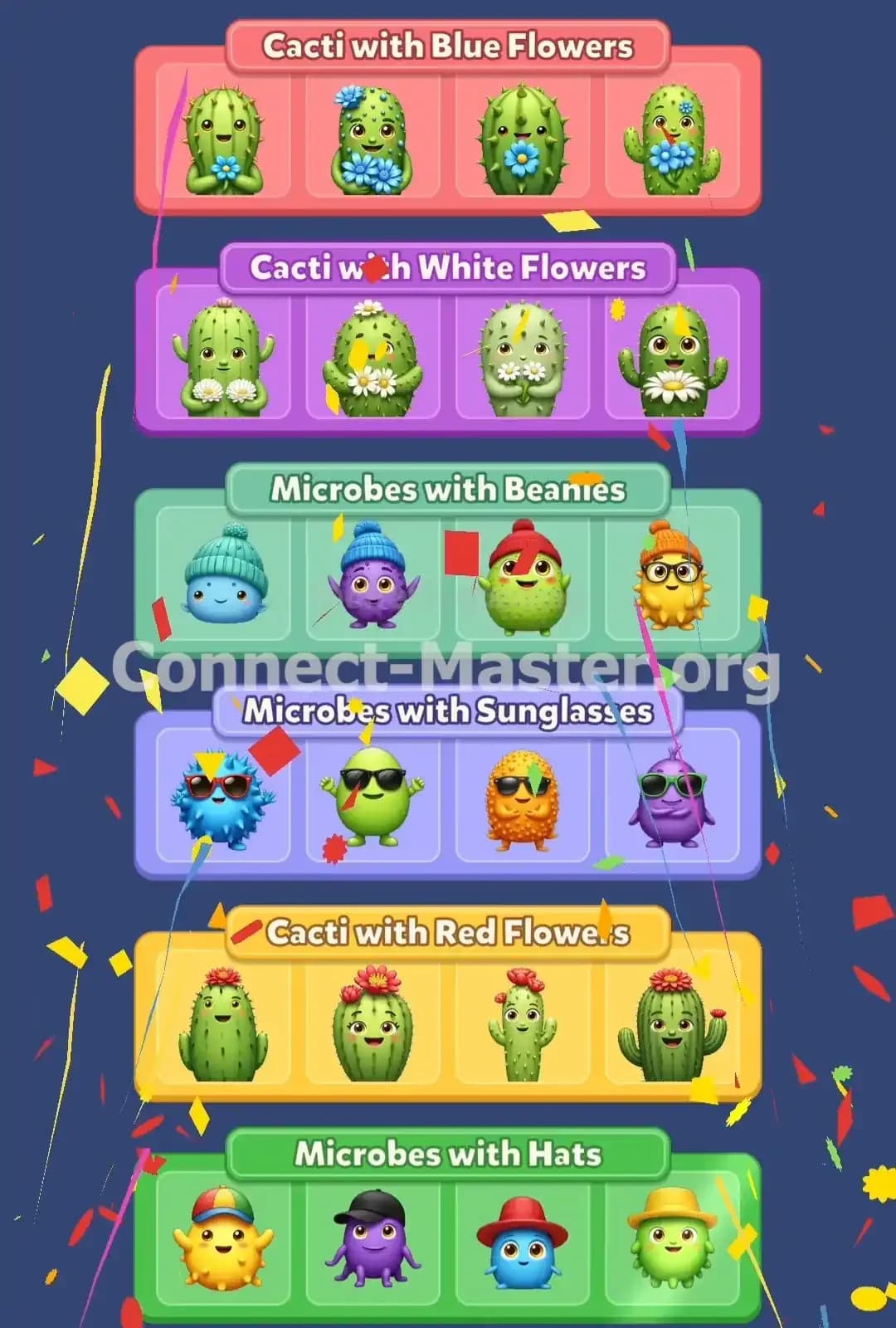
Connect Master Level 1442 uses a playful mix of smiling cacti and colorful microbes. The board contains 24 tiles divided into six correct sets of four. The main challenge is that several characters share similar body shapes, facial expressions, or colors, so the winning trait is usually a specific decoration rather than the character’s overall appearance.
Three groups are cacti separated by flower color, while the other three groups are microbes separated by eyewear or headwear. Once you recognize that the board is built around these two broad families, the puzzle becomes much easier to organize.
The six categories in Connect Master Level 1442
- Cacti with Blue Flowers: Four cactus characters decorated with blue blossoms. Their shapes differ, but each one has clearly visible blue flowers.
- Cacti with White Flowers: Four cacti carrying or wearing white flowers. Look closely at the petals, because these tiles can resemble the other flower groups at first glance.
- Cacti with Red Flowers: Four cactus characters topped or decorated with red flowers. Their body styles vary, but the red blossoms are the shared clue.
- Microbes with Beanies: Four microbes wearing close-fitting knitted caps. The beanies have visible ribbing or a soft, rounded winter-cap shape.
- Microbes with Sunglasses: Four microbes wearing dark sunglasses. Their colors and textures are different, but the sunglasses make this set straightforward once you notice the lenses.
- Microbes with Hats: Four microbes wearing structured hats such as caps or brimmed hats. These are not knitted beanies; each has a distinct crown, brim, or cap shape.
Why Connect Master Level 1442 Feels So Tricky
The most confusing set: Microbes with Hats
The Microbes with Hats set is the easiest group to overlook in Connect Master 1442 because “hat” is a broad category. A knitted beanie, a baseball-style cap, and a brimmed hat all cover the head, but they don’t share the same silhouette. If you quickly scan only for something sitting above the eyes, you may accidentally mix this group with Microbes with Beanies.
The key is structure. The beanies are soft, rounded, and ribbed, usually pulled down close to the head. The hats have a firmer shape, visible brims, or a more defined top. One hat looks like a cap, another has a broad brim, and another has a colorful, more traditional hat shape. Treat the headwear style—not the color—as the deciding feature.
Small overlaps between the categories
The cactus groups create the first major overlap. All three flower sets contain green cactus characters, and some blossoms are positioned around the face or torso. A cactus with a red blossom can initially look like a cactus with a darker pink or purple flower, especially when you’re viewing the tiles quickly. Check the petals directly and sort by the dominant flower color: blue, white, or red.
A second overlap appears among the microbes. The Microbes with Beanies and Microbes with Hats groups both place an item on top of the character’s head. Compare the texture and outline. Beanies have knitted lines, a rounded cap, and often a small gathered top. Hats have a brim or a clean, solid crown, making their edges more angular or clearly separated from the head.
The third overlap involves the Microbes with Sunglasses set. Some of these microbes are brightly colored or unusually textured, which can make you focus on their bodies instead of their faces. Don’t let the blue, green, orange, or purple coloring distract you. The dark lenses across the eyes are the complete rule for this group. A character’s body texture is only a decoy detail.
My pattern-recognition moment
I found Connect Master Level 1442 much easier once I stopped trying to group characters by color or body type. The “aha” moment came from separating the microbes by what they wear. The cactus tiles then fell into place by flower color. I needed two retries here because I initially treated every head covering as the same kind of hat, but the knitted texture on the beanies finally made the distinction obvious.
Step-by-Step Solution for Connect Master Level 1442
Opening: lock in the clearest sets first
Start with Microbes with Sunglasses. This is usually the strongest opening group because sunglasses are highly specific and appear across four different microbes. Select the blue spiky microbe, the light green round microbe, the orange textured microbe, and the purple microbe with dark glasses. Their body colors and shapes are distractions; the shared sunglasses are what matter.
Next, identify the three cactus flower groups. Begin with Cacti with Blue Flowers, since the blue blossoms stand out clearly against the green bodies. Then find Cacti with White Flowers, checking for pale petals around the cactus face or body. Finish the obvious flower-color sweep with Cacti with Red Flowers. Locking in these three sets removes all cactus decoys and leaves only the eight microbes wearing headgear.
Mid-game: separate the two kinds of headwear
With the sunglasses removed, compare the remaining microbes by headwear rather than by color. For Microbes with Beanies, look for knitted caps with vertical ribbing, rounded tops, and a snug fit. The blue, purple, green, and orange microbes wearing these winter-style caps belong together.
Be careful not to use a tile twice mentally. If a character seems to fit both a color-based idea and a clothing-based idea, write down the strongest visible trait and compare it with the other remaining tiles. In Connect Master 1442, a hat’s color is not the category. A yellow hat and a red hat can belong together if both are structured hats, while two blue head coverings may belong to different groups if one is a beanie and the other is a cap.
End-game: finish with Microbes with Hats
The final four are Microbes with Hats. These include the microbes wearing a multicolored cap, a black cap, a red brimmed hat, and a yellow brimmed hat. Their common trait is structured headwear with a defined shape or brim, not knitted fabric.
Before committing, make one final check against Microbes with Beanies. Look at the lower edge of each hat near the forehead. If the item has ribbed material and a soft, gathered top, it belongs with the beanies. If it has a visor, brim, firm crown, or broad edge, it belongs with the hats. That small comparison prevents the most likely final mistake in Connect Master Level 1442.
The Logic Behind This Connect Master Level 1442 Solution
Move from broad traits to precise details
The solution works because it uses a reliable hierarchy of clues. First, divide the board into the two broad character families: cacti and microbes. Then apply the major visual categories within each family. Cacti are sorted by flower color, while microbes are sorted by glasses, beanies, or hats.
After that, use fine details to resolve the overlaps. Petal color separates the cactus groups, lens shape separates sunglasses, and fabric texture separates beanies from structured hats. This approach steadily reduces the number of possible homes for every tile. Since each correct set contains exactly four tiles and there are no leftovers, the final ungrouped tiles must form the remaining valid category.
Use category names to prevent mistakes
Naming each set in your head makes the board much easier to manage. I’d label the groups Blue Flowers, White Flowers, Red Flowers, Beanies, Sunglasses, and Hats. When you examine a tile, ask one direct question: “Does this clearly belong to one of those labels?”
This method prevents double-using a tempting tile and keeps you from chasing weak similarities such as matching body color or facial expression. In Connect Master Level 1442, the strongest category is the one that explains all four tiles with the fewest exceptions. Once every tile has a specific label, the puzzle is solved logically rather than by guesswork.