Connect Master Level 1371 Solution Walkthrough & Answer
How to solve Connect Master level 1371? Get instant solution & answer for Connect Master 1371.
Connect Master Level 1371 Pattern Overview
The overall theme and board structure
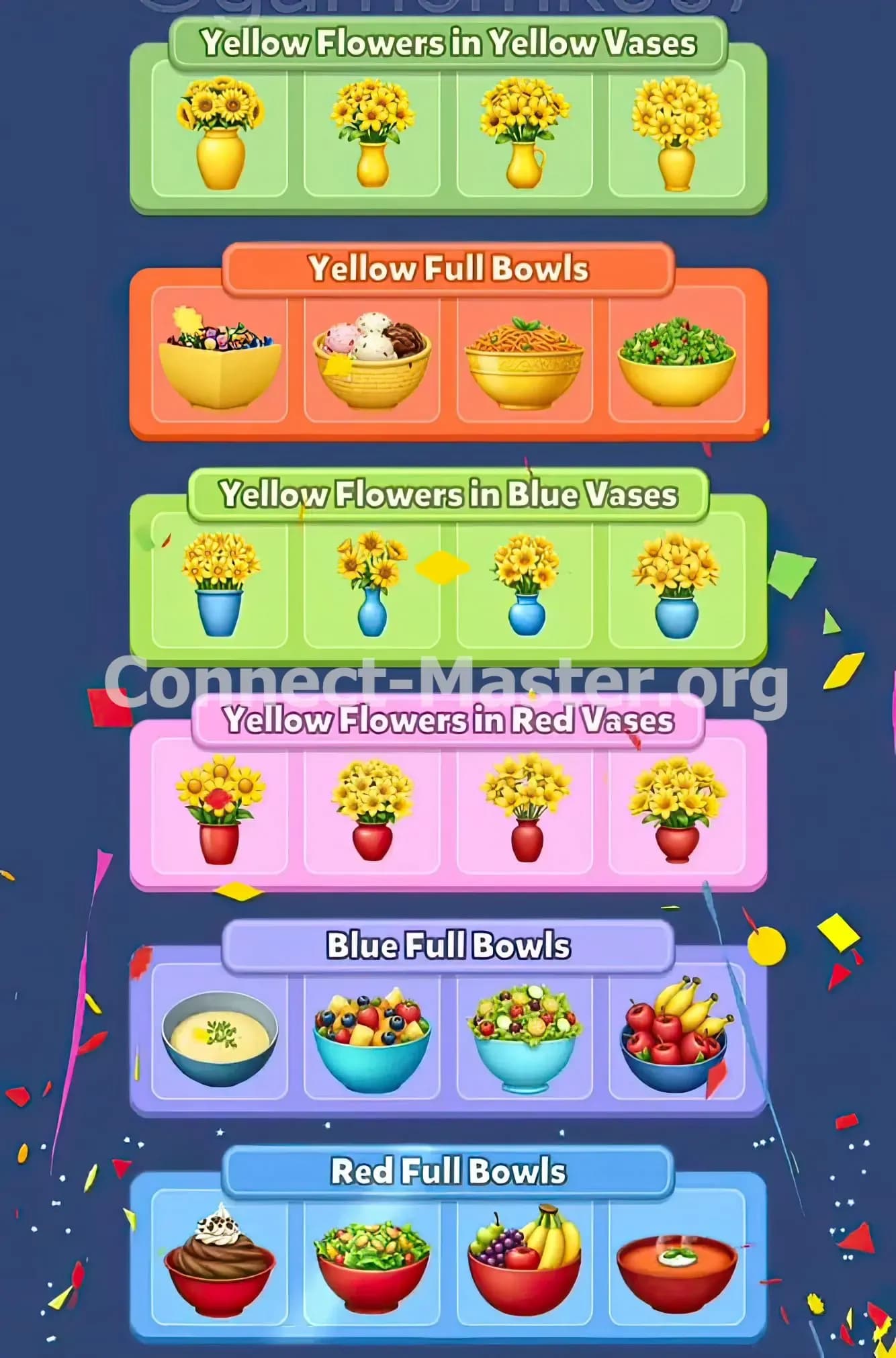
Connect Master Level 1371 uses a bright food-and-flower theme built around two kinds of visual clues: flower arrangements and filled bowls. There are six total sets, with four tiles in each set, so every tile has a precise home and there are no leftovers.
The first four groups focus on yellow flowers placed in vases of different colors. The remaining two groups use full bowls, separated mainly by bowl color. At first, the board seems to rely on broad color matching, but Connect Master 1371 actually rewards you for checking the container as carefully as the contents.
The six categories in Connect Master 1371
- Yellow Flowers in Yellow Vases: Four arrangements of yellow flowers displayed in yellow vases. The vase shapes vary, so the shared clue is the yellow container rather than an identical bouquet.
- Yellow Full Bowls: Four filled bowls with yellow containers. Their contents include different foods and desserts, but the bowl color unites them.
- Yellow Flowers in Blue Vases: Four yellow-flower arrangements held in blue vases. Bouquet shape and flower density change from tile to tile.
- Yellow Flowers in Red Vases: Four yellow-flower arrangements in red or reddish vases. Some have rounded pots, while others use taller or wider red containers.
- Blue Full Bowls: Four filled bowls in blue containers. These include soup, fruit, and salad-style foods, so the blue bowl is the strongest clue.
- Red Full Bowls: Four filled bowls in red containers. The contents range from dessert to soup and fruit, but each tile uses a red bowl.
The key pattern in Connect Master Level 1371 is that color applies to the container, not always to the item inside it. Yellow flowers appear in three separate sets, while bowls come in three different color groups.
Why Connect Master Level 1371 Feels So Tricky
The most confusing set: Yellow Flowers in Blue Vases
The hardest category is usually Yellow Flowers in Blue Vases. Players naturally notice the bright yellow flowers first and may try to combine all flower tiles together. That creates an immediate problem because the yellow flowers are deliberately reused across three categories.
The blue vases are not all the same shade or shape. One may look turquoise, another deep blue, and another rounded like a small jug. If you focus only on the bouquet, these tiles appear interchangeable with Yellow Flowers in Yellow Vases or Yellow Flowers in Red Vases. The solution is to ignore the flower color temporarily and inspect the base of each tile.
Small overlaps that cause mistakes
The first overlap is between Yellow Flowers in Yellow Vases and Yellow Flowers in Blue Vases. Both groups contain yellow flowers, and some bouquets have similar rounded silhouettes. Check the lower half of the tile: yellow-gold containers belong to Yellow Flowers in Yellow Vases, while cool blue or turquoise containers belong to Yellow Flowers in Blue Vases.
The second overlap is between Yellow Flowers in Red Vases and the yellow-vase group. A few red containers have orange highlights, especially around the rim, so they can look golden at a quick glance. Look for the dominant body color. If the vase reads as crimson, scarlet, or red-orange, keep it with Yellow Flowers in Red Vases.
The third overlap affects the bowl categories. A bowl may contain colorful fruit, green vegetables, noodles, or a creamy dish, making it tempting to sort by food type. That is the wrong level of detail here. A fruit bowl in blue belongs to Blue Full Bowls, while fruit in a red bowl belongs to Red Full Bowls. Likewise, a yellow bowl containing a dessert still belongs to Yellow Full Bowls.
I found the flower groups especially deceptive because the bouquets almost distract you from the vases. My “I finally saw it” moment came when I stopped comparing petals and started scanning only the containers. Once the vases were separated by color, the whole level became much more manageable.
Step-by-Step Solution for Connect Master Level 1371
Opening: lock in the obvious container groups
Start Connect Master Level 1371 by identifying the clearest repeated container colors. First, collect the four tiles from Yellow Flowers in Yellow Vases. These are the flower arrangements whose vases are unmistakably yellow or gold. Don’t worry if the bouquets look different; the container is the shared trait.
Next, find Yellow Full Bowls. These are the four bowl tiles with yellow containers, including the bowl with mixed food, the ice-cream-like dessert, the noodle dish, and the green food bowl. Their contents are intentionally varied, so select them by the bowl rather than by what is served inside.
Locking these two groups first removes eight tiles and gives you a much less crowded board. It also establishes the main rule for the level: the outside color is often more important than the inside picture.
Mid-game: separate the remaining flower and bowl groups
With the obvious yellow containers removed, sort the remaining flower arrangements into two groups: Yellow Flowers in Blue Vases and Yellow Flowers in Red Vases.
For every flower tile, compare the vase from top to bottom. Check the rim, central body, and base because highlights can make a red vase appear orange or a blue vase appear greenish. Place all blue-bodied containers into Yellow Flowers in Blue Vases, even when the bouquet is unusually large or sparse. Place all red-bodied containers into Yellow Flowers in Red Vases, even when the vase has a rounded shape that resembles one from another set.
Then turn to the bowl tiles. The four blue containers form Blue Full Bowls. This group includes the creamy bowl, the colorful fruit bowl, the green salad bowl, and the bowl filled with apples and bananas. The ingredients do not need to match; the blue exterior is the deciding feature.
Avoid making a food-based group such as “fruit” or “green dishes.” Connect Master Level 1371 is testing whether you can recognize the consistent visual frame around the food.
End-game: finish with the red bowls
The final group is Red Full Bowls. These four tiles use red bowls and contain a chocolate dessert, a green salad, assorted fruit, and a reddish soup. This set can feel uncertain because one bowl may look brown due to its contents and another may be partly hidden by the food.
Compare the visible bowl wall and rim, not the shade of the meal. Once four red containers are identified, the group is complete. If you have fewer than four, revisit the bowl tiles you assigned by ingredients and check whether a blue or yellow container was accidentally included.
At the end, verify that all six categories contain exactly four tiles. If one group has five, you have probably sorted by bouquet style or food type instead of the true container color.
The Logic Behind This Connect Master Level 1371 Solution
Move from broad clues to precise clues
The cleanest way to solve Connect Master 1371 is to work from large, reliable traits toward smaller details. Begin with the container type: flowers versus bowls. Then use the container color: yellow, blue, or red. Only after that should you inspect bouquet shape or food contents.
This approach systematically reduces confusion. A flower tile cannot belong to a bowl category, and a blue vase cannot belong to either red- or yellow-vase groups. Each confirmed set removes four possibilities at once, making the remaining choices easier to test.
Name every set in your head
Using short mental labels keeps the board organized. I’d call the groups Yellow Flowers in Yellow Vases, Yellow Full Bowls, Yellow Flowers in Blue Vases, Yellow Flowers in Red Vases, Blue Full Bowls, and Red Full Bowls.
These names prevent double-using a tile and stop you from chasing tempting but incomplete categories such as “fruit,” “salad,” or “large bouquets.” In Connect Master Level 1371, every tile must fit one and only one named group. Once each tile matches both the object type and the correct container color, the solution is guaranteed.