Connect Master Level 1583 Solution Walkthrough & Answer
How to solve Connect Master level 1583? Get instant solution & answer for Connect Master 1583.
Connect Master Level 1583 Pattern Overview
The overall theme and board layout
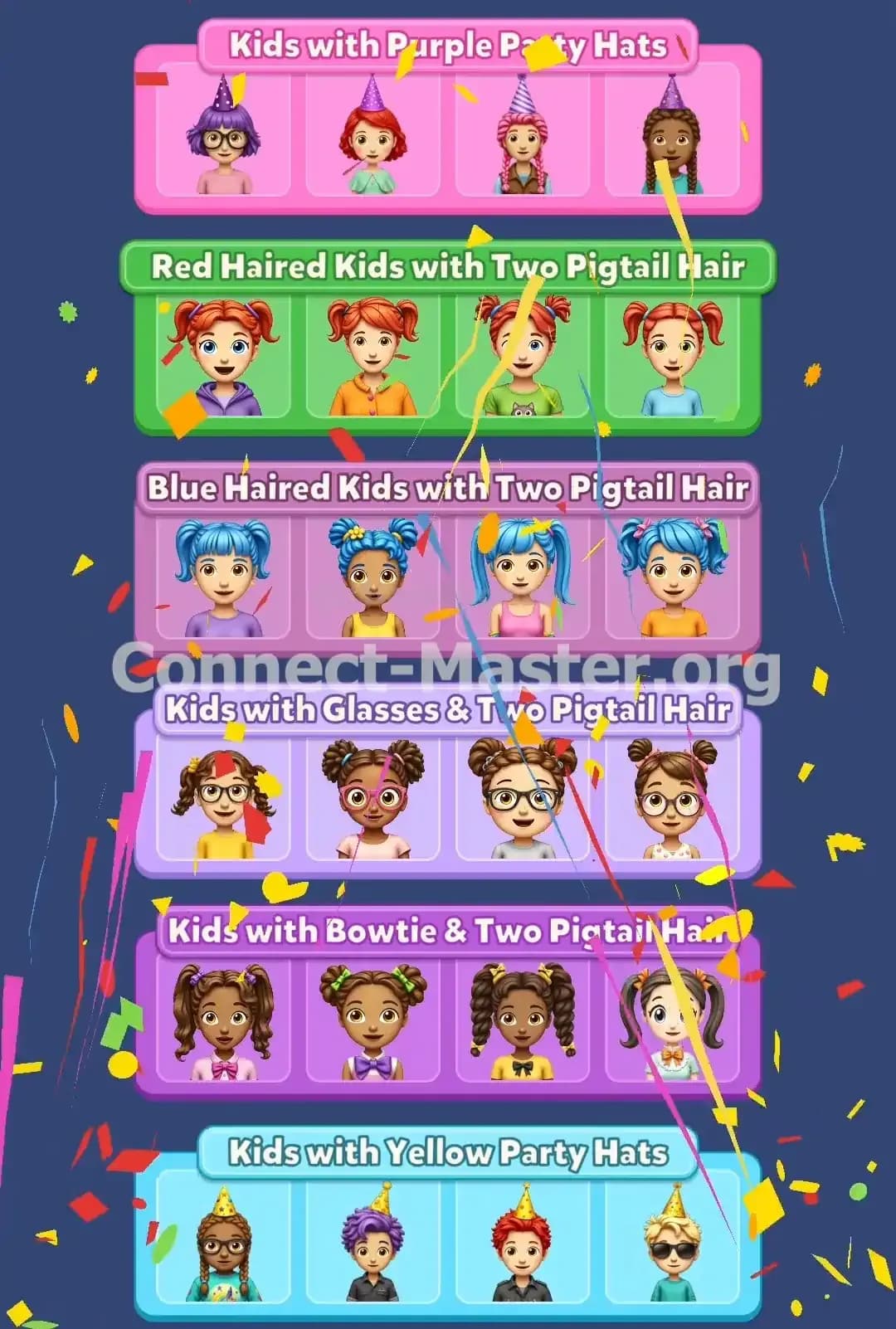
Connect Master Level 1583 uses a bright character-sorting theme built around children, hairstyles, accessories, and party hats. The board contains six groups of four tiles, giving you 24 characters to classify. At first glance, many tiles seem interchangeable because nearly every character has a colorful outfit and some form of distinctive hair.
The key is to separate broad traits from exact traits. Several groups contain children with pigtail-style hair, but their hair colors, glasses, or bowties determine where they really belong. Two other groups are defined by party-hat color rather than hairstyle. Once you recognize those six categories, Connect Master 1583 becomes much more manageable.
The six exact groups
- Kids with Purple Party Hats: Four children wearing purple cone-shaped party hats. Their hair, skin tones, and clothing vary, but the purple hats are the shared feature.
- Red-Haired Kids with Two Pigtail Hair: Four red- or orange-haired children, each styled with two pigtails. Hair color is the deciding trait, not clothing.
- Blue-Haired Kids with Two Pigtail Hair: Four children with bright blue hair arranged into two pigtails. Their tops and small hair decorations differ.
- Kids with Glasses & Two Pigtail Hair: Four children wearing visible eyeglasses while also having two pigtail-style sections of hair. Frame shape and clothing can vary.
- Kids with Bowtie & Two Pigtail Hair: Four children wearing prominent bowties and displaying two pigtails. The bowties are the safest confirmation.
- Kids with Yellow Party Hats: Four children wearing yellow cone-shaped party hats. This group includes different hairstyles, including short hair, braids, and hair covered by sunglasses or other details.
Why Connect Master Level 1583 Feels So Tricky
The most confusing group: Kids with Bowtie & Two Pigtail Hair
The Kids with Bowtie & Two Pigtail Hair set is the easiest to overlook because the bowties are relatively small compared with the large hairstyles and colorful faces. Some of these characters also resemble the glasses group or the red-haired group at a quick glance.
Look below the face rather than focusing only on the hair. Each correct bowtie tile has a clearly visible bow-shaped accessory at the neck. The bowtie colors are not all identical, so don’t reject a tile simply because one bowtie is purple, another is yellow, or another is pink. The common link is the accessory shape plus the two-pigtail hairstyle.
Subtle overlaps to watch for
The first major overlap is between Red-Haired Kids with Two Pigtail Hair and Kids with Bowtie & Two Pigtail Hair. A red-haired child may look like an obvious member of the red-haired group, but inspect the neck area before committing. If the tile has a bowtie, it belongs with the bowtie set even when the hair is brownish-red or copper-colored. The red-haired group is for the four matching red/orange hair appearances without relying on a bowtie.
The second overlap is between Blue-Haired Kids with Two Pigtail Hair and Kids with Glasses & Two Pigtail Hair. Blue hair is visually dominant, but the glasses group is determined by eyewear. Check the eyes carefully: glasses have visible frames around both eyes, while simple large eyes or hair decorations do not count. The blue-haired set contains the four blue-haired pigtail characters, even though their accessories and shirts are different.
The third overlap occurs between the two party-hat groups. Both Kids with Purple Party Hats and Kids with Yellow Party Hats use cone-shaped hats, and the hat patterns can make the colors look slightly muted. Focus on the dominant hat color at the top: purple belongs in the purple-hat set, while yellow or gold belongs in the yellow-hat set. Don’t use hair color to decide either party-hat group.
My pattern-recognition moment
I found Connect Master Level 1583 deceptively busy at first because almost every character looks like part of a hairstyle category. The breakthrough came when I stopped treating pigtails as a complete answer and started checking the accessory hierarchy: hat color first, then glasses or bowties, and only then hair color. Once I noticed that the bowtie set was hiding in plain sight, the remaining placements became much more obvious.
Step-by-Step Solution for Connect Master 1583
Opening: lock in the clearest sets first
Begin with the two party-hat groups because their defining features sit at the top of the tiles and are easy to compare. Find all four children with purple cone hats and group them as Kids with Purple Party Hats. Ignore their different hair colors and shirts; the hat color is the entire connection.
Next, gather the four yellow or gold cone hats for Kids with Yellow Party Hats. This should remove eight characters quickly and leave the pigtail-heavy portion of the board easier to read. Make sure you compare the hat itself rather than the character’s hair, since the yellow-hat group includes several very different hairstyles.
After that, look for the four unmistakable blue-haired characters. Their bright blue hair and two pigtails make Blue-Haired Kids with Two Pigtail Hair one of the most visually consistent categories. Lock them together only after confirming that all four have the same two-sided pigtail structure.
Mid-game: separate the overlapping pigtail sets
With the hat groups and blue-haired group removed, examine the remaining children for eyewear. The four characters with glasses form Kids with Glasses & Two Pigtail Hair. Look for actual frames around the eyes, including the darker or oversized frames that may initially resemble facial markings. Hair color is irrelevant here; the glasses are the stronger clue.
Now identify the four bowtie wearers for Kids with Bowtie & Two Pigtail Hair. Check the collar and upper shirt area on every remaining tile. A bowtie may be partly hidden by hair or clothing color, so enlarge your visual attention to the neck rather than relying on the face.
At this stage, avoid moving a tile into a group just because it has pigtails. Pigtails appear across multiple categories, so they act as a secondary clue. You should always pair them with the stronger identifying feature: blue hair, glasses, or a bowtie.
End-game: finish with the red-haired group
The final category is Red-Haired Kids with Two Pigtail Hair. These four tiles share the warm red, ginger, or orange hair color and the two-pigtail arrangement. They may wear different tops, and their facial expressions are not important.
Before confirming the group, double-check that none of the selected children has glasses or a bowtie that belongs to one of the earlier categories. This final verification matters because a reddish-brown hairstyle can look similar to the red-haired tiles. If the hair clearly matches the red/orange family and no stronger accessory category applies, the tile belongs here.
The Logic Behind This Connect Master Level 1583 Solution
Use broad clues before tiny details
The solution works because it moves from the most visible traits to the most specific ones. Party-hat color is immediately recognizable, so those groups reduce the board first. Bright blue hair is another strong visual marker. After those tiles are removed, glasses and bowties become easier to compare because fewer decoys remain.
This approach also protects you from false matches. A character can have pigtails and red hair, or pigtails and glasses, but each tile belongs to only one set. Treat the most distinctive feature as the deciding clue, then use hairstyle and clothing as confirmation.
Name every set in your head
Short category names keep the logic organized: Purple Party Hats, Yellow Party Hats, Blue Pigtails, Glasses and Pigtails, Bowties and Pigtails, and Red Pigtails. When you mentally assign a tile to one of those labels, you’re less likely to reuse it in a second group.
That naming habit is especially useful in Connect Master Level 1583 because the board is designed around near-matches. Once every character has a category name and all six names contain exactly four tiles, the puzzle is guaranteed to be complete.