Connect Master Level 1518 Solution Walkthrough & Answer
How to solve Connect Master level 1518? Get instant solution & answer for Connect Master 1518.
Connect Master Level 1518 Pattern Overview
The overall theme and board layout
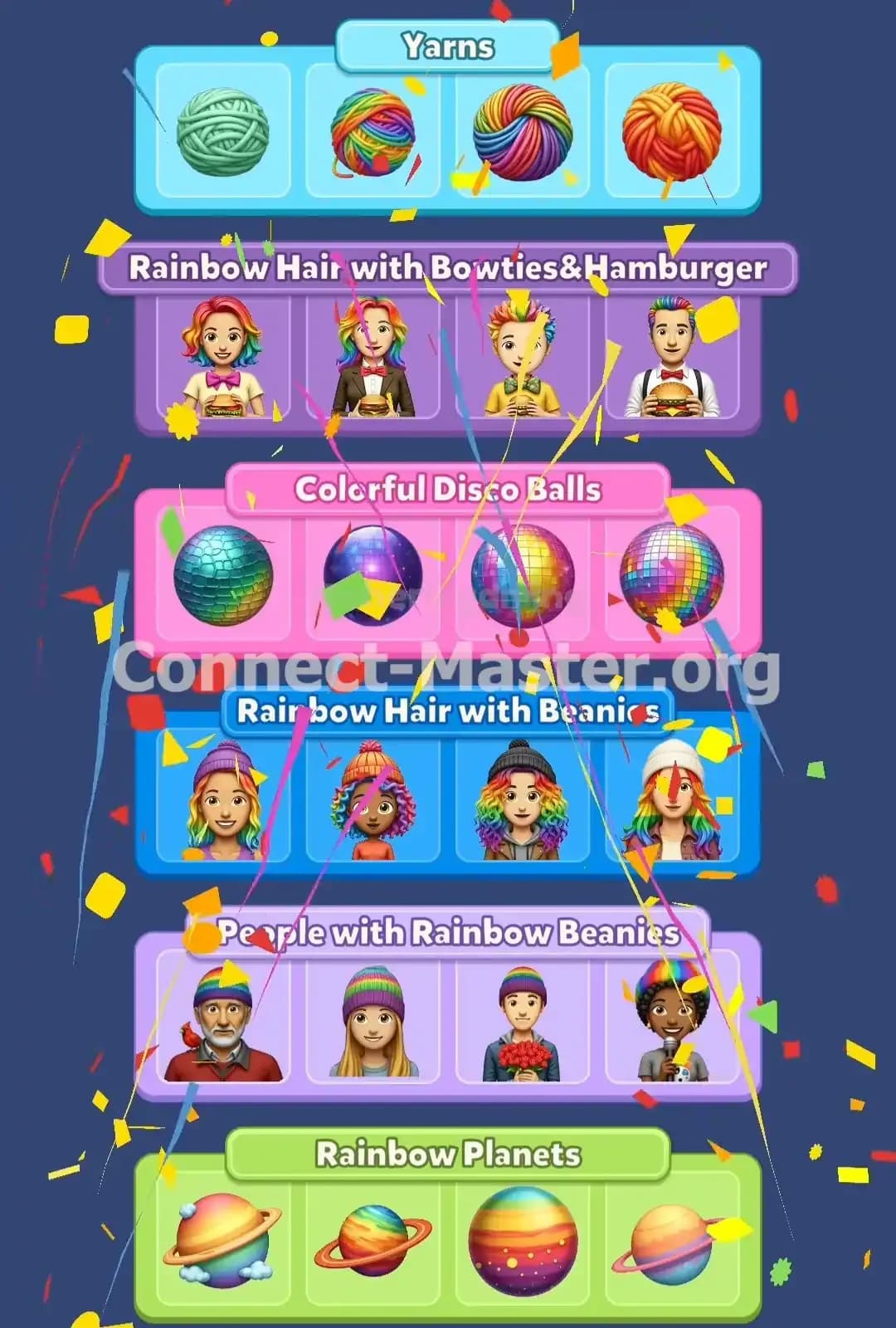
Connect Master Level 1518 is built around bright, colorful objects and characters. The board contains six sets of four tiles, for a total of 24 tiles. The main visual ideas are yarn balls, rainbow-colored hair, beanies, disco balls, hamburgers, bowties, and planets.
At first glance, the level looks like it should be easy because nearly everything uses vivid rainbow colors. That’s exactly what makes Connect Master 1518 deceptive. Several characters share rainbow hair or rainbow accessories, while the object groups use similar circular shapes and bright color bands. You need to focus on the defining detail rather than simply matching colors.
The six groups in Connect Master Level 1518
- Yarn Balls: Four balls of yarn with different tangled or wrapped textures and colorful thread patterns.
- Rainbow Hair with Bowties & Hamburgers: Four characters with rainbow hair who also show the bowtie-and-hamburger theme.
- Colorful Disco Balls: Four mirrored disco balls with multicolored reflections and mosaic-like surfaces.
- Rainbow Hair with Beanies: Four characters whose rainbow hair is paired with a visible beanie or knit cap.
- People with Rainbow Beanies: Four people wearing rainbow-striped beanies, with different faces, clothing, and handheld props.
- Rainbow Planets: Four ringed planets featuring colorful, striped, or gradient surfaces.
Those category names are useful shorthand while solving Connect Master Level 1518. Instead of repeatedly comparing every tile, you can ask, “Which tiles belong to Rainbow Hair with Beanies?” and immediately narrow your attention.
Why Connect Master Level 1518 Feels So Tricky
The most confusing group: Rainbow Hair with Beanies
The hardest set in Connect Master 1518 is Rainbow Hair with Beanies. Players often notice the rainbow curls first and assume these tiles belong with the other rainbow-haired characters. However, the important feature is the combination of rainbow hair and a beanie or cap.
This group includes four different-looking people. One has a purple cap, another has a warm orange knit cap, another wears a dark beanie, and the fourth has a pale cap. Their hair colors and face designs vary, so the shared trait isn’t obvious until you inspect the top of each character’s head. Once you see the caps, the group becomes much clearer.
Subtle overlaps between the character sets
The first major overlap is between Rainbow Hair with Bowties & Hamburgers and Rainbow Hair with Beanies. Both groups contain characters with colorful rainbow hair. To separate them, check the clothing and headwear. The bowtie-and-hamburger characters have formal or restaurant-style details, including bowties and visible burgers. The beanie group has caps and more casual appearances instead.
The second overlap is between Rainbow Hair with Beanies and People with Rainbow Beanies. Both groups feature hats with rainbow coloring, but the role of the hat is different. In Rainbow Hair with Beanies, the character’s hair itself is visibly multicolored and curls or strands extend around the cap. In People with Rainbow Beanies, the rainbow pattern is primarily on the beanie, while the person’s hair may be plain, mostly hidden, or much less important.
A third overlap appears among the round object tiles. Yarn Balls, Colorful Disco Balls, and Rainbow Planets all use circular shapes and strong color variations. Look at the surface texture and outline. Yarn Balls have thread wrapped into tangled bundles, disco balls have shiny square mirror facets, and Rainbow Planets have smooth spherical bodies with rings around them. The rings are the quickest way to identify the planets.
I’ll admit that I needed a second look at the two beanie groups. I initially treated every colorful hat as one category, but the moment I separated “rainbow hair plus cap” from “rainbow-striped cap,” the whole puzzle snapped into place.
Step-by-Step Solution for Connect Master Level 1518
Opening: lock in the clearest object groups
Start Connect Master Level 1518 with the groups that have the most distinctive silhouettes. Select the four Rainbow Planets first. The rings immediately distinguish them from every other circular object, and their smooth planetary surfaces confirm the match.
Next, find the four Colorful Disco Balls. These have reflective, tiled surfaces that look like tiny mirror squares. Even when their colors differ, the disco-ball texture is consistent. Removing these eight object tiles dramatically reduces the visual clutter.
After that, collect the four Yarn Balls. Compare the surface carefully: yarn appears as layered strands, loops, and winding fibers rather than flat color or reflective tiles. The yarn balls don’t need to match in color; their shared construction is the key.
Mid-game: sort the character tiles by accessories
With the three object groups removed, focus on the 12 people. Don’t sort them by gender, skin tone, hairstyle color, or facial expression. Those details are distractions in Connect Master 1518.
First identify Rainbow Hair with Bowties & Hamburgers. Look for the combination of rainbow hair, a bowtie, and a visible hamburger or burger-related presentation. The bowtie is especially useful because it is a small but repeated clothing detail. Confirm all four traits before committing the set; a character with rainbow hair alone isn’t enough.
Once those four are removed, inspect the remaining hats. This is where you should compare the actual hat pattern, not just the overall color. Separate the characters with rainbow hair and individual beanies from the characters whose defining item is a rainbow-striped beanie.
End-game: separate the two beanie groups
The final two groups are Rainbow Hair with Beanies and People with Rainbow Beanies. For Rainbow Hair with Beanies, select the four characters whose hair is clearly rainbow-colored and whose heads also include a cap or beanie. Their hair should remain visually prominent around the hat.
For People with Rainbow Beanies, select the four characters where the rainbow-striped beanie is the common feature. Their other details act as decoys: one may hold a parrot, another may carry flowers, and another may have a distinctive shirt or hairstyle. Ignore those props and concentrate on the striped hat.
If a tile seems to fit both groups, ask one question: Is the rainbow effect mainly in the hair, or mainly in the beanie? That check prevents the most common mistake in Connect Master Level 1518.
The Logic Behind This Connect Master Level 1518 Solution
Move from broad shapes to specific details
The reliable way to solve Connect Master 1518 is to begin with the largest, most objective traits. Rings identify Rainbow Planets, mirrored square facets identify Colorful Disco Balls, and tangled strands identify Yarn Balls. These groups have fewer misleading similarities than the character sets.
After removing the obvious objects, shift to accessory-based logic. Bowties, hamburgers, beanies, and rainbow hair are more specific than general appearance. Comparing those details systematically reduces the chance of placing a tile in a tempting but incorrect group.
Because every tile belongs to exactly one set, each confirmed group also provides useful negative information. Once four tiles are locked into Yarn Balls, no remaining circular object needs to be forced into that category. The same principle helps with the character groups: removing the four bowtie-and-hamburger characters makes the beanie distinctions much easier to see.
Use category names to keep your choices organized
Naming each set in your head is one of the simplest ways to avoid confusion. Think “Rainbow Planets,” “Disco Balls,” and “Yarn Balls” for the objects, then “Bowties & Hamburgers,” “Rainbow Hair with Beanies,” and “Rainbow Beanies” for the people.
These labels stop you from double-using a tile or chasing a vague color match. In Connect Master Level 1518, the winning approach is not to find four tiles that look generally alike. It’s to identify one precise trait, verify it across exactly four tiles, and then use the remaining board to test every unfinished category.