Connect Master Level 1531 Solution Walkthrough & Answer
How to solve Connect Master level 1531? Get instant solution & answer for Connect Master 1531.
Connect Master Level 1531 Pattern Overview
The overall theme and board structure
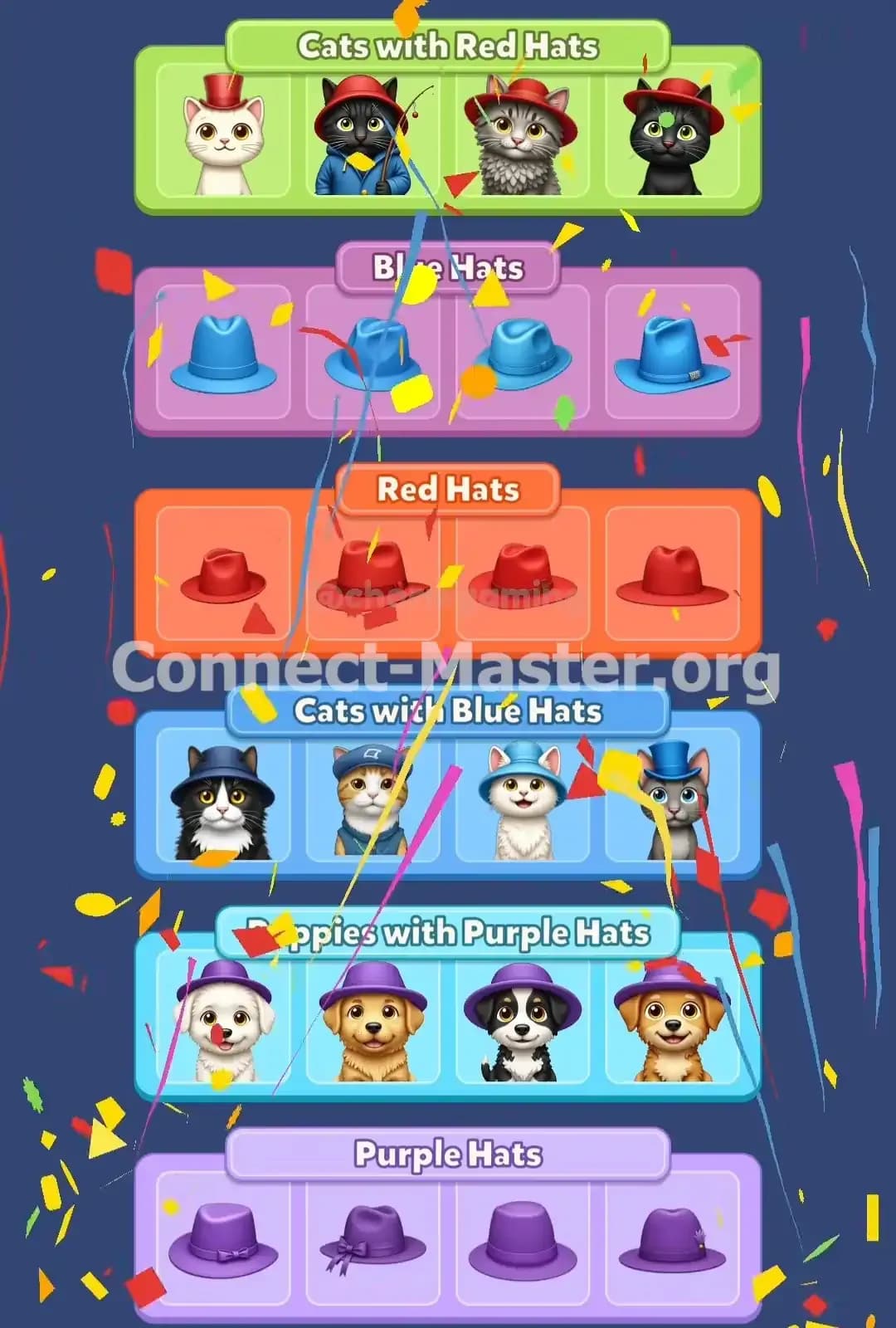
Connect Master Level 1531 is built around animals wearing colorful hats, plus standalone hat tiles. The board contains 24 tiles divided into six correct groups of four. Three groups feature cats or puppies, while the other three groups contain hats only.
The main challenge is that the colors repeat across different categories. For example, a red hat can belong with other red hats or with cats wearing red hats. The same split appears with blue and purple. You’ll need to check whether the tile shows an animal or only an accessory before deciding where it belongs.
The six groups in Connect Master 1531
- Cats with Red Hats: Four different cats, each wearing a red hat. The cats vary in fur color and style, but the red headwear is the shared trait.
- Blue Hats: Four standalone blue hats with different shapes, folds, and decorative details.
- Red Hats: Four standalone red hats, including different hat silhouettes and brim styles.
- Cats with Blue Hats: Four cats wearing blue hats. Their fur patterns and facial expressions differ, but each has blue headwear.
- Puppies with Purple Hats: Four puppies wearing purple hats. The puppies include white, golden, brown, and black-and-white coats.
- Purple Hats: Four standalone purple hats with distinct crowns, brims, bands, or decorations.
That gives you a useful mental map: three animal groups and three color-matched hat groups.
Why Connect Master Level 1531 Feels So Tricky
The most confusing set: Puppies with Purple Hats
The Puppies with Purple Hats group is easy to overlook because the puppies don’t look alike. One is white, another is golden, one has black-and-white markings, and another has a warm brown coat. If you focus on breed or fur color, the group seems random.
The purple hats are the real clue. Each puppy has purple headwear, even though the hat designs aren’t identical. Look above the ears rather than at the face, and the set becomes much clearer. This group also competes visually with the Purple Hats group, so make sure you don’t accidentally select a standalone hat when you’re trying to complete the puppies.
Small overlaps that cause wrong guesses
The first major overlap is between Cats with Red Hats and Red Hats. The red hats in both groups share the same strong color, and some of the cat hats have simple shapes. The deciding detail is the tile content: a correct Red Hats tile contains only a hat, while every Cats with Red Hats tile includes a visible cat underneath it.
The second overlap is between Cats with Blue Hats and Blue Hats. The blue cat group includes several different hat styles, including a taller blue hat and softer rounded caps. Compare the lower half of each tile. Fur, whiskers, eyes, and ears identify the animal group; a blue hat floating by itself belongs to Blue Hats.
The third overlap is between Puppies with Purple Hats and Purple Hats. Some purple hat tiles have decorations, such as a bow or a small accent, which can make them resemble the hats worn by the puppies. Check for paws, ears, noses, or fur around the hat. If none of those appear, it’s a standalone Purple Hats tile.
My pattern-recognition moment
I found Connect Master 1531 much easier once I stopped treating the hat colors as one broad clue. At first, the red, blue, and purple tiles seemed to form mixed groups. Then I noticed the board was deliberately pairing each color with two categories: animals wearing that color and hats in that color. Once that repeated structure clicked, the remaining tiles became much less intimidating.
Step-by-Step Solution for Connect Master 1531
Opening: lock in the obvious animal groups
Start by scanning for the four cats wearing red hats. The cats have different fur patterns, but the bright red hats are consistent enough to make Cats with Red Hats a strong opening group. Check that all four selected tiles contain cats, not just red hats. Lock this group first because it removes the most obvious red-themed decoys.
Next, find the four cats wearing blue hats and create Cats with Blue Hats. Look for the blue headwear on each cat, then verify that every tile includes a cat. The fur colors vary, so don’t reject a tile just because its cat looks different from the others. The hat color and animal type matter more than the coat pattern.
After those two groups are removed, locate the puppies wearing purple hats. Select the white puppy, golden puppy, black-and-white puppy, and brown puppy that each have purple headwear. This completes Puppies with Purple Hats. Be careful not to include one of the decorative purple-only hats, even if its shape looks similar.
Mid-game: separate animals from standalone accessories
With the animal groups gone, the remaining tiles should be standalone hats. This is where Connect Master Level 1531 becomes a clean color-sorting exercise, but you still need to inspect the shade and shape carefully.
Build Blue Hats by selecting the four tiles showing only blue hats. Some have rounded crowns, while others have taller or more stylized forms. Don’t require the hats to match in design; the shared blue color and absence of an animal are the important clues.
Then create Red Hats from the four red-only hat tiles. Compare the crown and brim rather than trying to find identical designs. A red hat with a curved brim still belongs with the other red standalone hats, even if another has a flatter shape or a different crease.
At this stage, keep already-used tiles mentally out of consideration. If a hat seems to fit two possible groups, ask whether it is being worn. That single question prevents most mis-grouping mistakes.
End-game: finish with the purple standalone hats
The final group should be Purple Hats. These are the four tiles that show purple hats without cats or puppies. Their details vary: one may have a band, another a bow-like decoration, and another a small accent on the side. Those differences are intentional decoys and don’t break the category.
The exact trait tying them together is simple: they are purple hats by themselves. Keep them separate from Puppies with Purple Hats by checking the entire tile, not just the top portion. If you see fur, eyes, ears, or a muzzle, it belongs to the puppy group; if you see only the accessory, it belongs to Purple Hats.
If you reach the last four and they are all standalone purple headwear, the solution is complete. If one tile doesn’t fit, revisit the earlier puppy group first, because that is the most likely place for a color-based mix-up.
The Logic Behind This Connect Master Level 1531 Solution
Move from broad clues to specific details
The most reliable method for Connect Master 1531 is to begin with large, obvious traits and then narrow your attention. First identify the object type: cat, puppy, or standalone hat. Next check the dominant color. Finally, use small details such as hat shape, bands, bows, fur markings, or facial features to reject near-matches.
This order reduces confusion because it prevents you from comparing every tile with every other tile. Once the four red-hat cats are removed, those tiles can no longer distract you while you search for standalone red hats. Each confirmed group shrinks the board and makes the next decision more precise.
Use category names to prevent double-use
I recommend naming each group in your head: Cats with Red Hats, Cats with Blue Hats, Puppies with Purple Hats, Blue Hats, Red Hats, and Purple Hats. These labels are short, descriptive, and tied directly to the two important properties: what the tile shows and what color defines it.
The names also enforce the one-group-only rule. A tile can’t be both a Red Hats tile and a Cats with Red Hats tile because one contains only an accessory while the other contains an animal wearing it. By keeping those categories separate, you avoid chasing attractive but incorrect matches and can solve Connect Master Level 1531 systematically rather than by guesswork.