Connect Master Level 1351 Solution Walkthrough & Answer
How to solve Connect Master level 1351? Get instant solution & answer for Connect Master 1351.
Connect Master Level 1351 Pattern Overview
The overall theme and board structure
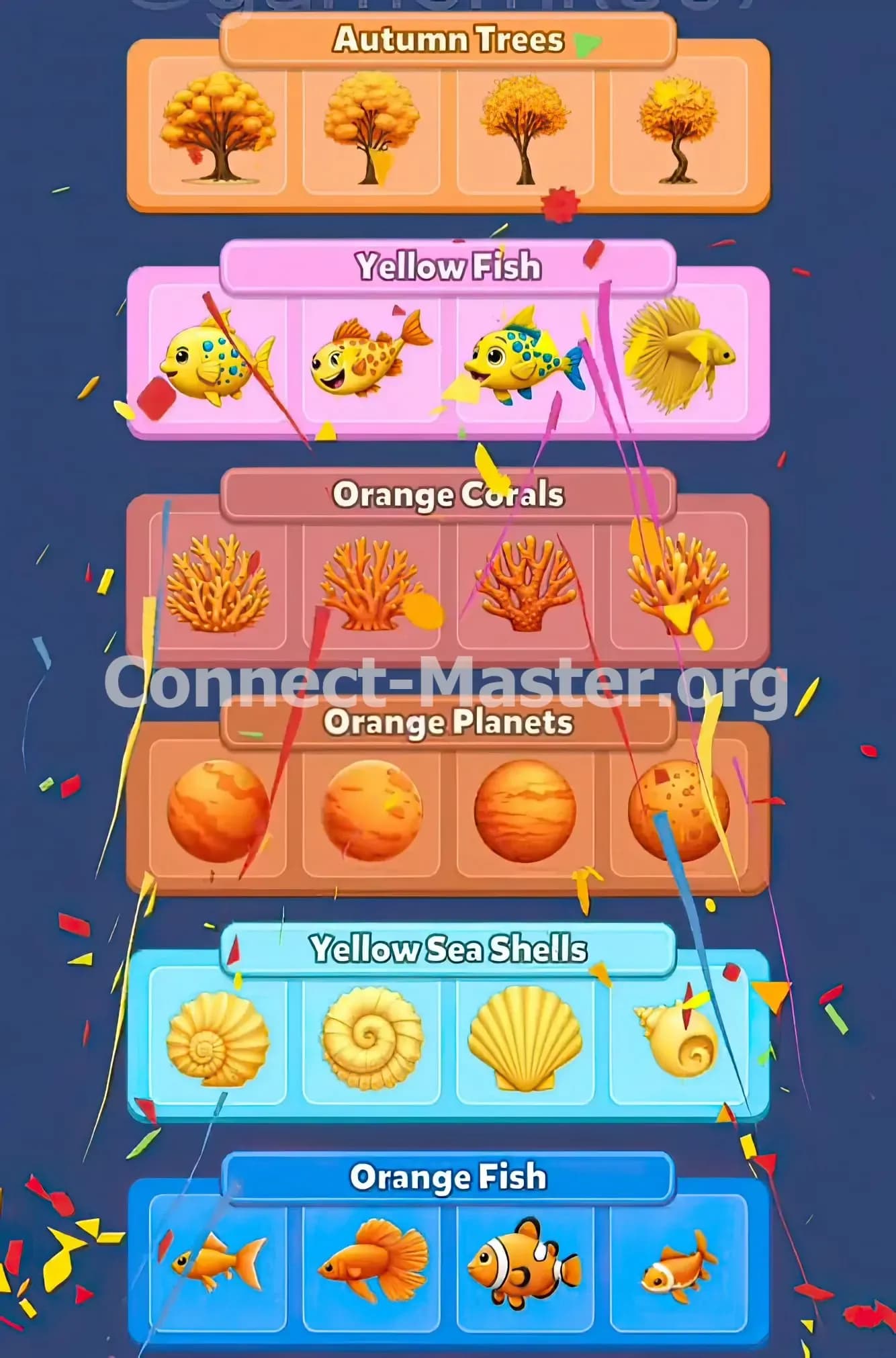
Connect Master Level 1351 uses a colorful nature-and-underwater theme with six sets of four tiles, for a total of 24 tiles. The board mixes autumn trees, sea life, coral, planets, and shells, so the first challenge is recognizing whether a tile belongs to a broad object family or a more specific color-based group.
The solution becomes much easier when you separate the tiles into large visual families first. There are two fish groups, one tree group, one coral group, one planet group, and one shell group. Several tiles use similar yellow and orange shades, which creates the main distractions in Connect Master 1351.
The six completed categories
- Autumn Trees: Four deciduous trees with golden or orange autumn foliage. Their shared trait is the seasonal tree shape, not an identical trunk or canopy.
- Yellow Fish: Four fish dominated by yellow coloring, including rounded spotted fish and a flowing yellow fish with long fins.
- Orange Corals: Four branching coral formations in orange, gold, or reddish-orange tones.
- Orange Planets: Four round, orange planetary objects with different surface markings and textures.
- Yellow Sea Shells: Four yellow shells, including spiral shells and a fan-shaped shell.
- Orange Fish: Four clearly orange aquatic animals, including a shark-like fish, a goldfish, a clownfish, and a smaller striped fish.
Keep these category names in mind throughout Connect Master Level 1351. They’re short enough to remember and specific enough to stop you from using the same tile in two possible groups.
Why Connect Master Level 1351 Feels So Tricky
The most confusing set: Yellow Fish
The Yellow Fish set is the easiest one to overlook because the fish don’t all share the same body shape. Three look like compact, decorated tropical fish, while the fourth has long, flowing fins and a more delicate silhouette. Their colors also vary from bright yellow to yellow mixed with blue and green markings.
Players often notice the spots or fins before they notice the dominant body color. That can make one yellow fish seem related to the orange fish, especially when you’re scanning quickly. The correct test is simple: look at the main body and head color rather than a small accent. If yellow is the visual base, place the tile with Yellow Fish.
Subtle overlaps between categories
The first major overlap is between Yellow Fish and Orange Fish. Both groups contain colorful fish, and several tiles include more than one strong color. To separate them, inspect the overall body: the Yellow Fish group has yellow-centered bodies with decorative spots or bright fins, while Orange Fish includes more recognizable orange species and orange-and-white markings. The clownfish belongs with Orange Fish even though its white bands are visually prominent.
The second overlap appears between Orange Corals and Autumn Trees. Both sets show branching forms, and some coral tiles can look like miniature leafless trees. Look at the base and branching style. Autumn Trees have a trunk supporting a leafy canopy, while Orange Corals are low, dense formations with many short, irregular branches and no leafy crown.
The third overlap is inside Yellow Sea Shells itself. Spiral shells and the fan-shaped shell don’t immediately look like one family, but their shared trait is the yellow seashell material and marine form. Don’t split the spiral shells into separate groups based on their interior patterns. The large fan shell completes the same four-tile category.
My pattern-recognition moment
I found Connect Master Level 1351 satisfying because the board looks much more complicated than it really is. At first, the two fish categories seemed to compete for the same tiles. Then the distinction between “yellow-based fish” and “orange-based fish” clicked, and the rest of the board became much more orderly. That was the “I finally saw it!” moment: the puzzle rewards identifying the dominant trait instead of matching every tiny color detail.
Step-by-Step Solution for Connect Master Level 1351
Opening: lock in the obvious object families
Start Connect Master 1351 by scanning for categories that are defined by shape rather than subtle color. The four round planetary objects are the safest opening group. They all have spherical forms and orange planetary surfaces, even though their markings differ. Lock in Orange Planets first.
Next, find the four branching coral formations. Their low, irregular branches and underwater appearance separate them from the taller tree silhouettes. Select these as Orange Corals. Removing the planets and corals should leave a much cleaner board.
The four autumn trees are also fairly reliable. Look for a visible trunk, spreading canopy, and golden-orange foliage. Their trunks may be straight, curved, or twisted, but the leafy crown identifies Autumn Trees. If one tree has an unusual silhouette, compare it with the canopy rather than judging only the trunk.
Mid-game: sort shells and fish by dominant traits
Once the obvious groups are gone, focus on the four seashells. The two spiral shells, the ridged fan shell, and the smaller spiral shell all belong to Yellow Sea Shells. The internal designs are different, but the important shared features are the shell material, yellow color, and marine-object theme.
Now you should be left with eight fish tiles. Avoid selecting four fish simply because they look similar. Instead, divide them by their dominant color and visual identity. The Yellow Fish set contains the yellow-centered, spotted or brightly decorated fish, including the long-finned yellow fish. The Orange Fish set contains the orange shark-like fish, orange goldfish, clownfish, and small orange-and-white fish.
Before confirming either fish group, check every candidate against the remaining tiles. A yellow fish with blue spots still belongs to Yellow Fish because the body is primarily yellow. Likewise, the clownfish remains in Orange Fish because its orange body and species pattern are stronger clues than its white bands.
End-game: separate the final fish groups carefully
The final stage of Connect Master Level 1351 is usually the most delicate because all eight remaining tiles share the same broad object type. Start with the most obviously orange fish: the shark-like fish, the orange fancy-tailed fish, and the clownfish. Add the smaller orange-and-white fish to complete Orange Fish.
For Yellow Fish, use the four remaining fish and verify that yellow is the main visual color across the body or head. Don’t reject the long-finned fish because it looks unlike the spotted fish. Its yellow body is the exact trait that completes the set.
If you’re uncertain, temporarily label the tiles rather than committing immediately. Write “yellow body,” “orange body,” “branching,” or “round planet” in your head and compare the labels. Once each category has exactly four tiles, the Connect Master Level 1351 solution is complete.
The Logic Behind This Connect Master Level 1351 Solution
Move from broad traits to precise details
The reliable way to solve Connect Master 1351 is to work from large visual properties toward smaller ones. First identify object families: trees, fish, corals, planets, and shells. Then use color and structure to divide the repeated family—in this case, fish—into Yellow Fish and Orange Fish.
This method reduces confusion because each completed group removes four possibilities from the board. It also protects you from decoys. A fish may have blue spots, white stripes, or unusual fins, but those details should be considered only after you identify its dominant category.
Use category names to prevent mistakes
Naming each set in your head keeps the board organized. Think Autumn Trees, Yellow Fish, Orange Corals, Orange Planets, Yellow Sea Shells, and Orange Fish rather than relying on vague impressions such as “the leafy ones” or “the bright fish.”
That mental labeling also prevents double-use. Every tile must belong to one and only one group, so when a tile seems to fit two categories, ask which named set has the stronger defining trait. Follow that process from the obvious shapes to the subtle fish colors, and Connect Master Level 1351 becomes a logical deduction puzzle instead of a guessing game.