Connect Master Level 1585 Solution Walkthrough & Answer
How to solve Connect Master level 1585? Get instant solution & answer for Connect Master 1585.
Connect Master Level 1585 Pattern Overview
Theme, layout, and number of sets
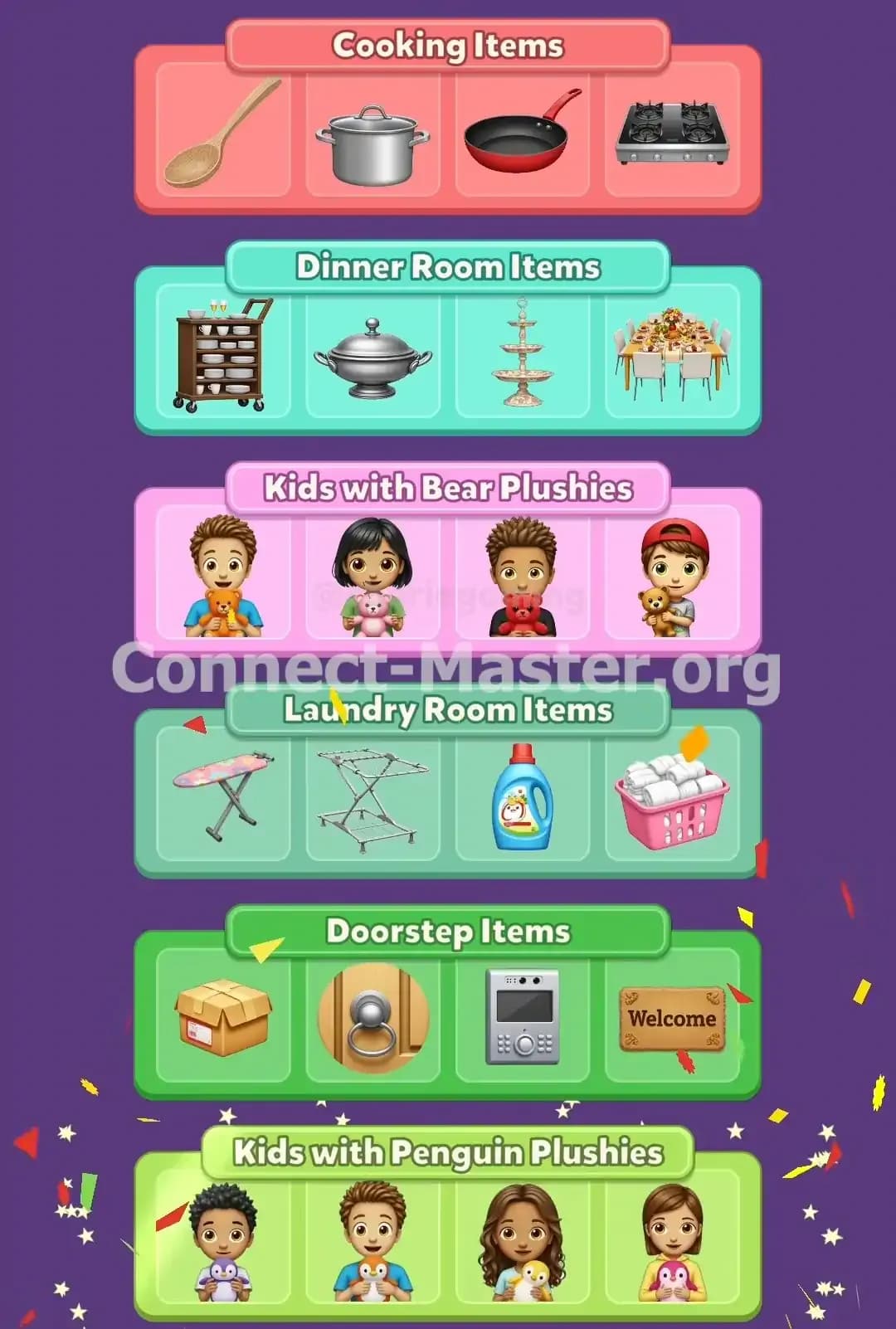
Connect Master Level 1585 uses a household-and-family theme, with a mixture of kitchen equipment, dining-room objects, laundry supplies, doorstep items, and children holding plush toys. There are six complete sets, and each set contains exactly four tiles.
The level looks busy because the object groups are spread across different rooms, while the character groups share similar faces, hairstyles, and colorful clothing. The safest approach is to separate the obvious room-based items first, then study the children by the plush toy in their hands.
The six categories in Connect Master 1585
- Cooking Items: A wooden cooking spoon, a lidded cooking pot, a frying pan, and a four-burner stovetop. Each belongs directly to food preparation.
- Dinner Room Items: A serving cart, a covered serving dish, a tiered dessert stand, and a fully arranged dining table. These are used for serving or presenting a meal rather than cooking it.
- Kids with Bear Plushies: Four children holding brown or orange teddy bears. Their clothing and hairstyles differ, but the bear is the shared clue.
- Laundry Room Items: An ironing board, a folding drying rack, a bottle of laundry detergent, and a laundry basket filled with clothes. These all support washing, drying, or pressing clothing.
- Doorstep Items: A cardboard package, a door knocker, a small doorbell or entry device, and a “Welcome” doormat. Every tile relates to the entrance of a home.
- Kids with Penguin Plushies: Four children holding purple, white, yellow, or pink penguins. The penguin shape is the deciding feature, not the child’s appearance.
Why Connect Master Level 1585 Feels So Tricky
The most confusing set: the children with plush toys
The hardest category in Connect Master Level 1585 is usually Kids with Bear Plushies or Kids with Penguin Plushies, because all eight character tiles follow the same basic design. Each child has large eyes, a friendly expression, and bright clothes, so it’s easy to sort by hair color or shirt color instead of by the actual object being held.
Players often overlook the plush toys because they focus on the child first. Don’t do that. Zoom in mentally on the toy’s silhouette, face, and ears. The bear plushies have rounded teddy-bear features, while the penguins have a compact body, contrasting belly, and a more birdlike shape.
Subtle overlaps and how to separate them
The first overlap is between the two child categories. A child with dark hair can look similar to another child with dark hair, but hairstyle is irrelevant here. Compare the plush: the bear group includes teddy faces and bear ears, while the penguin group has a lighter belly and a penguin-style head and body.
The second overlap appears among the cooking and dinner-room objects. The cooking pot and the covered serving dish both have lids and handles, but their roles are different. The cooking pot is a plain metal vessel used on the stove, whereas the dinner-room serving dish is a more decorative, pedestal-like piece intended for presenting food at the table.
The third overlap is among household appliances and room objects. The stovetop belongs with Cooking Items, while the small entry device belongs with Doorstep Items. Both can look like compact rectangular machines, so inspect their details: burners identify the stovetop, while buttons or a doorbell-style panel point to the entrance category.
My pattern-recognition moment
I found the level much easier once I stopped treating the children as individual characters. The breakthrough was realizing that the board wasn’t asking “which children look alike?” but “which children are holding the same kind of plush?” Once that distinction clicked, the six groups became clean and complete.
Step-by-Step Solution for Connect Master 1585
Opening: lock in the clearest object groups
Start with Cooking Items. The wooden spoon, metal pot, red frying pan, and stovetop have very direct kitchen functions, and there are no serious distractions once you view them as preparation tools.
Next, identify Laundry Room Items. The ironing board, drying rack, detergent bottle, and laundry basket are another strong four. Locking these two groups removes eight tiles and immediately makes the rest of the board less crowded.
Now look for Doorstep Items. The package, door knocker, entry device, and “Welcome” mat all belong to the front-door area. The doormat is especially helpful because it confirms the theme, while the knocker and entry panel provide matching entrance clues.
Mid-game: organize the dining-room objects
With the obvious utility items removed, collect Dinner Room Items: the serving cart, covered serving dish, tiered stand, and prepared dining table. Think of this set as “serving and displaying dinner,” not cooking it.
This distinction prevents a common mistake. The covered serving dish may tempt you to place it with the cooking pot, but the visual style and purpose separate them. The pot is a cooking vessel; the serving dish is part of the dining presentation. Likewise, the table itself is not a cooking item, even though it holds food.
At this stage, four bear-holding children and four penguin-holding children should remain. Avoid making a set based on shirt colors, hair, or skin tone. Those features are deliberately varied so that the plush toys remain the reliable category marker.
End-game: separate the two plush groups
Finish by sorting Kids with Bear Plushies and Kids with Penguin Plushies. Examine each child’s hands and the toy’s body rather than the child’s face. Put the four teddy-bear holders together, even if one child has a different hairstyle or outfit from the others.
Then place the remaining four children into Kids with Penguin Plushies. Check that each remaining toy has the penguin-like shape and contrasting front. If you’re uncertain about one tile, compare it with the confirmed bear and penguin examples instead of judging it by color alone.
A useful final check is to count four tiles in each category. If one character set has five or three, you’ve probably sorted by appearance rather than by plush type. Every child must belong to exactly one of the two toy-based groups.
The Logic Behind This Connect Master Level 1585 Solution
Move from broad traits to tiny details
The solution to Connect Master Level 1585 works because it follows a reliable visual hierarchy. Begin with broad, unmistakable traits: cooking tools, laundry equipment, and front-door objects. These categories have strong functional identities, so they’re safer than character-based groups.
After removing those tiles, focus on the dining-room theme and distinguish objects by purpose. Finally, use tiny details such as toy shape, belly color, ears, and facial features to separate the children. This progression reduces the number of possible matches after every group and guarantees that no tile is stranded.
The same method works whenever a level includes decoys. First ask what the item is used for, then ask where it belongs, and only afterward inspect small visual details. That prevents a superficial resemblance from controlling your decision.
Use category names to avoid double-counting
Naming each group in your head keeps the board organized. Think “Cooking Items,” “Dinner Room Items,” “Laundry Room Items,” and “Doorstep Items” as fixed labels. For the characters, use “Kids with Bear Plushies” and “Kids with Penguin Plushies.”
Once a tile is assigned to a named group, mentally remove it from consideration. Don’t reuse the same child while testing both plush categories, and don’t move the serving dish into the cooking group simply because it has a lid. In Connect Master 1585, every correct answer is a set of four, so complete categories are more trustworthy than attractive pairs or triples.