Connect Master Level 1596 Solution Walkthrough & Answer
How to solve Connect Master level 1596? Get instant solution & answer for Connect Master 1596.
Connect Master Level 1596 Pattern Overview
The overall theme and board structure
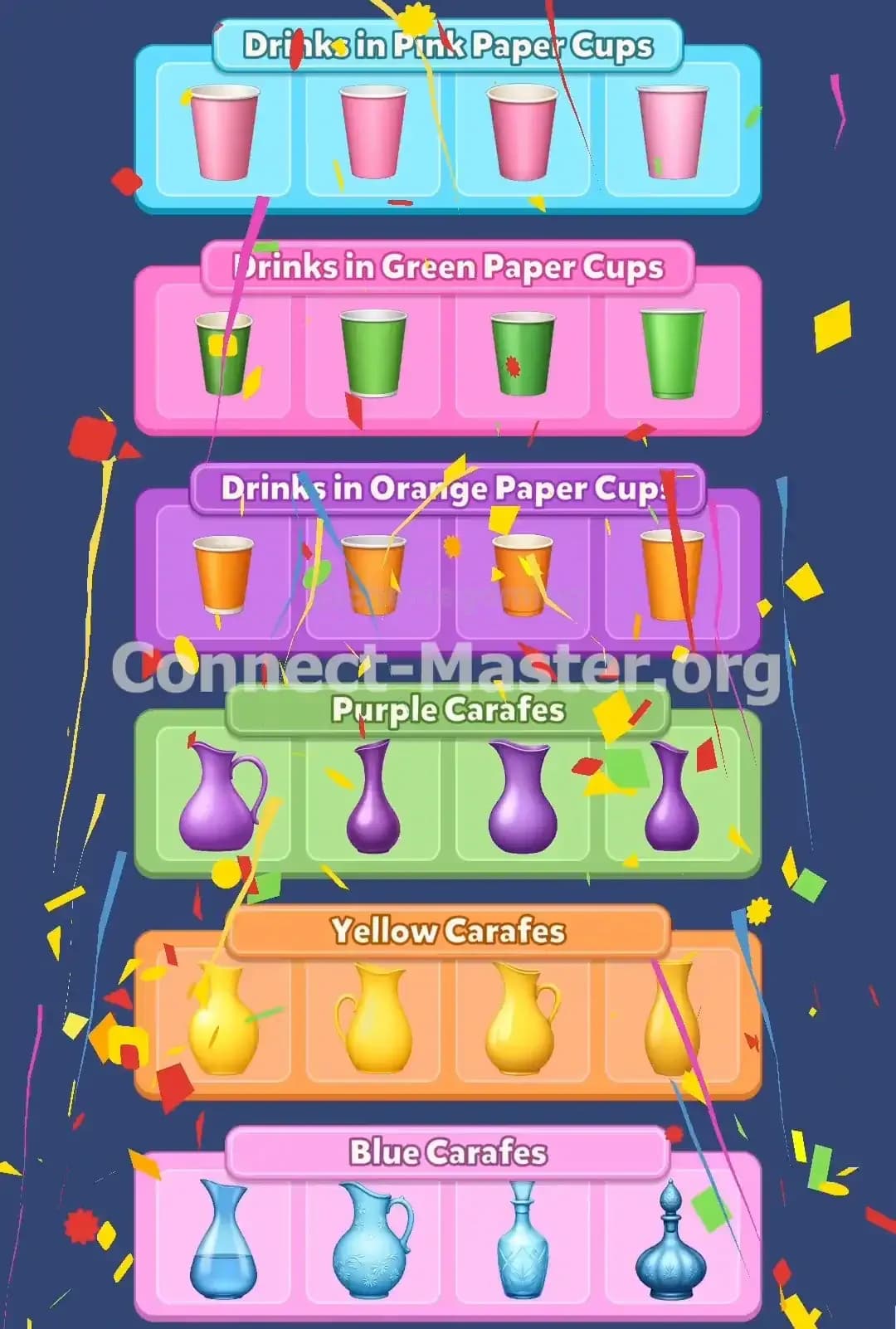
Connect Master Level 1596 uses a clean household-drinkware theme rather than characters, animals, or mixed objects. Every tile shows either a paper cup or a carafe, and the board contains six complete sets of four. The main sorting clues are the object’s color and, more importantly, whether it is a paper cup or a carafe.
The full board has 24 tiles:
- Three groups of colored paper cups
- Three groups of colored carafes
- Four tiles in each group
- No leftover tiles once all six categories are identified
At first glance, the repeating shapes make the level seem almost too simple. However, similar silhouettes and slightly different shades can tempt you into choosing the wrong four. In Connect Master 1596, the safest strategy is to identify the broad object type first, then confirm the exact color family.
The six sets in Connect Master 1596
Pink Paper Cups contains four pink disposable-style cups. They have the same basic tapered cup shape, pale rim, and pink body.
Green Paper Cups contains four green paper cups. Their green shades vary slightly, but each tile clearly shows the same lightweight cup design.
Orange Paper Cups contains four orange paper cups. Look for the orange cup body and the familiar paper-cup rim rather than focusing on small differences in shading.
Purple Carafes contains four purple pitchers or carafes. These are more substantial vessels than the cups, with rounded bodies, narrow necks, and purple coloring.
Yellow Carafes contains four yellow carafes. Their silhouettes vary more noticeably, but the yellow ceramic-like finish and pitcher form tie them together.
Blue Carafes contains four blue decorative carafes. These are the trickiest vessels to compare because some are narrow, ornate, or shaped like bottles, yet they all belong to the blue carafe category.
Why Connect Master Level 1596 Feels So Tricky
The most confusing set: Blue Carafes
The most confusing group in Connect Master Level 1596 is Blue Carafes. The four blue vessels don’t all have the same outline. One is broad and rounded, another has a handle, one is tall and slender, and another has a decorative stopper-like top. If you sort by shape alone, you may assume they belong to different categories.
Players often overlook this set because the blue tiles look more like separate types of bottles or vases. The important clue is the shared blue color and the overall decorative carafe theme. Once you recognize that the puzzle groups objects by visual family rather than identical silhouettes, the four blue vessels become much easier to keep together.
Subtle overlaps between the categories
The first overlap occurs between Pink Paper Cups, Orange Paper Cups, and Green Paper Cups. All three groups use the same tapered cup shape, and the lighting can make one color appear lighter or darker. Don’t judge a cup by a small highlight or shadow. Instead, compare the dominant body color across the entire tile. A cup with a pink body remains part of Pink Paper Cups, even if its rim or shading looks nearly white.
The second overlap is between the three carafe groups. Purple Carafes, Yellow Carafes, and Blue Carafes include different shapes, so the silhouette alone isn’t reliable. Check the main painted surface of each vessel. Purple carafes have a violet body, yellow carafes have a golden-yellow body, and blue carafes have a cool blue body. Handles, necks, and decorative patterns are secondary clues.
The third overlap appears when a narrow carafe resembles a large cup or bottle. The difference is in the construction: the carafes have a neck, heavier rounded base, or decorative pitcher styling, while the paper cups have a simple open rim and a consistent disposable-cup taper. When a tile seems ambiguous, ask whether it looks designed to hold a drink casually or displayed as a decorative vessel.
My pattern-recognition moment
I found this level deceptively easy at first because the colors stand out immediately. Then the different carafe shapes made me hesitate. The “I finally saw it” moment came when I stopped comparing outlines and started treating color as the primary label. Once I named the groups aloud—Purple Carafes, Yellow Carafes, and Blue Carafes—the remaining tiles fell into place quickly.
Step-by-Step Solution for Connect Master Level 1596
Opening: lock in the obvious paper-cup sets
Start Connect Master 1596 by scanning for the three paper-cup categories. They are the easiest sets because the cups share a simple, repeated shape and are separated mainly by color.
First, select the four pink cups for Pink Paper Cups. Confirm that each tile has the tapered paper-cup body rather than a rounded pitcher shape. Next, select the four green cups for Green Paper Cups. Finally, collect the four orange cups for Orange Paper Cups.
You don’t have to rely on their exact shade matching perfectly. The key is that all four tiles in each group have the same dominant color and paper-cup construction. Locking in these three sets removes half the board and leaves only the carafes.
Mid-game: separate the carafes by dominant color
After the paper cups are removed, inspect the remaining 12 tiles as one group of carafes. Avoid sorting them by height, handle placement, or neck shape because those features intentionally vary.
Begin with Purple Carafes. Find every vessel whose main body is purple, including both broad rounded forms and narrower shapes. Then identify Yellow Carafes, checking the entire body for a yellow or golden finish rather than relying on a bright highlight. The remaining four carafes should be blue, forming Blue Carafes.
A useful process-of-elimination rule is to assign a tile only when you can state two clues: its object type and its color. For example, “blue carafe” is stronger than simply “tall vessel.” This prevents you from placing a blue bottle-shaped tile with a yellow group just because their outlines are similar.
End-game: confirm the final carafe groups
The last tricky step is usually separating Blue Carafes from the other carafe sets. Check for blue across the broadest visible area of each vessel. One blue tile may be slender and ornate, while another may be rounded or equipped with a handle. Their shapes differ, but their color family remains consistent.
If two tiles still seem uncertain, temporarily mark them as possible members of two groups without committing. Complete the clearly yellow and purple tiles first. Once those sets contain four confirmed members, the unresolved blue tiles should become obvious. Remember that Connect Master 1596 has no leftovers: if three blue carafes are confirmed and one remaining blue vessel has the same color family, it completes Blue Carafes.
The Logic Behind This Connect Master Level 1596 Solution
Move from broad traits to specific details
The solution works because it uses the strongest visual trait first. Paper cup versus carafe is the broad distinction, while pink, green, orange, purple, yellow, and blue provide the specific category labels. Starting with these large differences quickly reduces the number of possible matches.
After that, use smaller details only as confirmation. A paper cup should have a simple tapered body and open rim. A carafe should have a more substantial vessel shape, often with a narrow neck, rounded base, handle, or decorative finish. These details help resolve tiles that color alone makes confusing.
Use category names to avoid double-counting
Naming each group in your head keeps the board organized. Think Pink Paper Cups, Green Paper Cups, and Orange Paper Cups for the first three sets, followed by Purple Carafes, Yellow Carafes, and Blue Carafes.
This method prevents you from using one tile twice or chasing a weak shape-based match. Every tile must belong to one and only one set, so each selection should support both halves of its name. By the end of Connect Master Level 1596, every cup has a color group, every carafe has a color group, and all 24 tiles are accounted for.