Connect Master Level 1481 Solution Walkthrough & Answer
How to solve Connect Master level 1481? Get instant solution & answer for Connect Master 1481.
Connect Master Level 1481 Pattern Overview
The overall theme and board layout
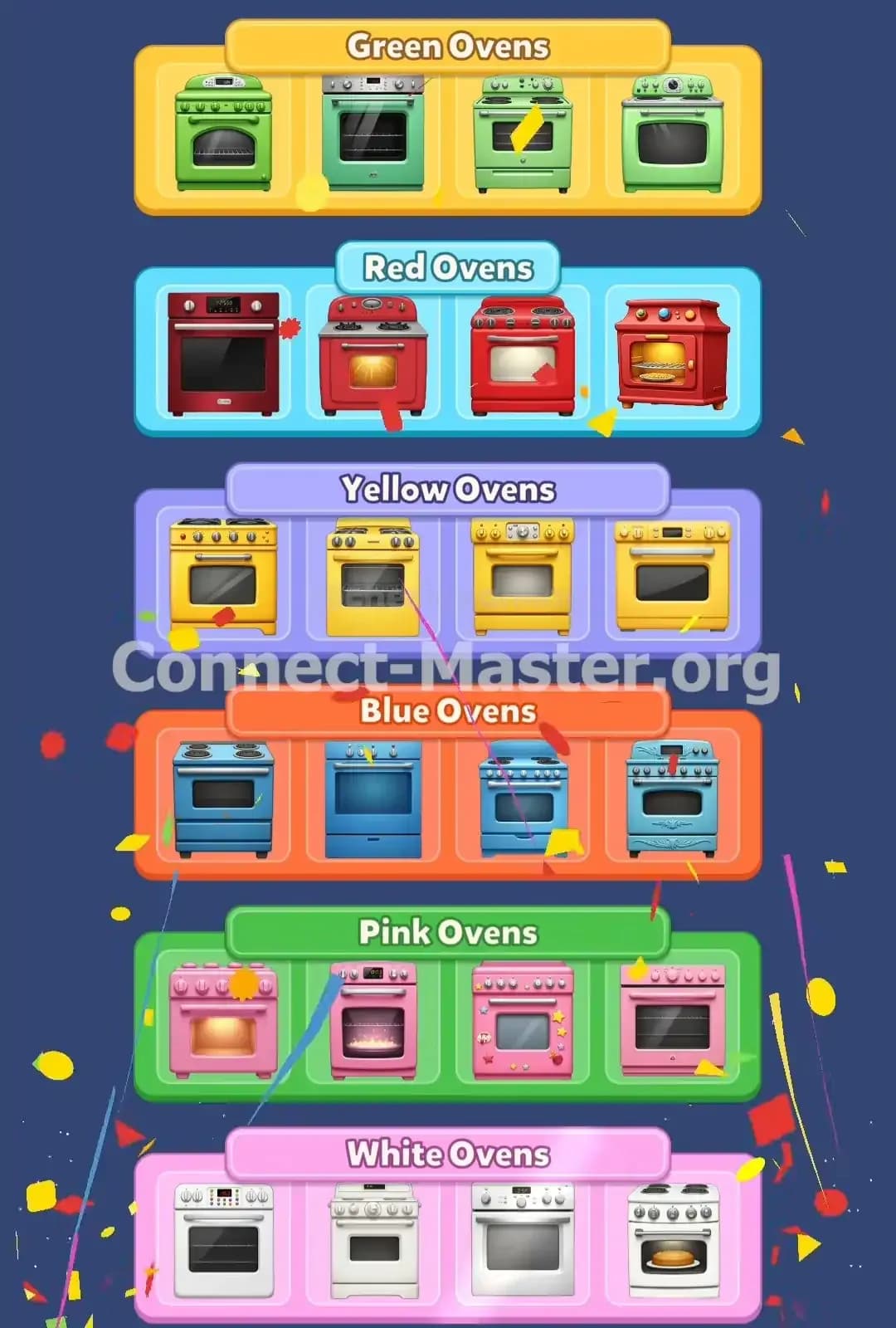
Connect Master Level 1481 is built around a clean appliance theme: every tile shows a kitchen oven or stove, and the solution depends mainly on the dominant color of each appliance. There are six sets of four tiles, giving you 24 ovens to organize in total.
At first glance, the board can feel repetitive because nearly every tile has the same basic shape: a cooking range, an oven door, knobs, and a control panel. The important distinction is not the oven’s exact design, number of burners, or window style. Instead, focus first on the main body color, then use smaller features to confirm that a tile belongs in the correct group.
The six completed categories in Connect Master 1481 are:
- Green Ovens: Four ovens with green or green-turquoise bodies.
- Red Ovens: Four ovens with clearly red or deep crimson finishes.
- Yellow Ovens: Four bright yellow or golden-yellow ovens.
- Blue Ovens: Four blue or blue-gray appliances.
- Pink Ovens: Four ovens with pink, rose, or magenta finishes.
- White Ovens: Four white or pale cream-colored ovens.
Each category contains exactly four tiles, so once you see four strong matches in one color family, you can safely treat that set as complete.
Why Connect Master Level 1481 Feels So Tricky
The most confusing set: Blue Ovens
The Blue Ovens group is the easiest one to overlook in Connect Master Level 1481 because its tiles don’t all use the same shade. One is a stronger medium blue, another looks slightly gray-blue, and another has a lighter icy-blue finish. Their control panels and oven windows also vary more noticeably than those in some other groups.
That variety can make you wonder whether one of the lighter tiles belongs with the green ovens. Don’t judge by the brightness of the tile alone. Check the full front panel, side edges, drawer, and trim. The blue appliances consistently stay within a cool blue family, while the green ovens have a more distinctly green cast around their knobs and body panels.
Subtle overlaps between the color groups
The first overlap is between Green Ovens and Blue Ovens. Several green appliances use teal or turquoise shading, especially around the door and control panel. To separate them, look at the main cabinet color rather than the reflective oven window. A dark or tinted window can look blue, but the surrounding enamel reveals the true group.
The second overlap is between Yellow Ovens and White Ovens. Some yellow tiles have pale highlights that make their doors or top panels look cream-colored. Conversely, the white ovens may have gray shadows and warm lighting. Focus on the knobs, frame, and lower drawer. A yellow oven keeps a golden tone across multiple solid areas, while a white oven remains neutral or lightly cream-colored.
The third overlap is between Red Ovens and Pink Ovens. The red group includes bright scarlet and deeper red finishes, while the pink group includes rose-colored appliances that can look reddish at a glance. Use the control panel and side borders as your test. Pink Ovens have a visibly softer, lighter finish, often with playful decorative details, while Red Ovens have a stronger saturated red body.
There are no character eyes, props, or outfit parts to compare in this appliance-themed level, so use the equivalent visual clues: burner rings, knobs, door handles, trim, decorative marks, and the color of the solid cabinet.
The pattern-recognition moment
I initially found Connect Master 1481 almost too obvious because the colors seem to announce the answer. Then the mixed shades slowed me down. The “I finally saw it” moment came when I stopped comparing the oven windows and started comparing the outer frames. Once the four color families were viewed as broad palettes instead of exact shades, the entire board became much easier.
Step-by-Step Solution for Connect Master Level 1481
Opening: lock in the clearest color groups
Begin with the most unmistakable category, usually Red Ovens or Yellow Ovens. The red tiles have strong red bodies that stand apart immediately, while the yellow tiles have bright golden cabinets and matching trim. Scan the entire board before selecting anything so you don’t accidentally count a pink tile as red or a cream tile as yellow.
Next, locate the four Green Ovens. Their bodies range from vivid green to green-turquoise, but the overall hue remains easy to recognize once you ignore the dark glass doors. These three groups—Red Ovens, Yellow Ovens, and Green Ovens—remove half of the board and leave fewer possible decoys.
When selecting a group, count carefully. Connect Master requires exactly four tiles, so don’t submit a set just because three tiles look perfect and a fourth is merely similar.
Mid-game: separate the cooler and lighter shades
After the obvious groups are identified, work through the remaining Blue Ovens, Pink Ovens, and White Ovens. Start by comparing the largest uninterrupted area on each appliance. The cabinet body is more reliable than a shiny door, a colored display, or a shadow.
For the blue set, compare the side panels, bottom drawer, and area beneath the oven door. If those sections are blue, the tile belongs to Blue Ovens, even if the glass looks nearly black or gray.
For the pink set, check the top trim and the lower corners. Pink Ovens generally keep their pink finish across the entire frame, and some include decorative stars or playful details that reinforce the category. Don’t let a dark pink tile drift into Red Ovens simply because it has a vivid control panel.
Finally, reserve the neutral appliances for White Ovens. White tiles may include gray doors, black displays, or metallic-looking knobs, but their main frame stays white or pale cream. This is a good place to use elimination: if an appliance is clearly not blue, pink, or yellow, inspect whether its body is neutral white.
End-game: finish the last tricky sets
The final one or two categories in Connect Master Level 1481 are usually Blue Ovens and White Ovens, since both can contain cool gray shading. Keep them separate by identifying the color of the solid enamel around the window. Blue Ovens have a noticeable blue cast in their cabinet, drawer, or control panel. White Ovens have a clean neutral frame, even when the door reflects gray.
If you’re left with a questionable tile, don’t force it into a set early. Temporarily mark it as uncertain and compare it against all remaining tiles. The correct group should share the same broad body color, not just one small feature such as a handle or a display.
Once four blue appliances are confirmed, the remaining four neutral appliances must be White Ovens. This final elimination works because every tile belongs to one and only one group, with no leftovers.
The Logic Behind This Connect Master Level 1481 Solution
Move from broad traits to specific details
The most reliable strategy is to begin with the largest visual trait: the oven’s dominant color. That immediately divides the board into six possible families. Afterward, use specific details—door frames, knobs, burner tops, handles, drawers, and decorative panels—to resolve close shades.
This broad-to-narrow method prevents you from being distracted by features that appear on several tiles. Every oven may have a black window or silver knobs, but only four share the same overall color family. Once you identify that family, the smaller details serve as confirmation rather than the main clue.
Use category names to organize the board
Naming each group in your head keeps the solution orderly. Think “Green Ovens,” “Red Ovens,” “Yellow Ovens,” “Blue Ovens,” “Pink Ovens,” and “White Ovens” rather than treating every appliance as an isolated puzzle piece.
That mental labeling also prevents double-using a tile. When an oven is assigned to Red Ovens, remove it from consideration completely. Continue until every category has four members. With that simple system, Connect Master Level 1481 becomes a controlled color-sorting puzzle instead of a guessing game.