Connect Master Level 1490 Solution Walkthrough & Answer
How to solve Connect Master level 1490? Get instant solution & answer for Connect Master 1490.
Connect Master Level 1490 Pattern Overview
The overall theme and board structure
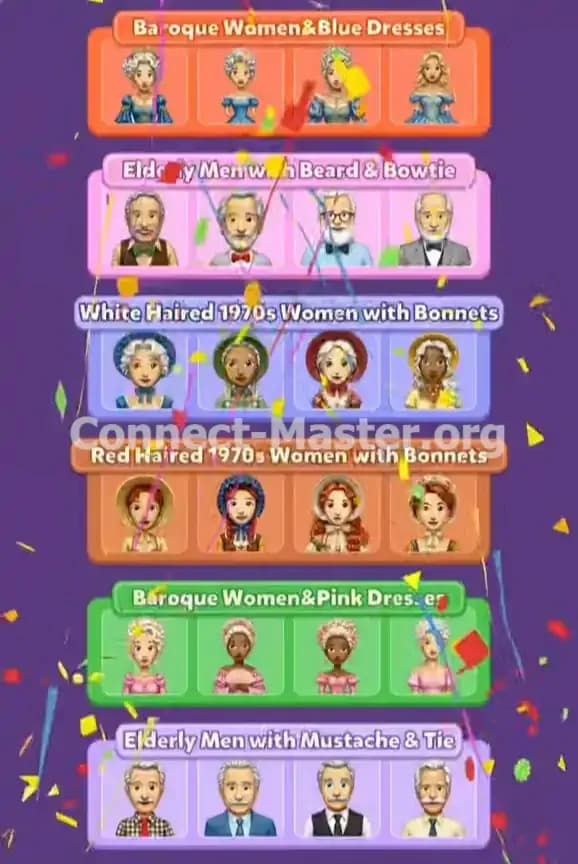
Connect Master Level 1490 uses a character-matching theme built around historical-looking people, hairstyles, facial hair, clothing, and color-coded outfits. There are six complete sets of four tiles, giving you 24 tiles to organize. At first glance, many of the characters appear interchangeable because several women wear similar bonnets, while the elderly men share gray hair and formal clothing.
The key is to avoid matching based on one broad feature alone. In Connect Master 1490, a bonnet, beard, dress, or mustache may point you in the right direction, but you still need to check the complete combination of hairstyle, clothing color, accessory, and facial expression.
The six matching sets
- Baroque Women with Blue Dresses: Four women styled in the ornate baroque look, each wearing a blue dress or blue-dominant outfit.
- Elderly Men with Beards and Bowties: Four older male characters identified by their beards and bowtie-style neckwear.
- White-Haired 1970s Women with Bonnets: Four women with pale or white hair, a 1970s-inspired appearance, and bonnets.
- Red-Haired 1970s Women with Bonnets: Four women with red or reddish hair, the same general 1970s styling, and bonnets.
- Baroque Women with Pink Dresses: Four ornate baroque women wearing pink dresses or pink-dominant outfits.
- Elderly Men with Mustaches and Ties: Four elderly male characters with mustaches and standard ties rather than bowties.
These category names are useful shorthand while solving Connect Master Level 1490. Instead of remembering individual faces, you can mentally label a tile as “pink baroque,” “red-haired bonnet,” or “mustache and tie.”
Why Connect Master Level 1490 Feels So Tricky
The most confusing set: the bonnet-wearing women
The White-Haired 1970s Women with Bonnets set is probably the easiest group to overlook. The women in this category resemble the Red-Haired 1970s Women with Bonnets group because both sets share the same general era, bonnet accessory, and visual design.
The difference is the hair color. The white-haired group has pale, silver, or very light hair, while the red-haired group contains distinctly red, auburn, or warm brown-red hair. Some tiles use shaded hair or a darker bonnet that makes the distinction less obvious, so don’t judge by the bonnet color. Look directly at the hair around the face and sides of the head.
Subtle overlaps between possible groups
The first overlap is between the two bonnet sets. A tile may look like it belongs to either group if the bonnet dominates the picture. Compare the exposed hair, not the hat. The White-Haired 1970s Women with Bonnets tiles keep their pale hair identity even when the bonnet is colorful. The Red-Haired 1970s Women with Bonnets tiles show warmer hair tones beneath or around the bonnet.
The second overlap is between Baroque Women with Blue Dresses and Baroque Women with Pink Dresses. Both groups have similar ornate hairstyles, jewelry, and historical clothing. It’s tempting to group the most visually elaborate women together, but the dress color is the deciding feature. Check the torso and sleeves carefully. Blue fabric belongs with Baroque Women with Blue Dresses, while pink fabric belongs with Baroque Women with Pink Dresses.
The third overlap involves the elderly men. The two male categories share gray hair, mature faces, and formal jackets. The important details are the facial hair and neckwear together. Elderly Men with Beards and Bowties have fuller beard coverage and compact bowties. Elderly Men with Mustaches and Ties have a mustache as the defining facial hair and a longer, conventional tie.
I found this level satisfying because the answer seemed almost visible once the categories were named. Before that, the characters looked like repeated variations of the same designs. The “I finally saw it” moment came when I stopped comparing faces and started comparing feature combinations: hair color plus bonnet, dress color plus baroque styling, and facial hair plus tie type.
Step-by-Step Solution for Connect Master Level 1490
Opening: lock in the clearest visual families
Start Connect Master 1490 by scanning for the two elderly-men groups. Male characters are easier to separate from the women, and their accessories provide strong confirmation. Look for four men with fuller beards and bowties, then look for four with mustaches and standard ties.
When checking the men, don’t remove a tile just because the beard looks slightly different. The set is based on the combined pattern: elderly appearance, facial hair, and neckwear. Once you identify four clear members of Elderly Men with Beards and Bowties, lock them in. Then confirm the remaining male tiles as Elderly Men with Mustaches and Ties.
Next, find the two baroque dress groups. The ornate hairstyles and period-inspired facial designs make these women stand out from the bonnet-wearing characters. Separate them by clothing color rather than by face. Select four blue-dominant outfits for Baroque Women with Blue Dresses, and four pink-dominant outfits for Baroque Women with Pink Dresses.
Mid-game: compare details instead of impressions
After the obvious male and baroque groups are removed, the remaining tiles should be the two bonnet categories. This is where Connect Master Level 1490 requires more careful observation. Lay the bonnet tiles mentally into two columns and inspect hair color one tile at a time.
For White-Haired 1970s Women with Bonnets, focus on silver, white, or very pale hair visible near the forehead, cheeks, or shoulders. For Red-Haired 1970s Women with Bonnets, look for red, copper, auburn, or warm reddish-brown hair. Don’t use skin tone, bonnet color, or dress shade as your primary test because those details can vary inside the same group.
A good elimination method is to identify two or three unmistakable white-haired women first. Then search the remaining bonnet tiles for the matching red-haired designs. Avoid forcing a fourth tile into a group simply because it has a similar hat. Every set must contain exactly four tiles, so a near-match should remain unassigned until its hair and styling are confirmed.
End-game: separate the last near-matches
The last tricky comparison is usually between Baroque Women with Pink Dresses and Red-Haired 1970s Women with Bonnets, especially when a baroque character has warm-colored hair. The hair alone is not enough. Check the outfit silhouette and headwear. Baroque women have more elaborate period styling and colored dresses, while the 1970s women consistently feature bonnets.
If two tiles still seem uncertain, compare them against the three already confirmed members of each category. Ask which one shares the same dress construction, sleeve shape, and historical hairstyle. A tile belongs with the group whose complete design it repeats, not merely the group with one matching color.
Likewise, if one elderly man remains during the final move, inspect the mouth and neck. A mustache with a narrow, hanging tie belongs to Elderly Men with Mustaches and Ties. A fuller beard paired with a bowtie belongs to Elderly Men with Beards and Bowties. This final accessory check prevents the most common last-move mistake.
The Logic Behind This Connect Master Level 1490 Solution
Move from broad traits to specific details
The most reliable method for Connect Master 1490 is to solve from large visual differences to small identifying details. First divide the board into women and elderly men. Then separate the men by facial hair and neckwear. Among the women, identify the baroque styling and divide those tiles by blue or pink dresses.
Only after those broad groups are handled should you focus on the bonnet tiles. Hair color becomes much easier to judge when the baroque women are no longer competing for your attention. This process steadily reduces the number of possible homes for every tile and prevents you from making a guess based on a single feature.
Use category names to prevent double-use
Naming each set in your head keeps the puzzle organized. I’d use the six labels Blue Baroque, Beard and Bowtie, White-Haired Bonnets, Red-Haired Bonnets, Pink Baroque, and Mustache and Tie.
When considering a tile, ask which label describes its full identity. If it seems to fit two groups, compare the strongest defining trait: dress color for the baroque women, hair color for the bonnet women, and facial hair plus neckwear for the elderly men. Once four tiles meet one label, mentally remove them and reassess the board.
That disciplined approach guarantees that every tile in Connect Master Level 1490 is used once and only once, leading to the complete six-set solution without relying on trial and error.