Connect Master Level 1511 Solution Walkthrough & Answer
How to solve Connect Master level 1511? Get instant solution & answer for Connect Master 1511.
Connect Master Level 1511 Pattern Overview
The overall theme and six matching sets
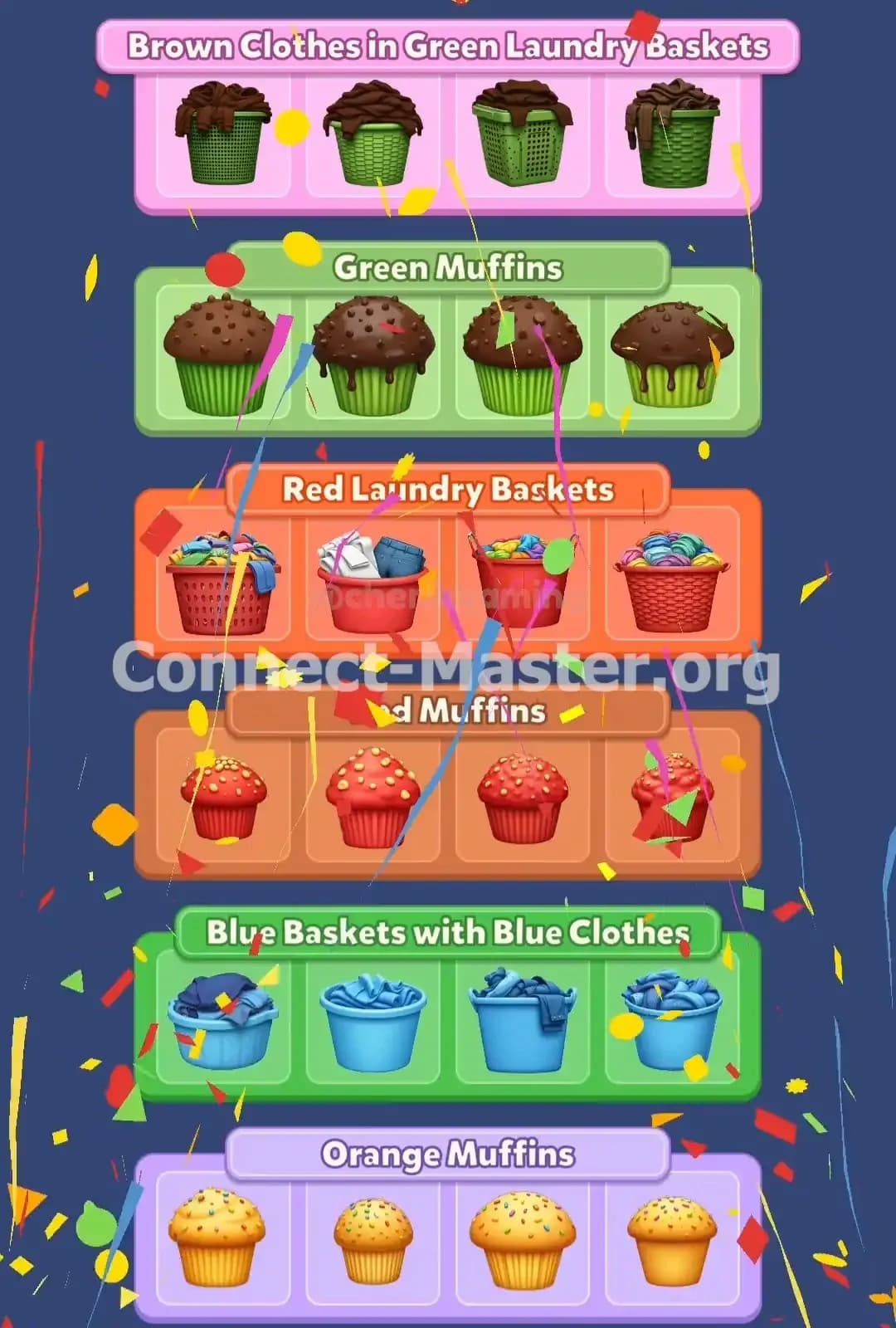
Connect Master Level 1511 uses a bright food-and-laundry theme. Instead of characters, the board combines baskets full of clothing with rows of muffins in different colors. There are six sets of four tiles, giving you 24 tiles in total.
The main challenge is that several groups use similar colors, while the baskets and muffins are designed to distract you. A green basket may look close to a green muffin at first glance, and the red objects include both laundry baskets and muffins. The safest approach is to classify each tile by its main object first, then confirm the color and smaller details.
The six categories in Connect Master 1511 are:
- Brown Clothes in Green Laundry Baskets: Four green laundry baskets filled with brown or dark-brown clothing. The basket color and the brown contents are the important combination.
- Green Muffins: Four muffins with green wrappers and brown, chocolate-like tops. Their green bases separate them from the red and orange muffin groups.
- Red Laundry Baskets: Four red or reddish laundry baskets filled with mixed-colored clothing. Their contents vary, but the basket itself is the defining feature.
- Red Muffins: Four muffins with red wrappers and red toppings. Some have more visible sprinkles or icing, but all belong to the red muffin group.
- Blue Baskets with Blue Clothes: Four blue laundry baskets containing blue clothing. This set is identified by matching blue color in both the basket and its contents.
- Orange Muffins: Four muffins with orange or golden-yellow wrappers and orange tops. Small topping differences are only decoration, not separate categories.
Why Connect Master Level 1511 Feels So Tricky
The most confusing set: Brown Clothes in Green Laundry Baskets
The hardest group in Connect Master 1511 is Brown Clothes in Green Laundry Baskets. Players often notice the green basket first and assume these tiles should be compared with the green muffins. That’s the trap: the baskets are green, but the objects inside them are clearly brown clothing.
This set also feels less uniform than the muffin groups because the baskets have slightly different shapes and textures. One may look tall, another may have a wider rim, and the clothing may be folded or piled differently. Ignore those small variations and focus on the repeated two-part trait: green laundry basket plus brown clothes.
Subtle overlaps between similar-looking tiles
The first overlap is between Green Muffins and Brown Clothes in Green Laundry Baskets. Both sets contain a strong green color, but the object type settles the question immediately. A muffin has a rounded baked top and a fluted wrapper, while a laundry basket has a rigid rim, perforations, and fabric sticking out of it.
The second overlap appears between Red Laundry Baskets and Red Muffins. Both use red as their dominant color, so color alone isn’t enough. Check the silhouette: muffins have domed tops, ridged wrappers, and sprinkles or icing, while baskets have open tops, handles or rims, and clothing piled inside. If you see fabric folds rather than frosting, you’re looking at Red Laundry Baskets.
The third overlap is between Blue Baskets with Blue Clothes and the other laundry groups. A blue basket with blue clothing can resemble a plain blue container because the contents blend into the basket. Look for separate fabric shapes at the top, especially folded sleeves, collars, or piled garments. The matching blue shades are intentional and identify this category.
I’ll admit, I needed a moment before the brown-clothes pattern clicked. Once I stopped sorting by the loudest color and started checking whether each tile was food or laundry, the board became much easier.
Step-by-Step Solution for Connect Master Level 1511
Opening: lock in the clearest object types
Begin Connect Master 1511 by separating muffins from baskets. This single decision cuts the visual confusion in half. Look for the obvious muffin silhouettes first: rounded tops, fluted wrappers, and baked toppings.
Start with Green Muffins. Find all four muffins with green wrappers and brown tops, then mentally place them together. Don’t reject one because its chocolate topping has a different drip pattern or a different number of spots. The wrapper color and muffin shape are the consistent traits.
Next, identify Orange Muffins. These have golden-orange wrappers and lighter orange tops, usually with small multicolored sprinkles. Their toppings may vary slightly, but the warm orange color makes this one of the safest groups to confirm.
Then gather Red Muffins. Check the muffin wrapper and topping together rather than focusing on sprinkles. All four have a red overall appearance, even if one has more noticeable icing or a slightly different topping texture.
Once the three muffin groups are mentally removed, focus on the laundry baskets. Red Laundry Baskets should be the next easy set. Find the four red baskets, including the clothing inside them, and keep them separate from the red muffins by checking for fabric and basket openings.
Mid-game: compare basket color and clothing color
With the muffin categories and red baskets accounted for, examine the remaining laundry tiles closely. The key question is not simply, “What color is this basket?” Ask instead, “What color is the basket, and what color are the clothes?”
For Blue Baskets with Blue Clothes, look for blue baskets whose contents are also blue. The matching colors may be slightly different in brightness, but the clothing should still read as blue. Basket texture is not the deciding factor; one tile may be smooth, while another has a stronger woven pattern.
Avoid grouping every blue-looking object together automatically. Confirm that each tile contains clothing rather than a muffin top or an empty-looking container. This prevents a near-match from stealing a tile that belongs in another set.
End-game: finish with the brown-clothes group
The final tricky category is Brown Clothes in Green Laundry Baskets. At this stage, the remaining green basket tiles should become much easier to recognize because the green muffins have already been removed.
Check each basket for dark brown fabric at the top. The clothing may appear as rolled garments, folded stacks, or loose material, but it should have a noticeably brown color. The green basket may have different perforation patterns or rim shapes, so don’t use the basket design as your primary test.
Keep these tiles separate from Green Muffins by checking the upper silhouette. Brown clothing has irregular folds and garment edges; a muffin has a smooth, rounded baked dome. That distinction gives you the exact four tiles needed to complete Connect Master 1511.
The Logic Behind This Connect Master Level 1511 Solution
Move from broad traits to specific details
The reliable method for Connect Master Level 1511 is to work from broad categories toward small confirmations. First, divide the board into food and laundry. Next, sort each type by dominant color. Finally, use details such as wrappers, basket rims, fabric folds, toppings, and clothing piles to verify each group.
This process reduces confusion because every confirmed set removes four tiles from consideration. Once Green Muffins, Orange Muffins, and Red Muffins are accounted for, the remaining tiles must be baskets. Once Red Laundry Baskets and Blue Baskets with Blue Clothes are identified, the last four naturally form Brown Clothes in Green Laundry Baskets.
Use category names to prevent double-using tiles
Naming each group in your head keeps the puzzle organized. Think “Green Muffins,” “Red Muffins,” and “Orange Muffins” rather than relying on vague impressions like “the green food.” For the baskets, use the full names Red Laundry Baskets, Blue Baskets with Blue Clothes, and Brown Clothes in Green Laundry Baskets.
This habit prevents you from using one tile twice or forcing a decoy into the wrong category. Every tile in Connect Master 1511 has one destination, and once each named group contains exactly four tiles, the solution is complete.