Connect Master Level 1423 Solution Walkthrough & Answer
How to solve Connect Master level 1423? Get instant solution & answer for Connect Master 1423.
Connect Master Level 1423 Pattern Overview
The overall theme and six completed sets
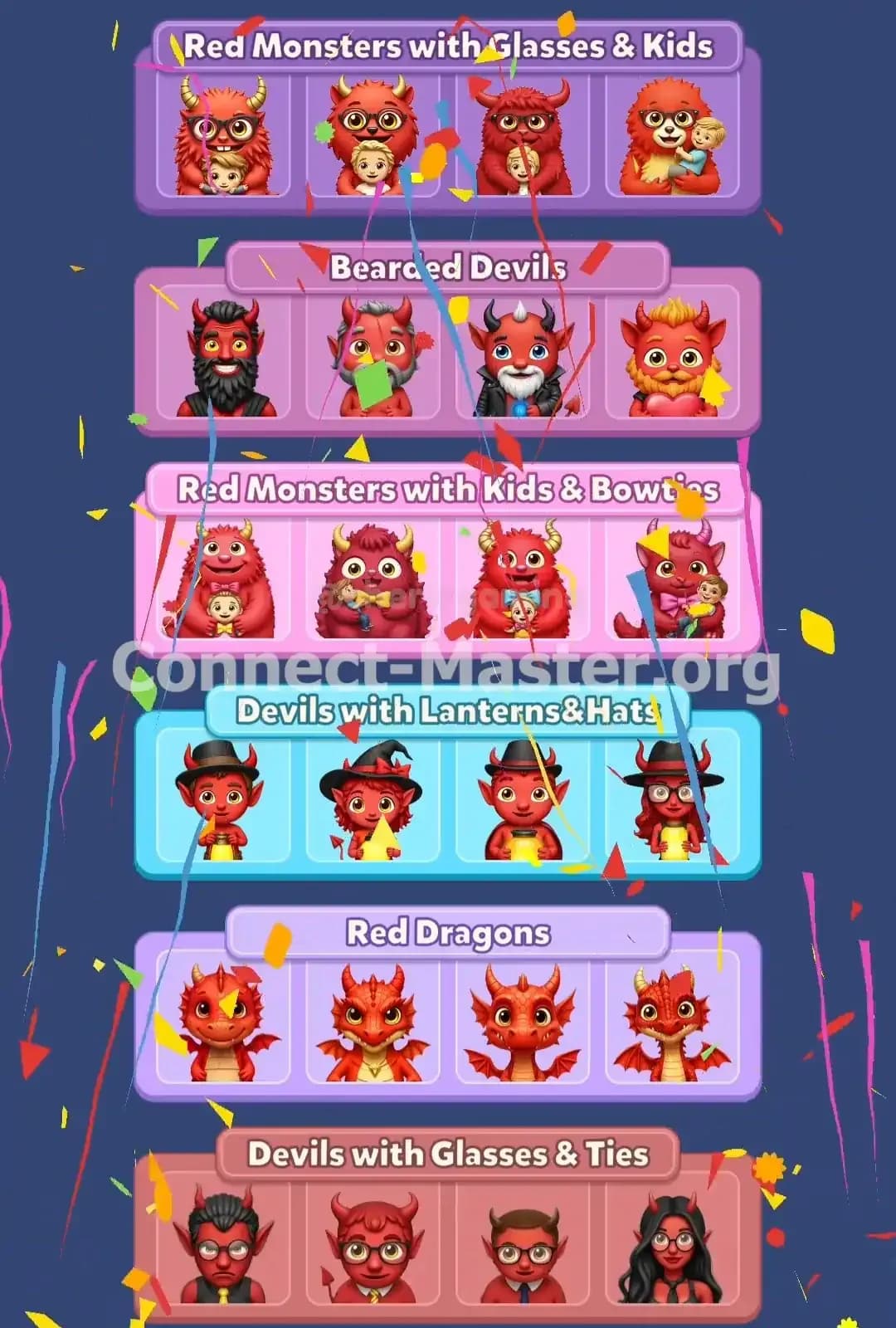
Connect Master Level 1423 is built around a colorful monster-and-devil cast, with a few dragons mixed in to make the visual sorting less immediate. The board contains 24 tiles divided into six correct sets of four. Most characters are red or reddish, so the winning clues come from accessories, companions, facial hair, clothing, and body shape rather than color alone.
The six groups in Connect Master 1423 are:
- Red Monsters with Glasses & Kids: Four red monster characters wearing glasses and shown with a child.
- Bearded Devils: Four devil characters identified by their prominent beards.
- Red Monsters with Kids & Bows: Four red monsters paired with children and decorated with bow details.
- Devils with Lanterns & Hats: Four devils holding yellow lanterns while wearing different styles of hats.
- Red Dragons: Four clearly dragon-like red creatures with wings, scales, horns, or long dragon features.
- Devils with Glasses & Ties: Four devil characters wearing glasses and formal neckwear, including both male and female designs.
When you approach Connect Master Level 1423, don’t treat every red character as interchangeable. The board is deliberately designed so that the broad theme is shared, while the smaller visual trait determines the correct group.
Why Connect Master Level 1423 Feels So Tricky
The most confusing set: Red Monsters with Kids & Bows
The hardest group for many players is Red Monsters with Kids & Bows. At first glance, these tiles look very similar to Red Monsters with Glasses & Kids, because both groups feature red monsters and children. The children are not enough by themselves to solve the category.
The overlooked clue is the bow decoration. Look for the monsters or children wearing clearly visible bows, especially around the neck or upper body. The glasses group is more consistent: every member has noticeable eyewear. If a tile has a child but no glasses, check whether the bow trait completes the Red Monsters with Kids & Bows set.
Small overlaps that cause wrong guesses
The first major overlap is between Red Monsters with Glasses & Kids and Devils with Glasses & Ties. Both sets use glasses, and the characters may share similar red coloring. Separate them by checking the second accessory: the top group has children, while the tie group has formal clothing and neckties. A child is not a minor detail here—it is the deciding clue.
The second overlap appears between Bearded Devils and Devils with Lanterns & Hats. Some bearded devils may look like they could fit with the hat-wearing characters, especially when their horns and head shapes are similar. Check the hands and headwear carefully. The lantern group has a yellow lantern in each tile and a recognizable hat, while the bearded set is defined by facial hair rather than props.
The third overlap is between the ordinary red monsters and the Red Dragons. Several monsters have horns, pointed ears, or bright red bodies, which can make them appear dragon-like. Dragons, however, have a more reptilian build, visible wings or dragon anatomy, scales, and elongated facial features. If the character looks humanoid and is interacting with a child, it belongs with one of the monster groups instead.
My pattern-recognition moment
I found the level much easier once I stopped sorting by color. My first instinct was to collect all the red characters together, but that created too many possible combinations. The “I finally saw it” moment came when I noticed that glasses were split into two completely different sets: glasses plus kids, and glasses plus ties. That immediately made the remaining visual details much easier to compare.
Step-by-Step Solution for Connect Master Level 1423
Opening: lock in the obvious sets first
Start Connect Master 1423 by identifying the set with the strongest silhouette difference: Red Dragons. These four tiles have unmistakable dragon traits, including wings, scales, horns, and more reptilian faces. They don’t rely on accessories such as glasses or hats, so they’re safe to separate immediately.
Next, find Devils with Lanterns & Hats. Look for the four characters holding bright yellow lanterns. Each also wears a different hat, so compare the full upper body instead of focusing only on horns. Once these eight tiles are mentally removed, the board becomes much less crowded.
After that, collect Bearded Devils. Compare the lower face of each remaining devil and look for full, obvious beards. Don’t be distracted by horn colors or hair on top of the head; the beard is the shared trait. Locking in these four gives you three complete groups and leaves the more closely related monster and glasses sets.
Mid-game: compare accessories and companions
Now focus on the characters shown with children. Separate them into two possible categories: Red Monsters with Glasses & Kids and Red Monsters with Kids & Bows. For each tile, check the eyes first. Large, obvious glasses place a character in the glasses-and-kids group, provided the child is also present.
For the remaining child tiles, inspect the neck, chest, and the child’s clothing for bow details. The four that share those bow features complete Red Monsters with Kids & Bows. This is a good stage to use elimination, but don’t force a group too early. If you see only three clear bow tiles, leave the uncertain fourth aside and check the glasses group first.
The key mistake to avoid in Connect Master Level 1423 is counting a generic red monster as a match. Red coloring, horns, and big eyes are background traits shared across multiple groups. Accessories and relationships are stronger evidence.
End-game: finish the glasses and tie group
The final group to verify is usually Devils with Glasses & Ties. These four characters wear glasses, but unlike the upper monster group, they are dressed as formal devils and have visible ties. Check the chest area for the neckwear, then confirm that the character is not holding a child.
At this point, Red Monsters with Glasses & Kids should also be clear: four red monsters, four children, and four sets of glasses. If one tile seems to fit both categories, use the companion clue first. A tile with a child belongs with the kid-based monster group; a formal devil with a tie belongs with Devils with Glasses & Ties.
Before confirming the solution, perform a final four-by-four check. Every tile must appear once, each category must contain exactly four members, and no group should depend on a vague trait such as “looks red” or “has horns.”
The Logic Behind This Connect Master Level 1423 Solution
Move from broad shapes to precise details
The most reliable method for Connect Master 1423 is to solve from the biggest visual differences to the smallest. Dragons have a unique body shape, lantern devils have repeated props, and bearded devils have strong facial-hair clues. These are high-confidence categories, so solving them first reduces the number of possible matches.
Once those obvious sets are gone, compare specific details: glasses, ties, children, and bows. This two-stage approach prevents broad similarities from controlling your decisions. It also exposes the decoys, because a character may share horns or hair with another group while lacking the correct accessory.
Use category names to prevent double-using tiles
I recommend naming each group in your head exactly as you build it: Red Dragons, Devils with Lanterns & Hats, Bearded Devils, Red Monsters with Glasses & Kids, Red Monsters with Kids & Bows, and Devils with Glasses & Ties.
These names act like visual labels. Instead of thinking “this red character might fit,” you can ask, “Does it belong to the glasses-and-kids group or the glasses-and-ties group?” That wording forces you to check the complete trait combination.
The logic of Connect Master Level 1423 is therefore systematic: isolate unique silhouettes, identify repeated props, compare overlapping accessories, and use elimination only after the strong clues are assigned. Follow that order and the entire board resolves cleanly into six sets of four.