Connect Master Level 1505 Solution Walkthrough & Answer
How to solve Connect Master level 1505? Get instant solution & answer for Connect Master 1505.
Connect Master Level 1505 Pattern Overview
The overall theme and board structure
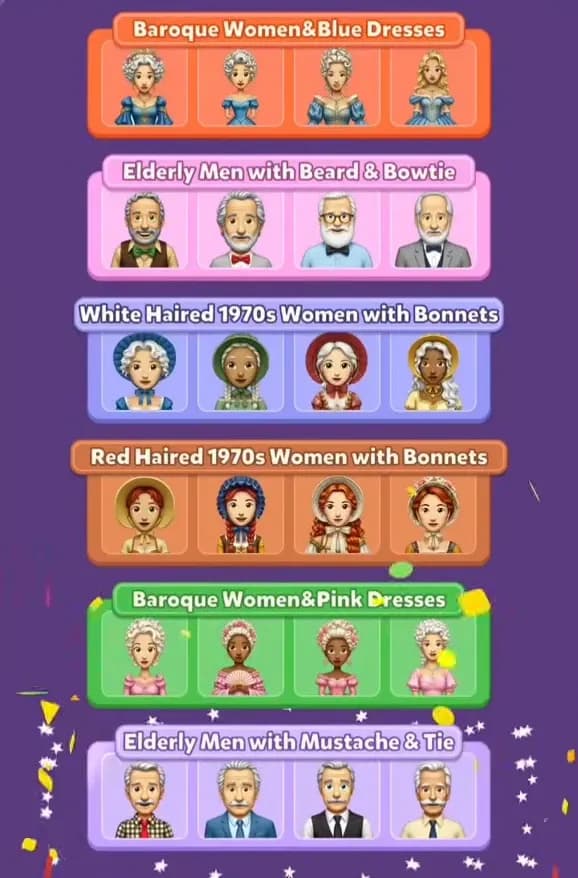
Connect Master Level 1505 uses a character-sorting theme built around historical fashion, hair color, facial hair, and clothing accessories. Instead of grouping tiles by one obvious feature alone, you need to combine several details: the character’s apparent era, hairstyle, dress color, bonnet, beard, mustache, bowtie, or necktie.
There are six sets of four tiles, giving you a full board of 24 characters. The main mix includes elegant Baroque women, 1970s-style women wearing bonnets, and elderly men divided by their facial hair and neckwear. Several characters look similar at first, so the safest approach is to identify a complete category before committing tiles.
The six categories in Connect Master Level 1505
- Baroque Women with Blue Dresses: Four women with ornate Baroque-style hair and formal blue dresses.
- Elderly Men with Beards and Bowties: Four older men who have beards and wear bowties with their formal outfits.
- White-Haired 1970s Women with Bonnets: Four women with white or silver hair, 1970s styling, and decorative bonnets.
- Red-Haired 1970s Women with Bonnets: Four women with red, auburn, or reddish hair, matching 1970s outfits, and bonnets.
- Baroque Women with Pink Dresses: Four women with elaborate Baroque hairstyles and formal pink dresses.
- Elderly Men with Mustaches and Ties: Four elderly men identified by mustaches and standard neckties rather than bowties.
These category names are intentionally specific. In Connect Master 1505, “women with bonnets” or “old men” isn’t enough to solve a group, because those broad descriptions apply to multiple sets.
Why Connect Master Level 1505 Feels So Tricky
The most confusing set
The most easily overlooked category is Elderly Men with Beards and Bowties. The men share similar gray hair, mature faces, and formal clothing, so it’s tempting to combine all eight elderly male characters into one large mental group. That creates an immediate problem because Connect Master requires exactly four tiles per set.
The key is to inspect the lower part of each portrait. The bearded men have fuller facial hair and bowties, while the other four men have more limited mustaches and longer, standard ties. Once you focus on the neckwear instead of just the faces, the two male sets become much clearer.
Subtle overlaps between the women’s groups
The two Baroque categories overlap in hairstyle and overall presentation. Both groups feature women with elaborate, powdered-looking hair and formal historical clothing. The strongest separator is the dress color: place the blue gowns together as Baroque Women with Blue Dresses, and keep the pink gowns for Baroque Women with Pink Dresses. Don’t let a similar hairstyle persuade you to move a pink-dressed character into the blue set.
The bonnet groups are also easy to mix up. Both White-Haired 1970s Women with Bonnets and Red-Haired 1970s Women with Bonnets include women in vintage-looking outfits and decorative headwear. Here, hair color is the deciding trait. Check the visible hair around the face and beneath the bonnet rather than judging the bonnet’s color. Silver or white hair belongs in the white-haired group; auburn, copper, or reddish hair belongs in the red-haired group.
A third overlap appears between the Baroque women and the white-haired bonnet women. Some characters in both categories have pale or powdered hair, formal dresses, and a similar old-fashioned expression. Look at the headwear and outfit construction: Baroque women have the more elaborate historical hairstyle and clearly colored blue or pink dresses, while the 1970s women are defined by their bonnet and period-style clothing.
My pattern-recognition moment
I found the board much easier once I stopped treating facial appearance as the primary clue. At first, the elderly men seemed interchangeable, and several of the women looked like they belonged to the same historical theme. The “I finally saw it” moment came from pairing the large visual traits first—blue, pink, white-haired, and red-haired—then using facial hair and neckwear to finish the men.
Step-by-Step Solution for Connect Master Level 1505
Opening: lock in the clearest sets first
Begin Connect Master Level 1505 by scanning for the strongest color-based groups. The Baroque Women with Blue Dresses set is usually a good opening because the blue gowns are easy to recognize across the four portraits. Select those four together, but verify that each woman also has the matching ornate Baroque styling.
Next, identify Baroque Women with Pink Dresses. The pink clothing creates another obvious group, and checking the hairstyles prevents you from accidentally selecting one of the bonnet-wearing women. Removing both Baroque sets leaves fewer historical-fashion decoys on the board.
After that, look for the two bonnet groups. Separate the women by hair color: choose the four white- or silver-haired characters for White-Haired 1970s Women with Bonnets, then group the four red- or auburn-haired characters as Red-Haired 1970s Women with Bonnets. If a bonnet seems to fit both categories, ignore the bonnet shade and inspect the hair framing the face.
Mid-game: use elimination carefully
Once the four women’s sets are removed, the remaining tiles are all elderly men. This is where you should slow down instead of selecting four based only on age or gray hair. Compare their facial hair and neckwear one tile at a time.
For Elderly Men with Beards and Bowties, look for the fuller beard paired with a small bowtie. These characters may wear different shirt or jacket colors, but the beard-and-bowtie combination is consistent. For Elderly Men with Mustaches and Ties, select the men with a distinct mustache and a longer, conventional tie.
A useful habit is to mentally label each tile before selecting it: “full beard, bowtie,” “mustache, long tie,” and so on. That prevents you from using one character in both male categories. If a man has gray hair and glasses, treat those as secondary details; the facial hair and neckwear carry more solving value.
End-game: separate the final male categories
The final two groups in Connect Master 1505 are both based on elderly men, so the exact trait matters. The first category is Elderly Men with Beards and Bowties. Confirm that each selected man has a beard extending beyond the chin or along the jaw and a bowtie at the collar.
The second is Elderly Men with Mustaches and Ties. These four men have mustaches rather than full beards and wear narrow or standard ties. Don’t rely on shirt color, glasses, or hair shade, since those features vary within the groups and can create false matches.
If you’re left with an apparent mismatch, revisit the beard line and collar area before changing a woman’s category. The board is designed so the final male split becomes exact once the clothing accessory is read correctly.
The Logic Behind This Connect Master Level 1505 Solution
Move from broad traits to specific details
The reliable method for Connect Master Level 1505 is to solve from large, unmistakable traits toward smaller ones. Dress color is more useful than a vague impression of historical style, while hair color is more useful than bonnet color. After the women are divided, facial hair and neckwear provide the precise distinction needed for the men.
This approach reduces confusion because every confirmed group removes four tiles from consideration. With fewer tiles remaining, similar hairstyles and expressions stop competing for your attention. You’re not guessing; you’re progressively narrowing the available traits until every character has one logical home.
Use category names to organize the board
Naming each set in your head keeps the solution structured. Think “Baroque Women with Blue Dresses,” not simply “blue women,” and think “Elderly Men with Mustaches and Ties,” not just “old men.” Those longer labels remind you which secondary details must also be present.
The names also protect against double-using a tile. Every character must belong to one and only one group, so mark each confirmed tile mentally and don’t reconsider it unless a complete set proves it wrong. By combining clear category names with careful comparisons of hair, dress, facial hair, and accessories, you can solve Connect Master Level 1505 consistently without relying on trial and error.