Connect Master Level 1530 Solution Walkthrough & Answer
How to solve Connect Master level 1530? Get instant solution & answer for Connect Master 1530.
Connect Master Level 1530 Pattern Overview
The overall theme and board structure
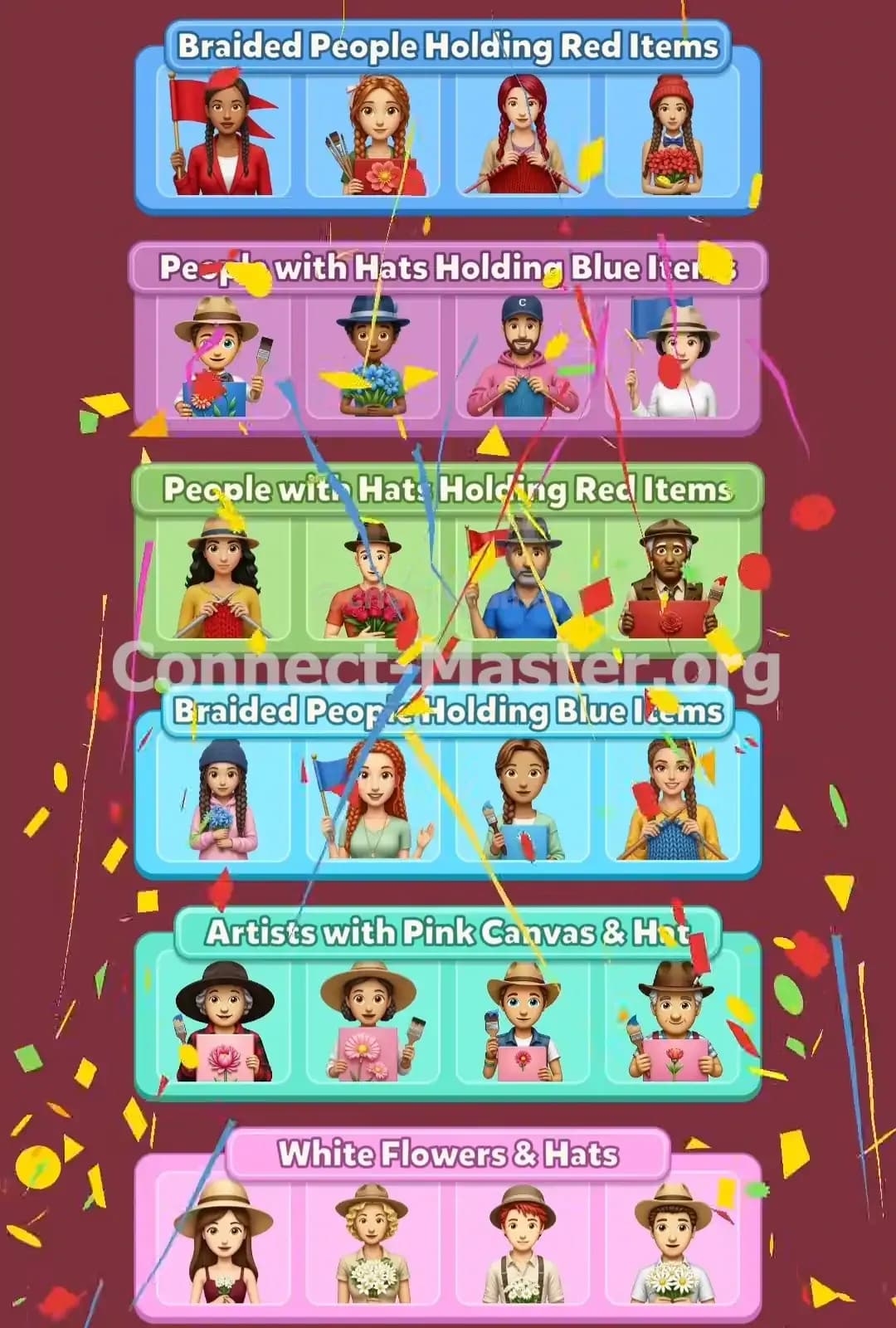
Connect Master Level 1530 uses a character-and-prop theme rather than a simple object-only arrangement. You’ll see people wearing different kinds of hats, several braided characters, artists, flowers, flags, paintbrushes, knitting, and colored items. The board contains six sets of four tiles, so every one of the 24 tiles must be assigned once.
The difficulty comes from overlapping visual traits. A character may have a hat and hold something red, while another may have braids and also appear to be an artist. In Connect Master 1530, the broad trait is rarely enough by itself; you need to combine the person’s hairstyle, headwear, prop color, and activity.
The six solved categories
- Braided People Holding Red Items: Four braided characters associated with red objects, including red flags, red flowers, or red-colored craft items.
- People with Hats Holding Blue Items: Four hatted characters holding or displaying blue objects, such as blue flowers, blue fabric, or blue props.
- People with Hats Holding Red Items: Four hatted characters whose key matching feature is a red object rather than a blue one.
- Braided People Holding Blue Items: Four braided characters connected to blue objects. This is separate from the red braided group, even when the hairstyles look nearly identical.
- Artists with Pink Canvases & Hats: Four painters wearing hats and holding pink canvases decorated with flower artwork.
- White Flowers & Hats: Four hatted characters holding or wearing white flowers, with the flowers—not the clothing color—providing the important connection.
Why Connect Master Level 1530 Feels So Tricky
The most confusing set
The hardest group in Connect Master Level 1530 is usually Braided People Holding Blue Items. Braids are easy to spot, but the blue detail is less visually dominant than the bright red props elsewhere on the board. One character can look as though she belongs with the red braided people simply because her clothing contains warm colors, while another may appear to be an artist because she is holding a brush-like object.
The trick is to inspect the item in the character’s hands instead of judging the whole tile by its strongest color. Once you isolate the braided characters, divide them by the color of the held item. That reveals the blue braided set and prevents you from borrowing a tile from Braided People Holding Red Items.
Small overlaps that cause wrong guesses
The first overlap is between People with Hats Holding Blue Items and People with Hats Holding Red Items. Both groups contain several obvious hats, so it’s tempting to match all hatted characters together. Don’t stop at the hat. Check the object in front of the character: blue flowers, blue fabric, or another blue prop belongs in the blue group, while red flowers, flags, or red boards belong in the red group.
The second overlap is between Braided People Holding Red Items and Braided People Holding Blue Items. The hairstyles are the shared clue, but the accessory or object color is the deciding detail. Look at the hands and chest area, where the held item is easiest to identify. A red flower or red craft piece stays with the red braided category even if the character’s outfit includes blue.
The third overlap involves Artists with Pink Canvases & Hats and White Flowers & Hats. Both sets feature hats, and several tiles show flowers. The artists are holding clearly pink rectangular canvases, often with a painted flower in the center. The white-flower characters are holding bouquets or wearing white blossoms directly, without the same pink canvas. That rectangular canvas shape is the fastest way to separate them.
My pattern-recognition moment
I found Connect Master 1530 much easier once I stopped treating “hat” or “braids” as complete categories. At first, I wanted to group every hat together, but that created an awkward leftover group immediately. The “I finally saw it!” moment came when I used two-part labels: hairstyle plus item color, or hat plus item color. Those combinations make the board far more structured.
Step-by-Step Solution for Connect Master 1530
Opening: lock in the obvious artists and flowers
Start with Artists with Pink Canvases & Hats. These four tiles are the cleanest group because each character wears a hat, holds a pink canvas, and displays flower artwork. The pink rectangle is a stronger clue than the individual hat styles, so lock these four together first.
Next, identify White Flowers & Hats. Look for the four hatted characters whose main shared feature is a cluster of white flowers. Some may have different hair colors or clothing styles, but the white bouquet or floral decoration remains consistent. Removing these eight tiles greatly reduces the number of hats left on the board.
At this stage, don’t try to solve every character with a hat at once. First remove the two groups with the most distinctive objects: pink canvases and white flowers.
Mid-game: separate the hat-and-color groups
With the artist and white-flower tiles out of the way, compare the remaining hatted characters. Divide them into People with Hats Holding Blue Items and People with Hats Holding Red Items.
For the blue set, inspect the actual prop rather than the background or shirt. Blue flowers, blue flags, blue fabric, and other blue-held objects are the useful evidence. For the red set, focus on red flags, red flowers, red books, or other clearly red items. A red shirt does not automatically qualify a tile for the red category, and a blue background does not automatically qualify one for the blue category.
Before committing, count four tiles in each group. If one category has five possible candidates, one of them is probably an artist, a braided character, or a decoy selected by clothing color instead of prop color.
End-game: resolve the two braided categories
The final two groups are Braided People Holding Red Items and Braided People Holding Blue Items. Start by gathering every character with clearly visible braids. Then inspect the object each one is holding or presenting.
Place the red-associated characters into Braided People Holding Red Items. The visible red flag, bouquet, yarn, or flower arrangement is the deciding trait. Place the remaining braided characters with blue props into Braided People Holding Blue Items. The blue item may be smaller or partly covered by the character, so zoom in mentally on the hands, torso, and object edges.
If you’re left with three tiles in one braided group and five in the other, pause before guessing. One tile probably looked braided because of long hair or a decorative strand, but doesn’t actually share the hairstyle. Likewise, a character can hold a multicolored object; use the dominant category color shown by the solution pattern rather than a tiny secondary accent.
The Logic Behind This Connect Master Level 1530 Solution
Move from broad traits to specific details
The reliable method for Connect Master Level 1530 is to solve from the most distinctive visual combinations to the least obvious ones. “Hat” is too broad because it appears in several sets. “Hat plus pink canvas” is specific enough to guarantee the artist group. In the same way, “braids” alone is incomplete, while “braids plus red item” identifies one exact category.
This approach systematically reduces confusion. First remove the unmistakable canvas and flower groups. Then separate the remaining hats by prop color. Finally, divide the braided characters by the color of their held objects. Because every tile must belong to exactly one set, each confirmed group makes the remaining choices clearer.
Use category names to prevent double-use
I recommend naming each group in your head exactly as you work: Braided People Holding Red Items, People with Hats Holding Blue Items, People with Hats Holding Red Items, Braided People Holding Blue Items, Artists with Pink Canvases & Hats, and White Flowers & Hats.
These labels act like checklists. When a tile seems to fit two groups, ask which full name describes it best. Does it have a pink canvas, or is it merely holding a flower? Is it braided with a blue object, or is the object actually red? Keeping the full category name prevents double-using a tempting tile and makes the complete Connect Master 1530 solution fall into place with confidence.