Connect Master Level 1476 Solution Walkthrough & Answer
How to solve Connect Master level 1476? Get instant solution & answer for Connect Master 1476.
Connect Master Level 1476 Pattern Overview
The overall theme and board structure
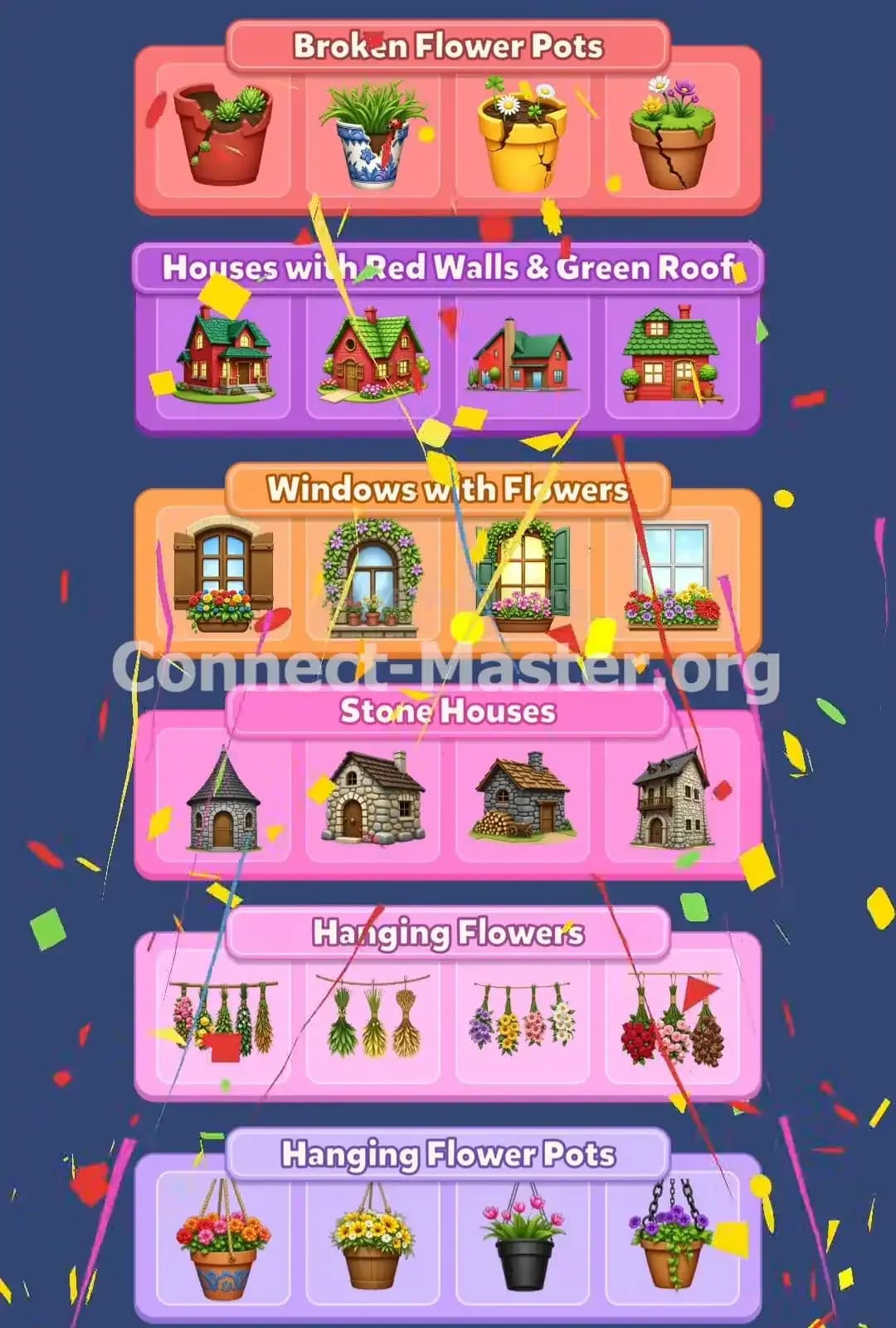
Connect Master Level 1476 uses a garden-and-cottage theme, with most tiles showing flowers, flower containers, windows, or small houses. The board contains six sets of four tiles, so every tile must be assigned to one of 24 total positions.
At first glance, the level looks like it should be solved by matching colors or flowers. That approach can be misleading, though. Several tiles contain similar blooms, green leaves, or rustic details. The safer method is to identify the main object first, then check the smaller feature that defines the category.
The six groups in Connect Master 1476 are:
- Broken Flower Pots: Four individual flower pots with visible cracks or broken sections.
- Red-Walled, Green-Roof Houses: Four house illustrations with red walls and green roofing.
- Windows with Flowers: Four window scenes decorated with flower boxes, vines, or blooms.
- Stone Houses: Four cottages whose main walls and exterior construction are made from stone.
- Hanging Flowers: Four flower arrangements suspended from horizontal rails, without being placed in ordinary pots.
- Hanging Flower Pots: Four actual containers hanging from ropes or chains.
The six categories at a glance
The Broken Flower Pots set is based on damage, not flower type. The pots use different colors and plants, but each container has a clear crack, split, or broken edge.
The Red-Walled, Green-Roof Houses set contains four homes with the same broad color combination. Details such as windows, chimneys, shrubs, and roof shapes vary, but the red exterior and green roof remain consistent.
The Windows with Flowers group is tied to the complete window scene. Each tile shows a window as the main object, with flowers placed on a sill, around the frame, or in a flower box.
The Stone Houses group is easy to recognize once you focus on the walls. These cottages are built from gray, beige, or brown stone blocks rather than painted red siding.
The Hanging Flowers group shows cut or bundled flower arrangements hanging from rails. The flowers themselves are suspended, but the key is that they are not displayed in a conventional flowerpot.
Finally, Hanging Flower Pots includes four separate planters suspended by cords, ropes, or metal chains. The container is the defining feature, even when the flowers look similar to those in another group.
Why Connect Master Level 1476 Feels So Tricky
The most confusing group
The most confusing category in Connect Master Level 1476 is Hanging Flowers. Many players instinctively group every suspended floral object together, but the level separates hanging bouquets from hanging planters.
The four Hanging Flowers tiles show bunches of flowers or foliage attached to a rail. They may have tied stems, but they do not have a substantial pot holding soil. By contrast, every tile in Hanging Flower Pots has a visible container beneath the plant. Some use ropes, while others use dark chains, but all clearly function as planters.
This distinction is easy to overlook because both groups contain dangling flowers and green leaves. Look below the blooms before selecting anything: if you can see a pot or planter body, it belongs to Hanging Flower Pots.
Subtle overlaps to watch for
The first overlap is between Broken Flower Pots and Hanging Flower Pots. Both groups contain pots filled with flowers, and some of the colors repeat. The deciding detail is whether the pot is damaged or suspended. A cracked container sitting by itself belongs to Broken Flower Pots; a healthy planter hanging from ropes or chains belongs to Hanging Flower Pots.
The second overlap is between Windows with Flowers and Red-Walled, Green-Roof Houses. A few house tiles include bright windows and surrounding plants, which can make them look like enlarged window scenes. Check the whole silhouette. If the tile shows an entire building with a roof, door, and walls, it belongs to Red-Walled, Green-Roof Houses. If the window is the central object and there is no complete house, use Windows with Flowers.
The third overlap is between Red-Walled, Green-Roof Houses and Stone Houses. Both sets show small cottages with doors, roofs, chimneys, and garden decorations. Ignore the flowers around the entrance and inspect the wall texture. Painted red walls with green shingles belong to Red-Walled, Green-Roof Houses. Block-like masonry, gray stones, or pale stone walls belong to Stone Houses.
My pattern-recognition moment
I found Connect Master 1476 much easier once I stopped treating the flowers as the primary clue. My first reaction was to compare petal colors, but that created too many false matches. The “I finally saw it” moment came when I separated Hanging Flowers from Hanging Flower Pots by looking for the container rather than the blossoms.
Step-by-Step Solution for Connect Master Level 1476
Opening: lock in the clearest sets first
Start with Stone Houses. The stone walls are visually stronger than the smaller details, so these four tiles can usually be removed with confidence. Do not worry if the roofs or gardens differ; the masonry is the important trait.
Next, identify Red-Walled, Green-Roof Houses. Compare the remaining house-shaped tiles and choose the four with red exterior walls and green roofs. A red wall is more important than a matching door, window, or shrub. Lock this group only after checking that each candidate has the green roof as well.
Now look for Windows with Flowers. These four tiles should show windows as standalone architectural features, often with flower boxes or vines around them. Removing the two house groups first makes this category much safer because complete cottages are no longer competing for attention.
Mid-game: separate the flower containers
With the buildings and windows removed, focus on the remaining floral objects. Find the four tiles in Broken Flower Pots by scanning for cracks, missing sections, or visibly split pottery. The flowers and pot colors do not need to match. The shared trait is the damaged container.
At this stage, avoid grouping a tile merely because it has a bright flower color similar to another tile. A yellow bloom, red bloom, or purple bloom can appear in several categories. Instead, ask whether the tile shows a cracked pot, a hanging container, or flowers suspended directly from a rail.
End-game: solve the two hanging groups
The last two categories are Hanging Flowers and Hanging Flower Pots. Separate them physically in your mind before selecting four.
For Hanging Flowers, choose the four rail displays where the flowers or leafy bundles hang directly from the support. There should be no obvious planter body below the stems. These arrangements may look like bunches, garlands, or tied floral clusters.
For Hanging Flower Pots, select the four tiles with visible pots suspended by ropes or chains. One planter may be a simple dark container, while another may be more decorative, so do not require matching shapes. The exact trait is “flower pot hanging from a support,” not a particular flower species.
If one tile seems to fit both categories, inspect the lower half first. The presence of a container resolves the ambiguity immediately.
The Logic Behind This Connect Master Level 1476 Solution
Move from broad traits to specific details
The cleanest way to solve Connect Master Level 1476 is to work from large visual structures toward small distinguishing marks. Entire stone buildings are broader and easier to identify than individual flowers, so Stone Houses should be considered before the hanging arrangements.
After removing obvious groups, the remaining board becomes less crowded. You can then use more specific traits: red walls plus green roofs, standalone windows, cracked pottery, or suspended containers. This progression reduces the number of possible matches after every successful set.
The one-and-only-one rule also helps. If a tile seems to fit two categories, that usually means you have not yet found the more precise defining feature. Check the object’s construction, not just its decoration.
Use category names to keep your thinking organized
I recommend naming each set in your head before committing: Broken Flower Pots, Red-Walled, Green-Roof Houses, Windows with Flowers, Stone Houses, Hanging Flowers, and Hanging Flower Pots.
These labels prevent you from reusing the same tile mentally. For example, once you decide a tile belongs to Hanging Flower Pots, you can stop comparing it with Hanging Flowers. The category names also keep you focused on the real trait, whether that is wall material, roof color, window structure, damage, or suspension method.
That systematic approach makes Connect Master Level 1476 feel less like guessing and more like sorting evidence. Once all six named groups are accounted for, every tile has a clear home and the level is solved.