Connect Master Level 1432 Solution Walkthrough & Answer
How to solve Connect Master level 1432? Get instant solution & answer for Connect Master 1432.
Connect Master Level 1432 Pattern Overview
The overall theme and six groups
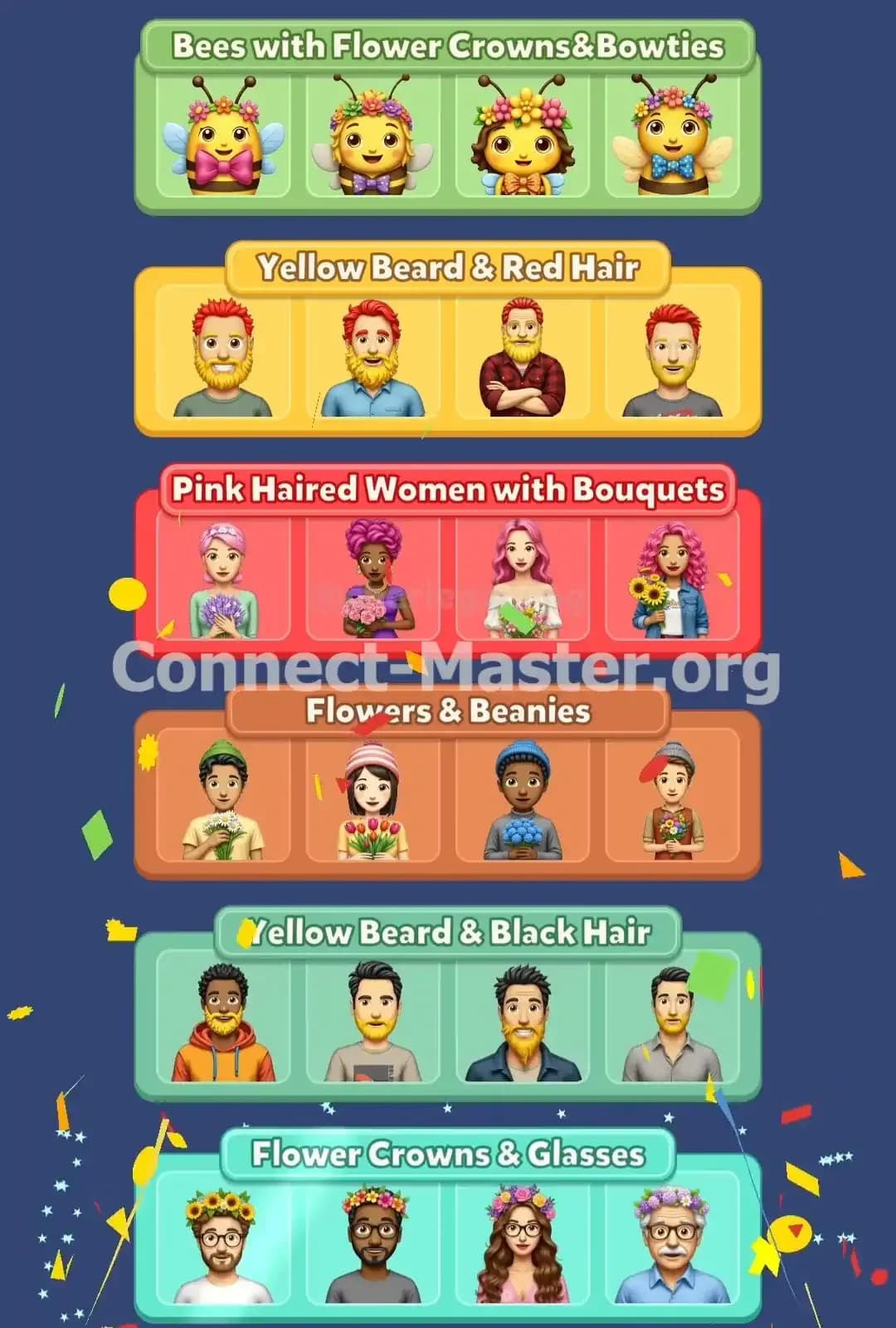
Connect Master Level 1432 uses a colorful character-and-flower theme. The board contains 24 tiles divided into six correct sets of four. Most tiles show people or friendly cartoon characters, while the main clues come from hair color, beard color, flowers, glasses, hats, wings, and bowties.
The level is designed around overlapping visual traits. Several characters hold flowers, several wear flower crowns, and multiple men have yellow beards. You’ll need to separate the broad clues from the exact combinations.
The six solution sets
- Bees with Flower Crowns & Bowties: Four bee characters wearing flower crowns and bowties. Their wings and antennae are the strongest identifying details.
- Yellow-Bearded Red-Haired Men: Four men with red hair and yellow or golden beards. Their shirts and poses vary, but the hair-and-beard combination stays consistent.
- Pink-Haired Women with Bouquets: Four women with pink or pinkish hair who are holding bouquets or bunches of flowers.
- Flowers & Beanies: Four characters wearing beanies while holding flowers. The hats come in different colors, so focus on the beanie and flower combination rather than appearance.
- Yellow-Bearded Black-Haired Men: Four men with dark or black hair and yellow beards. This group is especially easy to confuse with Yellow-Bearded Red-Haired Men.
- Flower Crowns & Glasses: Four people wearing flower crowns and glasses. Their hairstyles, ages, and clothing differ, but the crown-and-eyewear pairing is shared.
Why Connect Master Level 1432 Feels So Tricky
The most confusing set
The hardest group in Connect Master 1432 is usually Yellow-Bearded Black-Haired Men. At a quick glance, these men resemble the red-haired, yellow-bearded characters, and the facial hair is much more noticeable than the hair color. Because every man in both groups has a golden beard, it’s easy to grab four bearded tiles and assume you’re done.
The key is to inspect the hair above the forehead and around the sides of the head. The black-haired men have clearly dark hair, while the red-haired group has copper, orange, or bright red hair. Don’t let clothing color, pose, or beard length override that detail.
Subtle overlaps to watch for
The first major overlap is between Yellow-Bearded Red-Haired Men and Yellow-Bearded Black-Haired Men. The shared yellow beard is only a secondary clue. Sort these tiles by head hair first, then confirm that all four have the same beard color.
The second overlap is between Bees with Flower Crowns & Bowties and Flower Crowns & Glasses. Both groups wear decorative flower crowns, and the crowns can be visually prominent. The bee set has antennae, wings, and bowties, whereas the glasses set consists of human characters with visible eyewear. If you see wings or antennae, keep that tile with the bees immediately.
The third overlap involves Pink-Haired Women with Bouquets and Flowers & Beanies. Both sets include flowers and colorful characters, and some of the pink-haired women can look like general flower holders. Check the headwear carefully: the beanie group has knitted or winter-style caps, while the pink-haired group is defined by pink hair plus a bouquet. A flower crown is not the same thing as a beanie.
My reaction to the level
I found Connect Master 1432 deceptively difficult because the board repeats the same visual language—flowers, bright colors, and friendly faces—across several categories. The “I finally saw it” moment came when I stopped treating yellow beards as a complete group clue. Once I separated the men by red versus black hair, the remaining sets became much easier to verify.
Step-by-Step Solution for Connect Master 1432
Opening: lock in the obvious set
Start with Bees with Flower Crowns & Bowties. This is the cleanest group in Connect Master 1432 because the bee characters have multiple exclusive clues: antennae, wings, flower crowns, and bowties. Select those four first. Removing them clears away the most visually distinctive tiles and prevents the flower crowns from distracting you later.
Next, look for Pink-Haired Women with Bouquets. Identify the women whose hair is distinctly pink or rose-colored and confirm that each one is holding flowers. Don’t include a woman merely because she has a colorful outfit; the bouquet is essential to this category.
After those two groups are removed, the board should feel less crowded. You’ll have mostly men, beanie wearers, and people with glasses or flower crowns.
Mid-game: sort by combinations, not single traits
Now build Flowers & Beanies. Find the four characters wearing knitted or winter-style hats and holding flowers. The flowers may differ in color and shape, and the beanies are not identical, so use the combination of both clues. A tile with flowers but no beanie belongs elsewhere.
Then identify Flower Crowns & Glasses. Look closely at the eyes and bridge of the nose, since the glasses can be small. Every tile in this set has a decorative flower crown and visible glasses. Some characters may have darker hair, gray hair, or different clothing, but those details are not the category’s focus.
At this stage, avoid moving a tile into a set just because it shares one attractive feature. A flower crown alone is insufficient, and holding flowers alone is insufficient. Connect Master 1432 rewards exact four-tile relationships, so require at least two confirming details whenever possible.
End-game: separate the two beard groups
The final eight tiles form Yellow-Bearded Red-Haired Men and Yellow-Bearded Black-Haired Men. First place every remaining man into a temporary hair-color column. Put red, copper, or orange-haired characters together, and place black or very dark-haired characters in the other column.
Once you have four red-haired men, verify that each also has a yellow beard. That completes Yellow-Bearded Red-Haired Men. The remaining four should be the dark-haired men with matching yellow beards, completing Yellow-Bearded Black-Haired Men.
Pay attention to gray or shadowed hair, especially on the character with shorter hair. Compare the eyebrows, sideburns, and hairline rather than relying on the brightest section of the hairstyle. If one tile seems uncertain, leave it aside and compare the other seven; the correct grouping often becomes obvious through elimination.
The Logic Behind This Connect Master Level 1432 Solution
Move from broad clues to specific details
The reliable method for Connect Master 1432 is to begin with traits that are difficult to mistake, then move toward finer distinctions. Bees with wings and antennae are more obvious than hair color, so solve that set first. Next use combined clues such as pink hair plus bouquets or beanies plus flowers.
After the obvious groups are gone, inspect small features: glasses around the eyes, the texture of a knitted hat, the exact color of hair, and the difference between a flower crown and a regular hat. This progression reduces the number of possible matches after every successful set.
Because every tile belongs to one and only one group, each confirmed set also acts as a process-of-elimination tool. If a flower-holding character does not have pink hair and does not wear a beanie, it likely belongs to neither flower group still under consideration.
Use category names to keep the board organized
I recommend naming the groups in your head before selecting anything: Bees with Flower Crowns & Bowties, Yellow-Bearded Red-Haired Men, Pink-Haired Women with Bouquets, Flowers & Beanies, Yellow-Bearded Black-Haired Men, and Flower Crowns & Glasses.
These labels keep you from using the same tile twice mentally. They also help you ask precise questions: “Is this a flower crown and glasses tile?” or “Is this red hair with a yellow beard?” rather than simply asking whether a character looks colorful or has flowers. With those six categories fixed, the full Connect Master Level 1432 solution follows a clear path from distinctive characters to subtle hair-color distinctions.