Connect Master Level 1353 Solution Walkthrough & Answer
How to solve Connect Master level 1353? Get instant solution & answer for Connect Master 1353.
Connect Master Level 1353 Pattern Overview
The overall theme and board layout
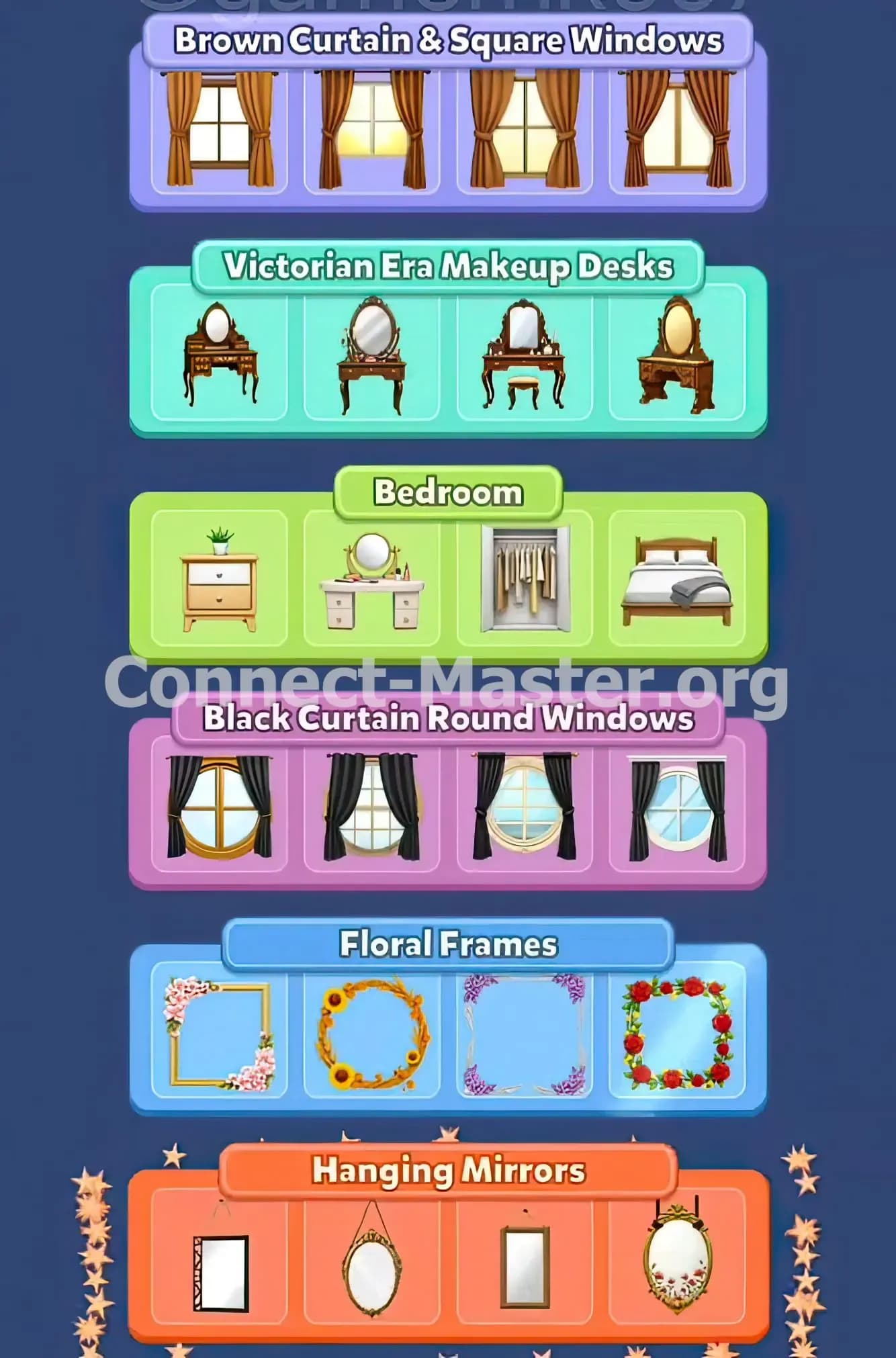
Connect Master Level 1353 uses a home-decor and interior-design theme, with tiles showing windows, dressing furniture, bedroom furnishings, picture frames, and mirrors. There are six sets of four tiles, so the key is to sort all 24 tiles without allowing one attractive decoy to pull a tile away from its true group.
The board mixes complete furniture collections with visual categories. Some sets are defined by what an object is, such as bedroom furniture, while others depend on matching design details, such as curtain color, window shape, or floral decoration. That combination is what makes Connect Master 1353 more demanding than a simple object-matching puzzle.
The six matching sets
- Brown Curtain & Square Windows: Four windows with brown curtains and clearly square or rectangular window panes.
- Victorian Era Makeup Desks: Four ornate dressing tables or vanities with mirrors, decorative legs, and old-fashioned styling.
- Bedroom: A bed, wardrobe, dresser, and modern bedroom vanity.
- Black Curtain Round Windows: Four rounded or circular windows surrounded by black curtains.
- Floral Frames: Four empty picture frames decorated with flowers, leaves, or botanical borders.
- Hanging Mirrors: Four standalone wall mirrors, each with its own hanging frame or suspension detail.
These category names are useful because they describe the exact logic rather than relying only on the color of each row. Keep them in mind as you scan Connect Master Level 1353.
Why Connect Master Level 1353 Feels So Tricky
The most confusing set: Victorian Era Makeup Desks
The Victorian Era Makeup Desks set is the easiest one to overlook. All four tiles show furniture with mirrors, but they don’t look identical. One desk is narrow and dark, another has a broad oval mirror, one includes a small matching stool, and another looks heavier and more cabinet-like.
That variety can make you wonder whether these tiles belong with the Bedroom set instead. The important clue is that each Victorian piece is a dedicated vanity or dressing table. They have ornate legs, carved trim, attached mirrors, or visible makeup-table styling. The bedroom vanity, by contrast, is more modern and belongs with the bed, dresser, and wardrobe.
Subtle overlaps to watch closely
The first overlap is between the two window groups. Both Brown Curtain & Square Windows and Black Curtain Round Windows contain curtains and panes, so color alone isn’t enough if you’re looking quickly. Check the curtain fabric first: brown drapes belong to the square-window set, while black drapes belong to the round-window set. Then confirm the window outline. A rounded frame should never be placed with the square windows, even if its panes look somewhat rectangular inside.
The second overlap involves the two mirror categories. The Victorian Era Makeup Desks group contains mirrors, but those mirrors are attached to furniture. The Hanging Mirrors group contains mirrors intended to stand alone on a wall. Look for a tabletop, drawers, legs, or a vanity base before assigning a mirror tile. If the mirror has no desk underneath and instead has a visible hanging loop, cord, or wall-mount design, it belongs in Hanging Mirrors.
The third overlap is between Floral Frames and Hanging Mirrors. Several floral tiles have ornate borders and could initially resemble decorative mirrors. The difference is the center: Floral Frames are empty frame openings with a blue background, while the Hanging Mirrors have reflective white centers. The floral decoration is secondary; the object type is the deciding clue.
My pattern-recognition moment
I found Connect Master 1353 much easier once I stopped treating every mirror-shaped object as part of one category. The “aha” moment came from separating furniture-mounted mirrors from wall mirrors, then noticing that the floral items were frames rather than reflective surfaces. After that, the window groups became almost automatic.
Step-by-Step Solution for Connect Master Level 1353
Opening: lock in the clearest categories
Start Connect Master Level 1353 by identifying the most obvious object-based set: Bedroom. Find the bed, the wardrobe or open closet, the small dresser, and the contemporary vanity. These four pieces clearly belong to a bedroom collection, even though the vanity also has a mirror.
Removing those tiles immediately reduces the number of possible distractions. Next, collect Floral Frames. Look for four decorative frame shapes with flowers, vines, or blossoms around their edges. Don’t worry about whether the flowers are pink, yellow, purple, or red; the shared trait is a floral frame design.
At this stage, you can also mark the obvious Hanging Mirrors. Choose the four standalone reflective pieces, including the simple rectangular mirrors and the more decorative oval mirror. Make sure none of them has a desk, drawers, or legs underneath.
Mid-game: separate the window designs
With the furniture and frame categories identified, focus on the eight window tiles. Divide them into two groups of four instead of trying to match them one at a time.
For Brown Curtain & Square Windows, select every tile with brown or rust-colored curtains and a square or rectangular window outline. Compare the panes carefully, since the number of internal divisions can vary. The window does not need to have the same exact grid; it needs to retain the square-window structure and brown curtain treatment.
For Black Curtain Round Windows, choose the four windows with dark black curtains and a rounded, circular, or arched window shape. Some may have a golden frame, while others have pale blue glass or several internal panes. Those differences are harmless. The black curtains and rounded window silhouette are the reliable combination.
Avoid grouping windows by glass color. Blue, white, and bright glass appear in more than one design, so using color as the main clue can create a false set. Always compare curtain color and outer shape together.
End-game: finish the tricky furniture group
The final remaining tiles should form Victorian Era Makeup Desks. Confirm that each one is a vanity rather than a general bedroom item. Look for an attached oval or rounded mirror, ornate wooden construction, small drawers, curved legs, carved trim, or an accompanying stool.
This is where process of elimination helps, but don’t rely on elimination alone. A tile should fit because it is a vintage makeup desk, not merely because it happens to contain a mirror. If a piece has a freestanding mirror with no tabletop, move it to Hanging Mirrors. If it is a simple modern desk with a clean white design, it belongs in Bedroom.
Once four Victorian vanities are together, the six categories account for every tile and Connect Master Level 1353 should be solved.
The Logic Behind This Connect Master Level 1353 Solution
Move from broad traits to precise details
The safest method is to begin with large, unmistakable traits and then work toward small design details. Objects such as beds, wardrobes, floral frames, and standalone mirrors are easier to recognize than the similar-looking vanities. Locking them first removes the strongest decoys from the board.
Next, use paired traits. For the windows, “brown curtains plus square shape” is stronger than either clue by itself. Likewise, “black curtains plus round shape” prevents a pale or unusual window from being misclassified. Combining two details makes the category more reliable.
Finally, inspect construction details. Attached mirrors, desk legs, drawer placement, hanging hardware, and reflective versus empty centers resolve the last uncertain tiles. This broad-to-specific process guarantees that every tile has one clear destination.
Name each set to keep the board organized
Using short labels makes the logic much easier to manage. In your head, call the groups Bedroom, Floral Frames, Hanging Mirrors, Victorian Era Makeup Desks, Brown Curtain & Square Windows, and Black Curtain Round Windows.
When you consider a tile, ask which label describes its strongest trait. Then mentally mark that tile as used. This prevents you from borrowing the same mirror for two categories or chasing a weak color match. By the end, every tile in Connect Master 1353 should be accounted for exactly once, with four tiles under each category name.