Connect Master Level 1615 Solution Walkthrough & Answer
How to solve Connect Master level 1615? Get instant solution & answer for Connect Master 1615.
Connect Master Level 1615 Pattern Overview
The overall theme and board structure
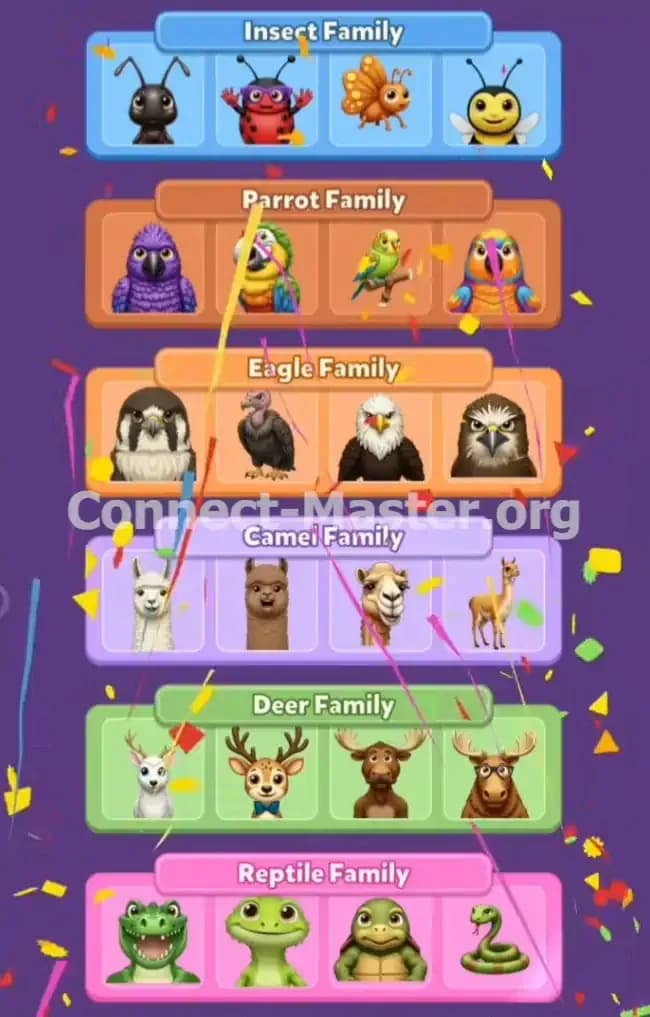
Connect Master Level 1615 is built around recognizable animal families. The board contains six sets of four tiles, creating a total of 24 animals. Instead of mixing unrelated objects, this level asks you to sort insects, parrots, birds of prey, camel relatives, deer relatives, and reptiles or amphibious-looking creatures.
The good news is that most groups have a strong visual identity. The challenge comes from comparing similar animals within the same broad type. Several birds have comparable beaks and feathers, while the hoofed animals can blend together at first glance. Connect Master 1615 rewards careful observation more than fast tapping, so take a moment to inspect body shape, facial details, horns, wings, and color patterns.
The six groups in Connect Master 1615
- Insect Family: The black ant, red ladybug, orange butterfly, and yellow bee all share the defining trait of being insects. Their body shapes and accessories differ, but wings, antennae, and segmented forms point toward this set.
- Parrot Family: The purple parrot, green-and-yellow parrot, small green budgerigar, and brightly colored macaw are all parrots. Their curved beaks and colorful plumage make this group identifiable.
- Eagle Family: The dark eagle, gray bird of prey, bald eagle, and stern brown raptor form the Eagle Family. Look for hooked beaks, powerful bodies, and the serious expressions common to predatory birds.
- Camel Family: The white llama, brown camel-like animal, decorated camel, and tall one-humped camel belong together as camel relatives. Their long necks, narrow faces, and distinctive humps or wool are the important clues.
- Deer Family: The white deer, bow-wearing fawn, dark antlered deer, and large moose-like animal make up the Deer Family. Antlers, hooves, and long deer-shaped faces separate them from the camel group.
- Reptile Family: The crocodile, green frog, turtle, and snake are grouped together as the Reptile Family in this puzzle’s visual classification. Their low-to-the-ground bodies, scales, smooth green coloring, shells, or long forms make them easy to distinguish from mammals and birds.
Why Connect Master Level 1615 Feels So Tricky
The most confusing set: Camel Family
The Camel Family is the group players are most likely to overlook. The white llama looks more like a generic farm animal, the furry brown animal can resemble a bear at a quick glance, and the decorated camel may draw attention to its colorful accessories instead of its body shape. The tall camel is the clearest member, but the other three need closer inspection.
Focus on the head and neck rather than the colors. All four have elongated faces and a camelid silhouette. The llama has wool, the middle animal has a compact camelid face, the decorated animal has the characteristic long muzzle, and the tall animal has the familiar raised neck and hump. Once you recognize those shared proportions, the set becomes much easier.
Subtle overlaps to watch for
The first overlap is between Parrot Family and Eagle Family. Both groups contain birds with large beaks, feathers, and upright poses. To separate them, check the beak shape and coloring. Parrots have curved, heavier beaks and bright or highly varied plumage. The Eagle Family birds look more powerful and subdued, with hooked predatory beaks and darker brown, gray, black, or white feathers.
A second overlap appears between Camel Family and Deer Family. Both sets contain four-legged animals with long faces, so you might be tempted to move the llama or camel into the deer group. The decisive detail is the head equipment and body shape. Deer Family tiles show antlers, small deer ears, or a clearly deer-like forehead. Camel Family tiles instead show wool, humps, long necks, or camelid facial features.
The third overlap is inside the Reptile Family. A crocodile, frog, turtle, and snake do not look as closely related as the other sets. Their connection is a broader visual animal category based on scaly, low-slung, pond, or crawling creatures. Don’t reject the frog simply because it lacks scales; in Connect Master Level 1615, it belongs with the other green, ground-level animals rather than with insects or mammals.
My pattern-recognition moment
I found the level fairly manageable after spotting the six broad families, but the Camel Family took the most attention. The “I finally saw it!” moment came when I stopped comparing colors and started comparing silhouettes. The long muzzle and neck shape linked the animals immediately. That shift—from surface color to body structure—is the key to Connect Master 1615.
Step-by-Step Solution for Connect Master Level 1615
Opening: lock in the obvious families
Begin with Insect Family. The ant, ladybug, butterfly, and bee are visually distinct from everything else, and there’s little risk of using a tile incorrectly. Removing these four clears space and confirms that the board is organized around broad animal categories.
Next, identify Parrot Family. Look for the four colorful birds with curved parrot beaks. The purple parrot and vivid macaw are especially clear, while the smaller green bird and green-yellow parrot complete the group. Lock all four together rather than pairing one with the darker birds of prey.
After that, select Eagle Family. Compare the remaining birds by beak and expression. The four raptor-like tiles have heavier bodies and sharper, hooked beaks. Their muted feathers also contrast strongly with the bright parrots.
Mid-game: separate the hoofed animals
Once the insects and birds are removed, focus on the eight mammal tiles. Split them into Camel Family and Deer Family by checking for antlers versus camelid features.
Place the white deer, blue-bow fawn, dark antlered animal, and large moose-like animal into Deer Family. The antlers are the strongest clue, but even the smaller fawn has a clearly deer-shaped face and body.
Then collect the white llama, brown camelid, decorated camel, and tall camel for Camel Family. Avoid sorting by coat color because the animals vary from white to brown and may look unrelated. Instead, compare their narrow muzzles, long necks, woolly coats, and hump-like profiles.
End-game: finish with Reptile Family
The final four should be Reptile Family: crocodile, frog, turtle, and snake. This group can feel unusual because it combines animals with different body plans. Use elimination, but verify the visual theme before committing. The crocodile has a broad toothy jaw, the frog has a rounded green body, the turtle has a shell, and the snake has a long coiled form.
Keep these four separate from the insects by looking at legs and body construction. The frog and crocodile are not winged or antennaed, and the snake and turtle clearly have no insect-like segmentation. Once the four bird groups and two mammal groups are locked, this last category is the only complete set remaining.
The Logic Behind This Connect Master Level 1615 Solution
Move from broad traits to specific details
The safest method in Connect Master 1615 is to begin with large, unmistakable traits. Insects have antennae and tiny segmented bodies; parrots have vivid feathers and curved beaks; eagles have hooked beaks and predatory builds. These obvious sets reduce the board quickly.
Then move to smaller details. Antlers separate Deer Family from Camel Family, while long necks and camelid faces identify the camel relatives. Finally, use the unusual shared category of green, crawling, swimming, or low-slung animals to complete Reptile Family. This progression prevents you from forcing a weak match too early.
Use names to prevent double-use mistakes
Naming each set in your head keeps the puzzle organized. Think “Insect Family,” “Parrot Family,” “Eagle Family,” “Camel Family,” “Deer Family,” and “Reptile Family” as you inspect the tiles. When a tile seems to fit two groups, ask which category needs it more and whether the other three members share the same defining trait.
This mental labeling also guarantees that every tile belongs to one group only. If removing a tile leaves a set with only three convincing members, pause and reconsider. By checking the board as six complete groups of four, you can solve Connect Master Level 1615 methodically instead of relying on guesses.