Connect Master Level 1484 Solution Walkthrough & Answer
How to solve Connect Master level 1484? Get instant solution & answer for Connect Master 1484.
Connect Master Level 1484 Pattern Overview
The overall theme and board structure
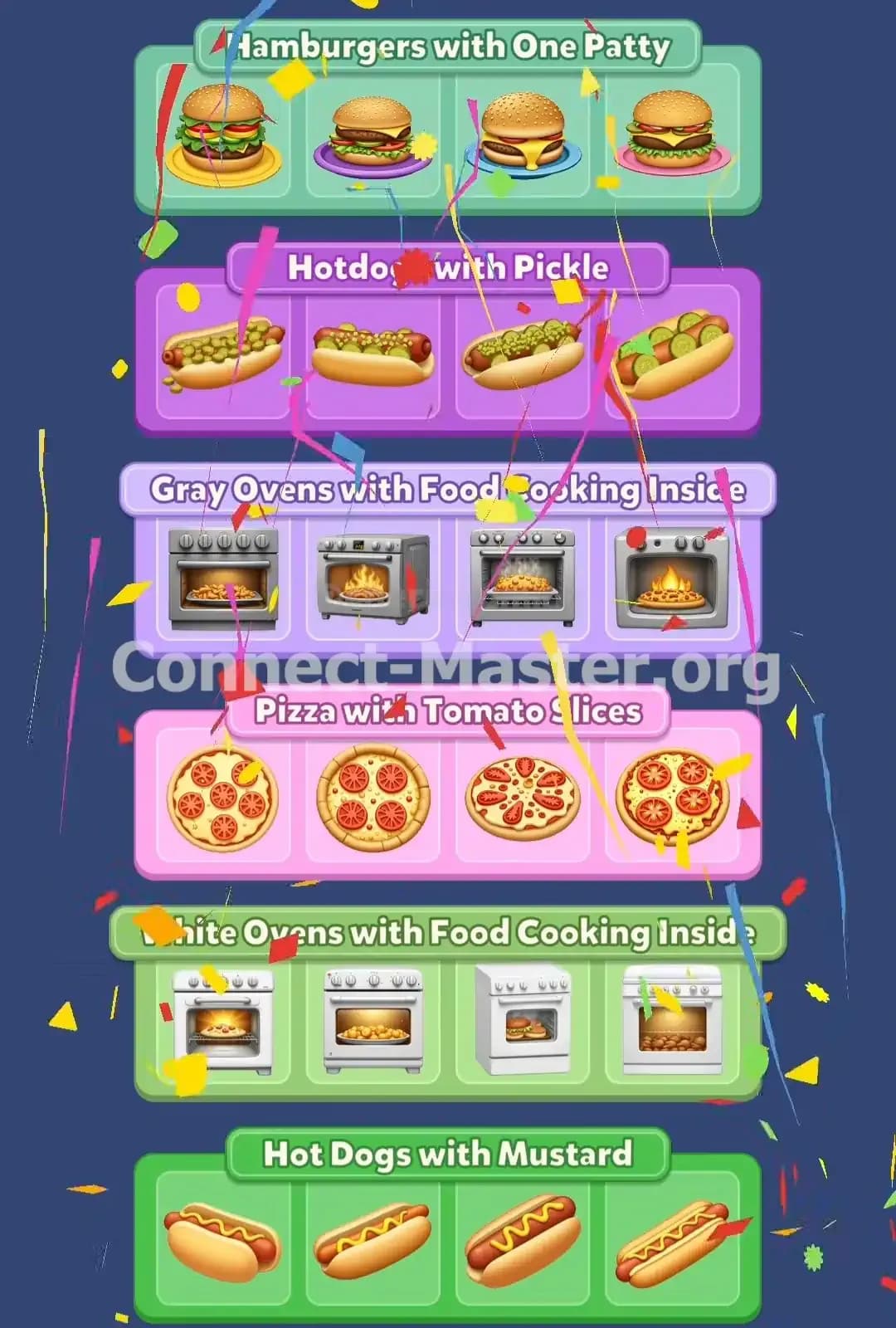
Connect Master Level 1484 is built around food and kitchen objects, with six complete groups of four tiles. The board mixes hamburgers, hot dogs, pizzas, and ovens, so the challenge comes from separating similar-looking food tiles and distinguishing oven colors before the visual details blur together.
The six sets in Connect Master 1484 are:
- Hamburgers with One Patty: Four burgers that each contain a single visible patty, despite differences in toppings, cheese, sauces, and plate colors.
- Hot Dogs with Pickle: Four hot dogs topped with green pickle pieces or pickle relish.
- Gray Ovens with Food Cooking Inside: Four gray or metallic ovens, each showing food cooking behind the open or visible oven door.
- Pizza with Tomato Slices: Four pizzas decorated with recognizable round tomato slices.
- White Ovens with Food Cooking Inside: Four white ovens containing food, separated from the gray group by the appliance color and design.
- Hot Dogs with Mustard: Four hot dogs marked by a yellow mustard zigzag across the sausage.
Every tile belongs to one of these six categories, so there are no spare pieces to ignore. The safest approach is to identify the clearest topping or color trait first, then use the remaining tiles to confirm the less obvious groups.
Why Connect Master Level 1484 Feels So Tricky
The most confusing group: the oven sets
The two oven categories are the biggest trap in Connect Master Level 1484. Both groups show ovens with food cooking inside, and the contents can look more noticeable than the appliance itself. If you focus on whether an oven contains pizza, bread, fries, or another dish, you may accidentally mix the sets.
The correct distinction is much simpler: Gray Ovens with Food Cooking Inside contain gray or silver appliances, while White Ovens with Food Cooking Inside contain white appliances. Treat the food as confirmation only. The oven’s outer casing, front panel, and overall body color are the details that decide the group.
Subtle overlaps between similar tiles
The two hot dog categories are another easy place to make a mistake. A pickle-topped hot dog may have a yellowish bun or sauce-colored highlights, while a mustard hot dog can also include darker toppings around the sausage. Look for the dominant topping: green pickle chunks or relish belong to Hot Dogs with Pickle, while the long, bright yellow zigzag belongs to Hot Dogs with Mustard.
The burger tiles can also appear to overlap with the other food groups because several have green toppings. Don’t classify them by color alone. The defining feature of Hamburgers with One Patty is the burger structure: bun, fillings, and one central meat patty. A burger with lettuce, cheese, or extra sauce still belongs here as long as there is only one patty.
The pizza tiles share a round shape with some food visible in the ovens, creating a third overlap. The Pizza with Tomato Slices set is identified by separate red tomato rounds placed on the pizza surface. If the pizza has a different arrangement of toppings or appears inside an appliance, don’t let the circular shape decide the category; check whether the tile is actually one of the standalone pizzas.
I found the oven split especially satisfying once I stopped studying the food inside them. The moment I compared the appliance bodies instead, the board became much more manageable. It’s one of those “I finally saw it!” patterns where the background object matters more than the obvious contents.
Step-by-Step Solution for Connect Master Level 1484
Opening: lock in the clearest food toppings
Start Connect Master Level 1484 by finding the four hot dogs with unmistakable yellow mustard lines. These tiles usually stand out because the topping forms a long, repeated zigzag from one end of the sausage to the other. Mark them mentally as Hot Dogs with Mustard and avoid using any of those tiles while testing the pickle group.
Next, locate the four pizzas with visible round tomato slices. The tomatoes appear as red circular pieces, often with a lighter center or seed-like detail. Put these aside as Pizza with Tomato Slices. This is a strong early group because the tile shape, crust, and tomato decoration work together to make the category clear.
Then identify the four burgers. Check the center of each sandwich and count the patties rather than judging the toppings. The correct group is Hamburgers with One Patty, so a burger with a different plate color or extra vegetables still qualifies if it has one meat layer. Lock this set only after checking that none of the tiles is actually a hot dog or pizza.
Mid-game: separate the oven colors
After removing the obvious hot dogs, pizzas, and burgers, the remaining tiles should primarily be ovens and pickle-topped hot dogs. This is where you need to slow down and compare the entire object instead of one small feature.
Find the four Gray Ovens with Food Cooking Inside by examining the casing around the door. Gray ovens have a silver, charcoal, or metallic appearance, even when the food inside is brightly lit. Their knobs, handles, and front panels may vary slightly, but the appliance body remains gray.
Then gather the four White Ovens with Food Cooking Inside. These appliances have a clearly white exterior and usually contrast strongly with the darker oven interiors. Don’t reject a white oven because its door window looks gray; the interior shadow is not the same as the outer casing. Compare the frame, control panel, and side edges.
A useful process-of-elimination rule is to count before committing. You need exactly four gray ovens and exactly four white ovens. If a proposed group has only three obvious members, one tile may have been borrowed from the other oven category. Recheck the body color before moving anything.
End-game: clean up the pickle hot dogs
The last difficult group in Connect Master 1484 is Hot Dogs with Pickle. Once the mustard hot dogs and ovens are removed, these should become easier to see, but don’t rely only on the green color. Look for chopped pickle pieces, relish-like texture, or green slices placed along the sausage and bun.
Keep this group separate from Hot Dogs with Mustard by tracing the topping’s shape. Mustard runs as a smooth yellow line, usually in a repeated wave. Pickle toppings look uneven, chunky, or clustered, with visible green pieces rather than one continuous stripe.
Before finalizing, scan every set again. Each category must contain four tiles, and every visual type should have a logical home. If one pickle hot dog seems uncertain, compare it with the confirmed pickle tiles rather than with the entire board. Similarity within a set is often easier to recognize than difference across all twenty-four tiles.
The Logic Behind This Connect Master Level 1484 Solution
Move from broad traits to specific details
The solution works because it progresses from the largest visual signals to the smallest ones. First, separate obvious object types: pizzas, burgers, hot dogs, and ovens. Next, divide those object types using clear traits such as mustard versus pickle or gray versus white. Finally, verify small details like one patty, round tomato slices, and chopped relish.
This method systematically reduces confusion. You’re not trying to solve all twenty-four tiles at once; you’re shrinking the number of possibilities after every confirmed group. Since Connect Master uses every tile exactly once, each correct set also makes the remaining categories easier to identify.
Use category names to prevent double use
Naming each group in your head is extremely helpful in Connect Master 1484. Think Hamburgers with One Patty, Hot Dogs with Pickle, Gray Ovens with Food Cooking Inside, Pizza with Tomato Slices, White Ovens with Food Cooking Inside, and Hot Dogs with Mustard as six labeled boxes.
When a tile seems to fit two groups, ask which label describes its defining trait more precisely. A green topping should not enter the burger group if the object is clearly a pickle hot dog, and a food-filled oven should not be assigned by its contents when its casing identifies the gray or white set. Keeping those labels active prevents double-using tiles and makes the final arrangement feel logical rather than lucky.