Connect Master Level 1545 Solution Walkthrough & Answer
How to solve Connect Master level 1545? Get instant solution & answer for Connect Master 1545.
Connect Master Level 1545 Pattern Overview
Theme, layout, and number of sets
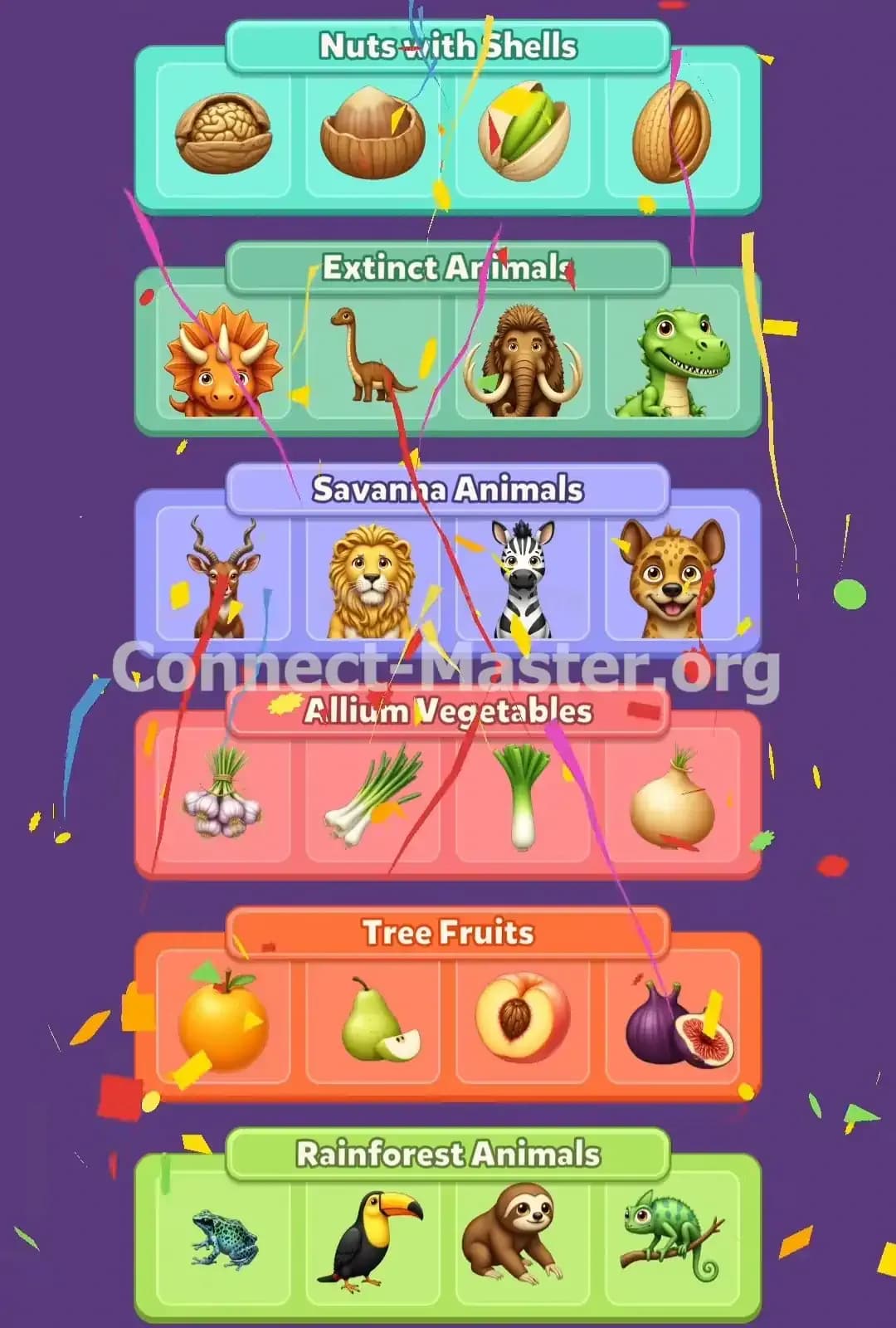
Connect Master Level 1545 uses a bright mix of food, animals, and produce. The board contains 24 tiles divided into six correct sets of four. Three groups feature animals, while the other three focus on nuts, vegetables, and fruit.
The animal tiles are separated by habitat or time period, which creates a few tempting decoys. The food tiles are also deliberately close in appearance: several are fruits, several have shells or skins, and multiple vegetables are green or bulb-shaped. The key is to look for the most specific shared trait rather than simply matching color or general appearance.
The six categories in Connect Master Level 1545
- Nuts with Shells: walnut, coconut, pistachio, and almond. Each is a nut or seed shown with a hard outer shell or husk.
- Extinct Animals: triceratops, brachiosaurus, woolly mammoth, and Tyrannosaurus rex. These are prehistoric animals that are no longer living.
- Savanna Animals: antelope, lion, zebra, and hyena. All are recognizable animals associated with African grassland habitats.
- Allium Vegetables: garlic, green onion, leek, and onion. These vegetables belong to the allium family and have a strong, distinctive flavor.
- Tree Fruits: orange, pear, peach, and fig. Each grows on a tree rather than on a low plant or vine.
- Rainforest Animals: frog, toucan, sloth, and chameleon. These animals are associated with warm, lush rainforest environments.
Why Connect Master Level 1545 Feels So Tricky
The most confusing set: Nuts with Shells
The Nuts with Shells set is the easiest one to overlook in Connect Master 1545. The four tiles don’t look alike in the same obvious way. A walnut has a ridged shell, a coconut has a large fibrous husk, a pistachio is partly open, and an almond has a narrow textured shell. If you search only for matching shapes or colors, this group seems unrelated.
The common point is that each tile shows a nut or seed protected by a hard outer covering. The coconut is the biggest decoy because many players think of it as a fruit, while the almond and pistachio may look like ordinary snack foods. Once you focus on the shell or husk, the category becomes much clearer.
Small overlaps that cause wrong matches
The first major overlap is between the Savanna Animals and Rainforest Animals groups. The lion, zebra, antelope, and hyena belong together because they are familiar African savanna animals. The frog, toucan, sloth, and chameleon form the rainforest group. A frog can live in many environments, so it may feel less specific than the lion or zebra, but the bright tropical appearance and tree-dwelling rainforest animals separate it from the grassland set.
The second overlap involves Tree Fruits and Nuts with Shells. The fig and peach are shown with their interiors visible, while some nuts are also displayed partly open. Don’t group them based on whether the inside is visible. Instead, ask whether the tile is a fleshy fruit from a tree or a hard-shelled nut. The orange, pear, peach, and fig all fit the tree-fruit idea, even though their colors and shapes differ.
The third overlap appears in Allium Vegetables. Garlic, green onion, leek, and onion don’t all have the same shape. The green onion and leek are long and leafy, while garlic and onion are round bulbs. Their shared clue is the allium family: layered bulbs, narrow leaves, and a recognizable onion-like structure. The leek is especially useful as an anchor because it helps you see that the category is broader than just round onions.
My pattern-recognition moment
I found the animal groups fairly quickly, but the food tiles caused the real hesitation. The “aha” moment came when I stopped treating the coconut as a fruit and compared the outer coverings instead. That immediately connected it with the walnut, pistachio, and almond. Connect Master Level 1545 rewards that change in viewpoint: a tile can be classified by its shell, habitat, or plant family rather than by its most familiar name.
Step-by-Step Solution for Connect Master Level 1545
Opening: lock in the obvious animal groups
Start Connect Master 1545 by scanning for sets with a strong visual theme. The four extinct animals are the clearest opening group: triceratops, brachiosaurus, woolly mammoth, and Tyrannosaurus rex. Their prehistoric designs are distinct, and none of the modern animal tiles should be mixed with them.
Next, identify the Savanna Animals set: antelope, lion, zebra, and hyena. Their grassland association is strong, and the zebra’s stripes and lion’s mane make this group easy to confirm. Then select the Rainforest Animals: frog, toucan, sloth, and chameleon. The toucan, sloth, and chameleon provide especially clear rainforest signals.
Removing these 12 animal tiles cuts the board in half. It also prevents you from confusing a frog or chameleon with a general “wild animal” category later.
Mid-game: sort the food by function and family
With the animal tiles removed, inspect the remaining food tiles in two passes. First, identify the obvious Allium Vegetables: garlic, green onion, leek, and onion. Compare the stems and bulbs carefully. The green onion and leek are both elongated, but the leek has a thicker white base. Garlic and onion are rounded bulbs, yet both belong to the same vegetable family.
Then look for Tree Fruits. The orange, pear, peach, and fig are the correct four. The visible peach pit and fig interior are not the main clue; their shared feature is that they grow on trees. The pear’s cut half confirms its identity, while the orange is the easiest fruit to recognize.
Avoid grouping food tiles simply because they are round, yellow, or shown open. Those are presentation details, not reliable categories. In Connect Master Level 1545, always test a proposed group against all four tiles. If one tile requires a vague explanation, the set probably isn’t ready to lock.
End-game: solve the shell-based food set
The final four tiles are the Nuts with Shells: walnut, coconut, pistachio, and almond. Their exact trait is a hard outer shell, husk, or protective covering. The walnut and almond have obvious textured shells, the pistachio is recognizable by its split shell, and the coconut has a thick outer husk.
Keep this group separate from Tree Fruits by checking what is being emphasized. The peach and fig show soft fruit flesh around seeds, whereas the nut tiles emphasize a rigid exterior. Once the other five groups are removed, this final category becomes a confident conclusion rather than a guess.
The Logic Behind This Connect Master Level 1545 Solution
Move from broad traits to precise details
The safest method for Connect Master Level 1545 is to begin with broad, unmistakable traits and finish with narrow classifications. “Prehistoric animal” is more reliable than a vague idea such as “large animal.” “Rainforest animal” is stronger than “green animal.” After the obvious groups are removed, use smaller details such as shells, bulbs, leaves, pits, and habitats.
This approach systematically reduces confusion. Every confirmed set removes four tiles, making the remaining relationships easier to see. It also exposes decoys: if a tile seems to fit two categories, wait until the surrounding tiles reveal which category needs it.
Use category names to prevent double-use
I recommend naming each set in your head before selecting it: Nuts with Shells, Extinct Animals, Savanna Animals, Allium Vegetables, Tree Fruits, and Rainforest Animals. These labels act like a checklist and keep your reasoning organized.
For example, once you have mentally reserved the lion for Savanna Animals, you won’t accidentally reuse it in a general animal group. Likewise, calling the final food category Nuts with Shells reminds you to inspect the outer covering rather than forcing the coconut into Tree Fruits.
The completed solution is therefore six groups of four, with every tile used exactly once. Follow the broad-to-specific method, and Connect Master Level 1545 becomes a careful classification exercise instead of a trial-and-error scramble.