Connect Master Level 1516 Solution Walkthrough & Answer
How to solve Connect Master level 1516? Get instant solution & answer for Connect Master 1516.
Connect Master Level 1516 Pattern Overview
The overall theme and six tile sets
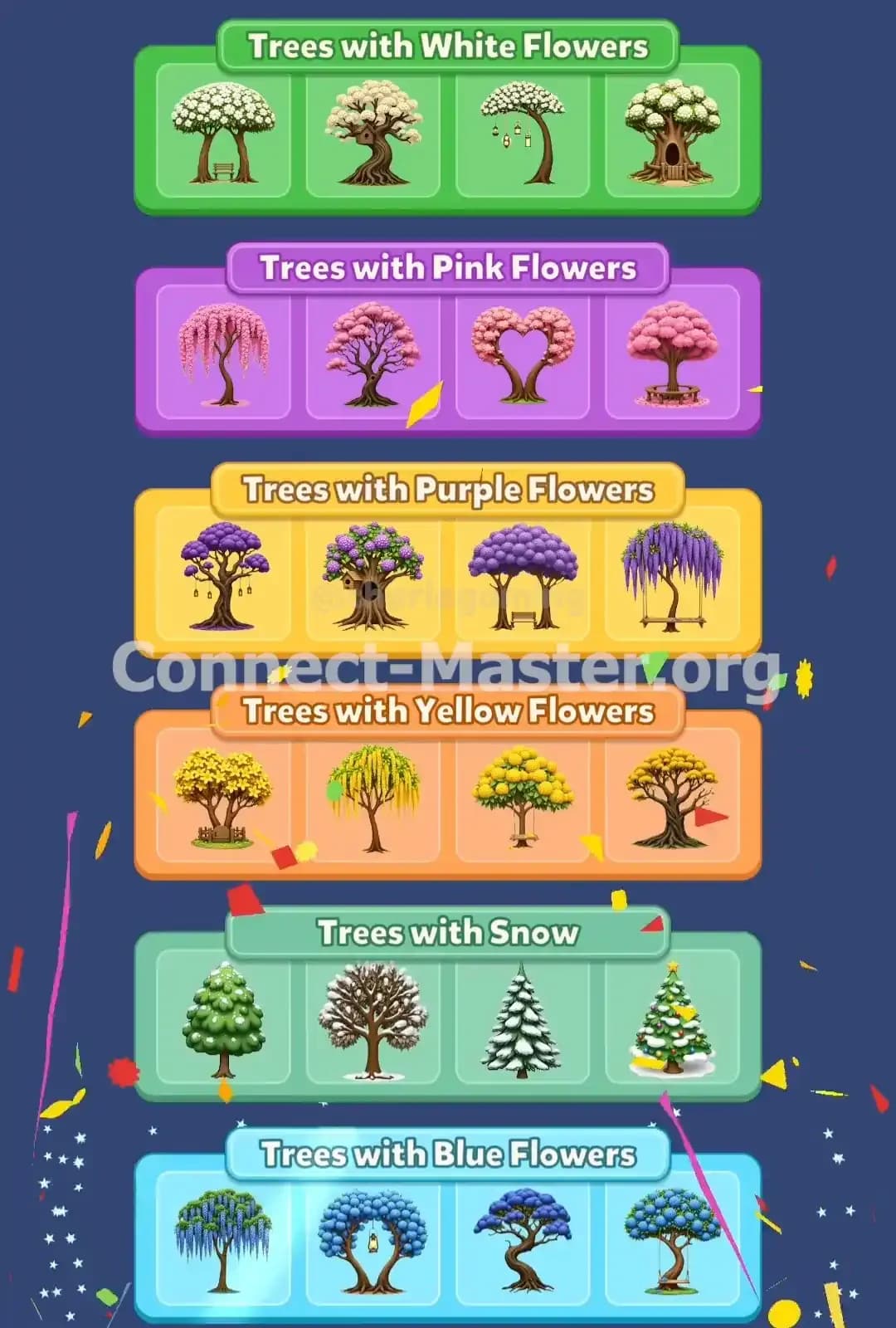
Connect Master Level 1516 is built around one clear visual theme: flowering and snowy trees. Instead of mixing characters, animals, and objects, this board gives you 24 tree illustrations divided into six groups of four. The main challenge is separating the flower colors, then using the tree shapes and small props to confirm each match.
The six groups in Connect Master 1516 are:
- Trees with White Flowers: four trees covered in white blossoms, including a pair of trunks with a bench, a twisted flowering tree, a tree with hanging ornaments, and a hollow tree with roots around its base.
- Trees with Pink Flowers: four pink-flowering trees, including a drooping willow-style tree, a spreading single-trunk tree, a heart-shaped pair of trunks, and a rounded tree beside a circular bench.
- Trees with Purple Flowers: four purple-flowering trees, including a lantern-hanging tree, a hollow-trunk tree, a pair of trunks with a bench, and a tree with a swing.
- Trees with Yellow Flowers: four yellow-flowering trees, including a bench tree, a drooping yellow tree, a rounded tree on a small platform, and a thick twisted tree.
- Trees with Snow: four winter trees, including a snow-covered broadleaf tree, a bare tree dusted with snow, a snowy evergreen, and a decorated Christmas tree.
- Trees with Blue Flowers: four blue-flowering trees, including a blue weeping tree, an arched pair of trunks with a lantern, a twisted bonsai-like tree, and a rounded tree on a small base.
That gives Connect Master Level 1516 a straightforward six-by-four structure. Once you recognize the color families, the board becomes much easier to organize.
Why Connect Master Level 1516 Feels So Tricky
The most confusing set: Trees with Purple Flowers
The Trees with Purple Flowers group is the easiest to overlook because its tiles borrow several shapes and props from other sets. One purple tree has hanging lanterns, another has a hollow trunk, one includes a bench, and the last has a swing. Those accessories make the set look like a collection of unrelated object categories rather than one color-based group.
The trick is to ignore the prop at first and inspect the flower canopy. All four tiles use the same purple flower family, even though their silhouettes differ dramatically. Once you spot the purple color, the lantern, hollow trunk, bench, and swing become confirmation details instead of distractions.
Subtle overlaps between near-matches
The first major overlap is between Trees with White Flowers and Trees with Purple Flowers. Both groups contain trees with hanging objects and unusual trunks. The white-flowering group includes a tall tree with several hanging ornaments and a hollow tree, while the purple group also includes a lantern tree and a hollow-trunk design. Compare the blossoms rather than the accessories: white clusters belong together, and violet clusters belong together.
A second overlap appears between Trees with Pink Flowers and Trees with Blue Flowers. Both sets feature soft, rounded canopies and decorative compositions. The pink group includes the heart-shaped tree and a circular bench, while the blue group includes an arched tree with a lantern and a rounded tree on a base. The flower color is the deciding detail, but the trunk arrangement helps too: the heart shape is pink, while the blue arch has a hanging lantern inside it.
The third overlap involves Trees with Yellow Flowers and Trees with Snow. The yellow group contains drooping branches and rounded yellow crowns that may look pale at a glance. Snow tiles, however, have white layers sitting on branches, visible bare wood, evergreen needles, or Christmas decorations. If the white material looks like snow rather than blossoms, move the tile to Trees with Snow.
I’ll admit I initially wanted to group the lantern trees together. The pattern finally clicked when I stopped treating the props as the category and compared the color of every canopy. That “the accessories are decoys” moment is the key to Connect Master Level 1516.
Step-by-Step Solution for Connect Master Level 1516
Opening: lock in the clearest color groups
Start Connect Master Level 1516 by scanning for the most obvious group: Trees with Snow. These four tiles stand apart because they show snow layers, bare winter branches, evergreen shapes, or Christmas decorations. Lock them in together first. They have the least ambiguous visual identity on the board.
Next, collect Trees with Yellow Flowers. Look for the bright yellow blossoms rather than the branch shape. The group includes the yellow tree with a bench, the yellow weeping tree, the rounded yellow tree on a small platform, and the thick, gnarled yellow-flowering tree. Their silhouettes are different, but the flower color is consistent.
After that, identify Trees with Pink Flowers. Choose the pink weeping tree, the pink spreading tree, the heart-shaped pair of trunks, and the pink tree beside the circular bench. The heart design is especially useful as an anchor because it is unique, while the other three are confirmed by their pink canopies.
Mid-game: sort similar props by blossom color
With the snow, yellow, and pink groups removed, compare the remaining white, purple, and blue trees. This is where you should slow down and avoid grouping by bench, lantern, hollow trunk, or swing.
For Trees with White Flowers, locate the four bright white canopies. The pair of trunks with a bench is one tile, the twisted flowering tree is another, the slender tree with hanging ornaments is a third, and the hollow tree with exposed roots completes the set.
Then identify Trees with Blue Flowers by their cool blue or deep blue blossoms. The blue weeping tree, the blue arch with a lantern, the twisted bonsai-style tree, and the rounded blue tree on a small base all belong here. Don’t let the lantern or curved trunk pull these tiles into another group; the blue canopy is the reliable trait.
That leaves Trees with Purple Flowers. Before submitting, check that each remaining tile has purple blossoms and that you haven’t accidentally borrowed a blue or white tree because of a similar shade.
End-game: separate the final look-alikes
The final tricky comparison in Connect Master Level 1516 is usually between Trees with Purple Flowers and Trees with Blue Flowers. Their colors can appear close, especially on rounded flower clusters. Purple flowers have a warmer violet tone, while the blue set uses a cooler blue or indigo tone.
Use the distinctive shapes as a second check. The purple group has the tree with a swing, the hollow-trunk tree, the lantern-hanging tree, and the bench tree. The blue group has the arched lantern tree, twisted bonsai-like tree, blue weeping tree, and rounded tree on a low base.
If one tile seems uncertain, don’t force it immediately. Find all four likely members of one color group, then verify that the other tiles still form a complete set. Connect Master 1516 guarantees that every tile belongs to one group, so a leftover mismatch usually reveals an earlier color mistake.
The Logic Behind This Connect Master Level 1516 Solution
Move from broad traits to precise details
The reliable solving order is broad trait first, specific detail second. Begin with the largest visual difference: snow versus flowers. Then separate the flower tiles by color—yellow, pink, white, purple, and blue. This quickly reduces a board of 24 possibilities into six manageable categories.
After the color families are visible, use shape and props as confirmation. A bench, lantern, hollow trunk, swing, or hanging branch should never be your primary category because those details intentionally appear in multiple groups. Instead, ask whether the tree’s blossoms match the category color and whether the silhouette supports that choice.
This method systematically reduces confusion and guarantees that each tile has a home. If a group has only three members, check for a similar shade or a misleading accessory before creating a new theory.
Name every group in your head
Short category names keep the board organized. I used White Flowers, Pink Flowers, Purple Flowers, Yellow Flowers, Snow, and Blue Flowers while solving Connect Master Level 1516. Naming each group prevents you from mentally using the same lantern tree or bench tree twice.
It also makes the final check simple: four white, four pink, four purple, four yellow, four snowy, and four blue. Once those six named groups each contain exactly four tiles, Connect Master Level 1516 is solved logically rather than by guesswork.