Connect Master Level 1416 Solution Walkthrough & Answer
How to solve Connect Master level 1416? Get instant solution & answer for Connect Master 1416.
Connect Master Level 1416 Pattern Overview
The overall theme and board layout
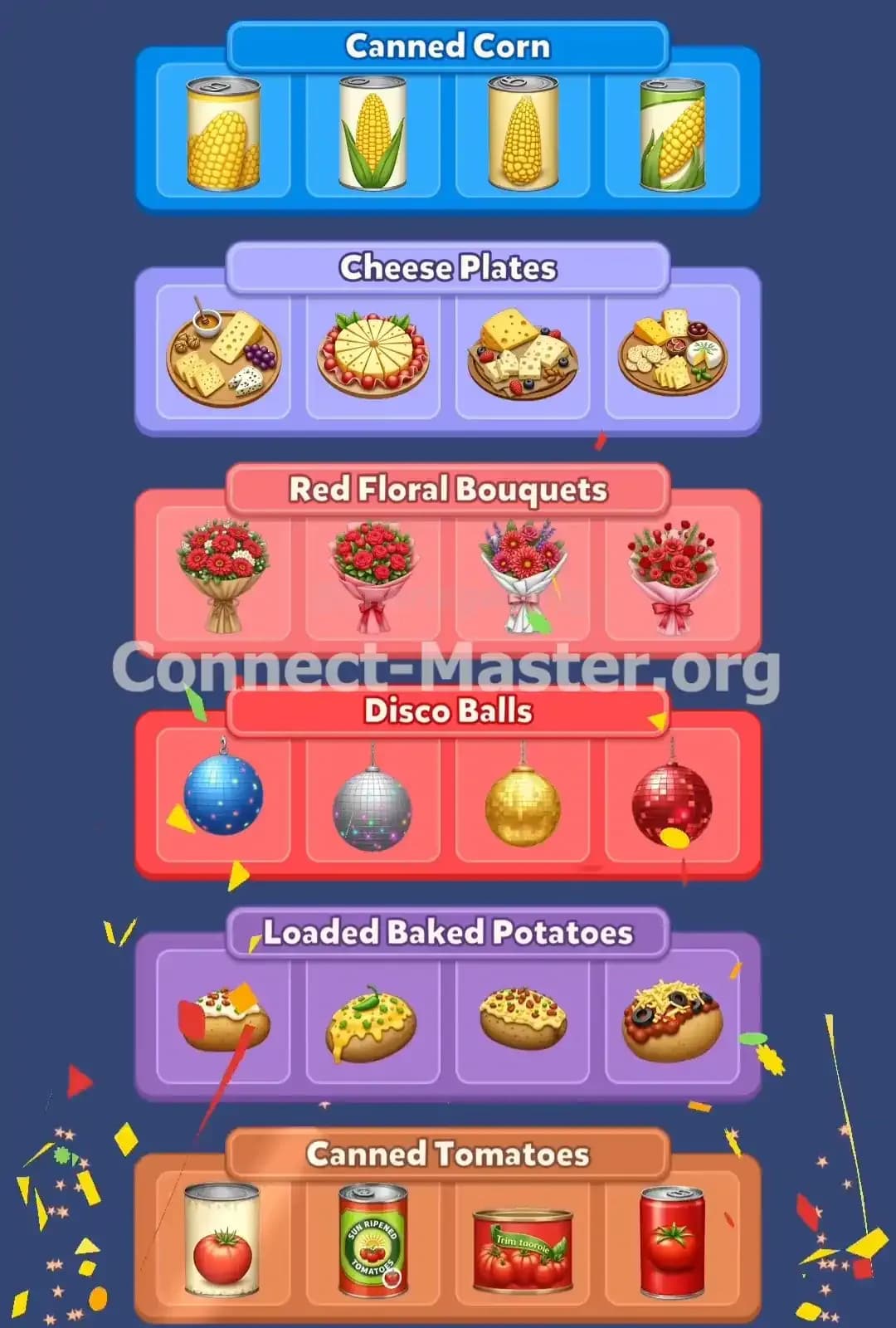
Connect Master Level 1416 uses a food, celebration, and party-supply theme rather than a character-based layout. The board contains 24 tiles divided into six correct sets of four. You’ll see canned vegetables, prepared foods, decorative objects, and floral arrangements, so the main challenge is recognizing the shared category instead of focusing only on color or shape.
The six groups in Connect Master 1416 are:
- Canned Corn: Four cans featuring corn or corn-on-the-cob artwork. Their labels vary, but each can clearly shows yellow corn as the main product.
- Cheese Plates: Four boards or plates arranged with assorted cheeses, crackers, fruit, and small garnishes.
- Red Floral Bouquets: Four bouquets dominated by red flowers, including roses and daisy-like blooms, even though their wrapping and extra flowers differ.
- Disco Balls: Four hanging mirrored balls in blue, silver, gold, and red.
- Loaded Baked Potatoes: Four baked potatoes covered with toppings such as cheese, herbs, bacon, olives, or other savory ingredients.
- Canned Tomatoes: Four tomato cans with different label designs, colors, and can shapes, all showing tomatoes as the central product.
Once you recognize these six category names, Connect Master Level 1416 becomes much more manageable. Every tile belongs to one of these groups, and there are no leftovers to account for after the final match.
Why Connect Master Level 1416 Feels So Tricky
The most confusing group: Cheese Plates
The Cheese Plates group is the set most players overlook in Connect Master Level 1416. Each tile contains several unrelated-looking foods, including grapes, berries, crackers, nuts, spreads, and different cheese shapes. That variety can make the four tiles appear less connected than the simple cans or disco balls.
The key is to judge the whole arrangement, not one ingredient. A tile with grapes might tempt you toward a fruit category, but there is no fruit group here. Instead, ask whether the item is a complete serving board or plate built around assorted cheeses. The presence of cheese wedges, crackers, and a composed platter is more important than any single garnish.
Small overlaps that cause mistakes
The first overlap occurs between Canned Corn and Canned Tomatoes. Both groups contain metal cans with farm-produce artwork, and some labels use similar cream, green, or red colors. Check the featured crop carefully: corn cans show kernels or a full ear of corn, while tomato cans show round red tomatoes, tomato vines, or tomato-themed labels. Don’t sort by can color alone.
The second overlap appears between Red Floral Bouquets and the red Disco Ball. The bright red tiles can attract attention as a color group, but the object type separates them immediately. The four bouquets contain stems, petals, wrapping paper, and prominent red blossoms. The red disco ball has a smooth spherical shape covered in square mirror panels and a hanging hook.
A third overlap involves Cheese Plates and Loaded Baked Potatoes, since both groups show toppings and small pieces of food. For the potato group, look for the unmistakable brown baked potato shell with an open top and toppings piled into the center. Cheese plates are flat boards or dishes with multiple separate portions arranged around the surface. The potato shape is the deciding detail.
I found the cheese tiles especially deceptive at first because the fruit and crackers pulled my attention in different directions. The “I finally saw it” moment came when I stopped naming individual ingredients and recognized all four as complete cheese-serving arrangements.
Step-by-Step Solution for Connect Master Level 1416
Opening: lock in the obvious sets first
Start Connect Master Level 1416 by selecting the four Disco Balls. This is the cleanest opening group because the mirrored spheres are visually distinct from every food tile. Their colors differ—blue, silver, gold, and red—but the hanging hook and tiled reflective surface make the connection certain.
Next, find the Loaded Baked Potatoes. Each tile shows a brown potato with a split or open center and visible toppings. Compare the silhouette rather than the toppings: cheese, green herbs, bacon-like pieces, and olives may vary, but all four are clearly baked potatoes. Locking in these two groups removes eight tiles and leaves a much less crowded board.
After that, identify the Red Floral Bouquets. Look for wrapped flower arrangements with red blooms as the dominant feature. The wrapping may be brown, pink, white, or another color, and a few arrangements include purple or green accents. The important trait is that each is a bouquet centered on red flowers, not merely an object containing a little red.
Mid-game: separate the canned foods
With the party objects, potatoes, and bouquets out of the way, focus on the two canned-food groups. The four Canned Corn tiles show yellow corn in different presentations. One may show loose kernels, while another displays a full ear with green leaves. Their labels are not identical, so use the image of the food itself as your anchor.
Then collect the Canned Tomatoes. These cans use more varied branding, including red labels, green label details, and plain packaging with a tomato illustration. Some cans may look like generic vegetables at a quick glance, so inspect the central picture and any readable label design. If the can shows a red tomato or tomato cluster, it belongs with Canned Tomatoes, not Canned Corn.
A useful Connect Master 1416 rule is to compare matching candidates side by side before committing. If two cans share a similar background, ignore the background and compare the produce illustration. This prevents a red or green label from pulling the wrong tile into a group.
End-game: finish with the Cheese Plates
The remaining four tiles should form Cheese Plates, but don’t rush simply because they are the last available options. Confirm that every tile is a serving board or platter containing cheese portions along with complementary foods. Look for wedges, slices, crackers, berries, grapes, nuts, or a small bowl of spread.
Keep these tiles separate from the eliminated food groups by checking the container format. A cheese plate is flat and arranged for sharing, while a baked potato is one individual oval food with toppings on top. The cheese category also has multiple food components spread around the plate rather than one central item.
Once the four platters are together, Connect Master Level 1416 is complete. If one tile seems questionable, revisit the earlier groups rather than forcing it into the final set. Every category must contain exactly four tiles, so a wrong early selection usually reveals itself through an incomplete group later.
The Logic Behind This Connect Master Level 1416 Solution
Move from broad traits to specific details
The most reliable method for Connect Master 1416 is to begin with large, unmistakable traits. Shape identifies the Disco Balls, the potato silhouette identifies Loaded Baked Potatoes, and the bouquet structure identifies Red Floral Bouquets. These broad categories quickly reduce the number of tiles you need to compare.
After the obvious groups are removed, switch to specific details. For the cans, distinguish corn kernels and ears from tomato illustrations and tomato labels. For the last group, examine the arrangement and serving style rather than isolated ingredients. This broad-to-specific process reduces confusion and ensures that every tile has a logical destination.
Use category names to organize the board
Naming each set in your head is particularly helpful on this level. I’d mentally label the groups Disco Balls, Loaded Baked Potatoes, Red Floral Bouquets, Canned Corn, Canned Tomatoes, and Cheese Plates before making difficult selections.
These short names prevent double-using a tile and make decoys easier to reject. If a red tile seems tempting, ask whether it belongs to the red-flower category or the mirrored-ball category. If a food tile looks versatile, ask whether it is canned, baked, or arranged on a platter. In Connect Master Level 1416, that simple naming habit turns a busy board into six clear four-tile patterns.