Connect Master Level 1393 Solution Walkthrough & Answer
How to solve Connect Master level 1393? Get instant solution & answer for Connect Master 1393.
Connect Master Level 1393 Pattern Overview
The overall theme and set count
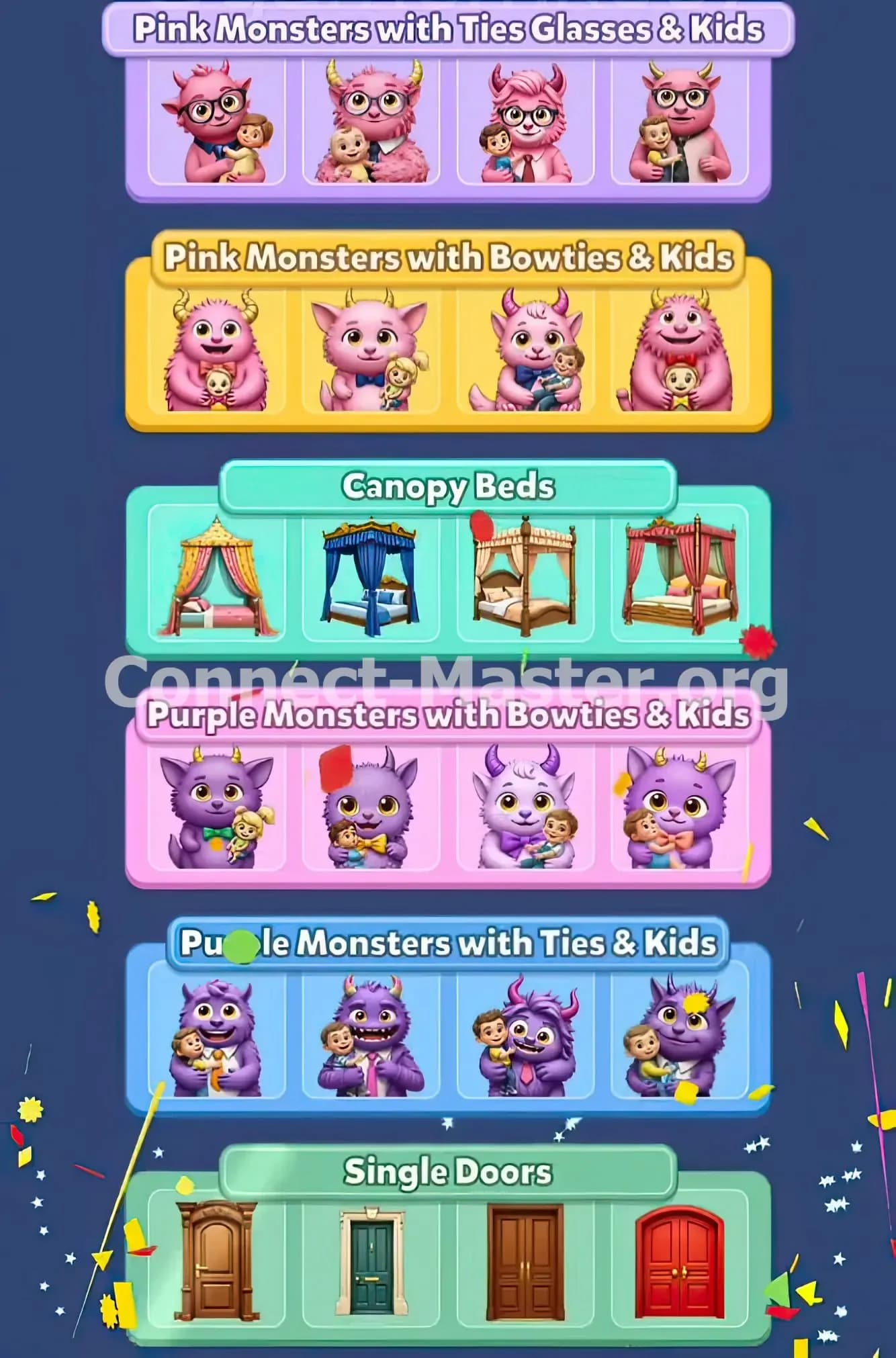
Connect Master Level 1393 contains seven sets of four tiles, for a total of 28 tiles. The board mixes colorful monster characters, children, bedroom furniture, and doors. At first, the monsters seem to be the main subject, but the real solution depends on noticing their accessories and color families.
There are four monster groups: two pink and two purple. Each monster group also includes a child, so the child figures are deliberate decoys rather than a separate category. The remaining two sets are much more object-focused: four canopy beds and four single doors.
The safest way to approach Connect Master 1393 is to separate the board into broad families first, then check the smaller details such as glasses, ties, bowties, horns, and bed or door design.
The seven categories in Connect Master 1393
- Pink Monsters with Ties, Glasses & Kids: Four pink monsters that wear glasses and neckties while holding or standing with children.
- Pink Monsters with Bowties & Kids: Four pink monsters wearing bowties and pictured with children.
- Canopy Beds: Four four-poster or canopy-style beds, each with curtains and a different color or wood finish.
- Purple Monsters with Bowties & Kids: Four purple monsters wearing bowties and appearing with children.
- Purple Monsters with Ties & Kids: Four purple monsters wearing neckties and appearing with children.
- Single Doors: Four individual doors, including different colors, panels, frames, and handles.
- The remaining monster accessory groups: The four categories above account for all eight pink and purple monster tiles in each accessory/color combination, with no monster left over once color and neckwear are checked carefully.
A useful summary is: pink versus purple, then tie versus bowtie, with glasses acting as an extra confirmation for the pink tie group. The furniture and doors are independent sets and can usually be locked immediately.
Why Connect Master Level 1393 Feels So Tricky
The most confusing set
The hardest category in Connect Master Level 1393 is usually Pink Monsters with Ties, Glasses & Kids. Players often notice the pink color and immediately place those tiles with the pink bowtie group. That mistake is understandable because both sets contain pink monsters, children, and similar friendly expressions.
The key is that the tie group has a more formal appearance. Each monster has eyewear and a necktie, while the bowtie group uses a clearly visible bow at the collar. Don’t classify these tiles by the child’s clothing or the monster’s horns; those features vary and are designed to distract you.
Subtle overlaps and how to separate them
The first overlap is between Pink Monsters with Ties, Glasses & Kids and Pink Monsters with Bowties & Kids. Both categories have pink bodies and children. Look directly at the monster’s neck: a narrow hanging tie belongs to the first group, while a compact bow-shaped accessory belongs to the second. The glasses are also an important confirmation for the pink tie set.
The second overlap is between Purple Monsters with Bowties & Kids and Purple Monsters with Ties & Kids. The purple monsters may have similar faces, horns, and furry textures, so the child can seem like the most noticeable feature. Ignore the child at first. Instead, inspect the monster’s collar area. A large bowtie identifies the purple bowtie set; a long tie identifies the purple tie set.
The third overlap comes from the children themselves. Several children have similar hair colors, poses, or bright outfits, and some are held against the monster’s chest in nearly identical ways. The child is not the category clue. Use the monster’s color and neckwear, and treat the child only as a supporting detail.
My reaction to the difficulty
I found Connect Master 1393 deceptively difficult because the board repeats the same basic formula so often: monster plus child. I initially wanted to group every pink character together, but the moment I separated ties from bowties, the layout became much clearer. That “I finally saw it” moment comes when you realize the accessories are doing more work than the characters’ expressions.
Step-by-Step Solution for Connect Master Level 1393
Opening: lock in the obvious object sets
Start Connect Master Level 1393 by finding Canopy Beds. These four tiles are the cleanest category on the board because they show furniture rather than characters. Match the beds by their four-post structure and hanging curtains. The colors differ, but the canopy frame is the shared trait. Locking these four removes a large group without risking confusion.
Next, select Single Doors. Compare the door shape, frame, panels, and handles rather than focusing only on color. The brown, green, darker wood, and red doors all belong together because each is a standalone hinged door. Once these eight object tiles are removed, the monster groups become easier to compare.
Mid-game: sort the monsters by color and accessory
With the furniture out of the way, divide the remaining tiles into pink and purple monsters. Don’t finalize a group based on color alone, because each color has two different categories.
For the pink tiles, identify Pink Monsters with Bowties & Kids by locating the four monsters with obvious bow-shaped neckwear. Then identify Pink Monsters with Ties, Glasses & Kids by checking for the narrow hanging ties and glasses. If a tile appears to have both a child and formal clothing, zoom in mentally on the monster’s face and collar rather than making a quick guess.
Repeat the same process for the purple tiles. Gather the four bowtie characters under Purple Monsters with Bowties & Kids, then use the remaining purple characters with long neckties for Purple Monsters with Ties & Kids. The children may be dressed in different colors, but that variation doesn’t change the category.
End-game: verify the final two monster sets
The last tricky step in Connect Master 1393 is keeping the purple tie and purple bowtie groups separate. Before submitting either group, count four tiles and check the accessory on every monster. A tie should hang vertically down the chest; a bowtie should spread sideways from the collar.
Then recheck the pink groups, especially the glasses. If a pink tile lacks the expected glasses or appears to show a bowtie instead of a long tie, it may have been placed incorrectly. The board is designed so that one wrong monster can make the final four look plausible, so use the exact accessory rather than general appearance.
When every tile has a category, confirm that no child, monster, bed, or door has been used twice. Connect Master’s rule is strict: each tile belongs to one and only one set.
The Logic Behind This Connect Master Level 1393 Solution
Move from broad traits to specific details
The solution works because it follows a reliable visual hierarchy. Begin with the broadest traits: furniture versus characters, then beds versus doors. After that, divide the character tiles by pink and purple. Finally, use the smallest details—tie, bowtie, and glasses—to complete the groups.
This approach reduces the number of possible matches at every stage. Instead of comparing all 28 tiles at once, you first remove eight obvious objects, then compare only related monsters. It also protects you from decoys because a tile must satisfy the complete category, not merely share one feature.
Use category names to avoid double-counting
I recommend naming each group in your head as you play Connect Master 1393: Canopy Beds, Single Doors, Pink Bowties, Pink Ties and Glasses, Purple Bowties, and Purple Ties. These short labels make it much easier to remember what has already been claimed.
Most importantly, mentally cross off each tile after assigning it. If a possible group needs a tile you already used, that’s a warning that your original category was too broad. In Connect Master 1393, the correct solution is the one that accounts for every tile cleanly, with four members per set and no leftovers.