Connect Master Level 1572 Solution Walkthrough & Answer
How to solve Connect Master level 1572? Get instant solution & answer for Connect Master 1572.
Connect Master Level 1572 Pattern Overview
Theme and board structure
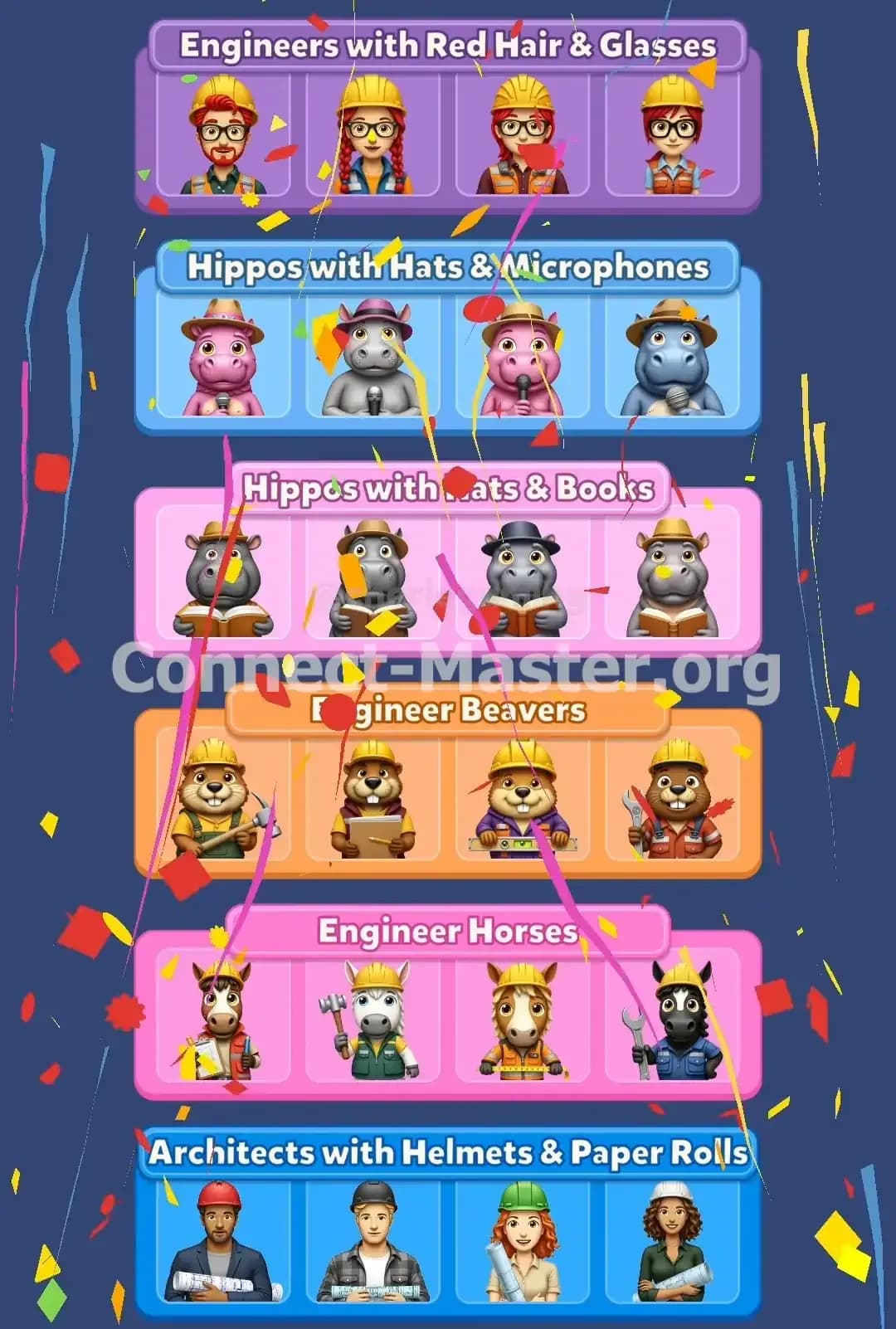
Connect Master Level 1572 uses a workplace-and-profession theme with a playful animal twist. The board contains 24 tiles divided into six exact groups of four. You’ll see human engineers, architects, engineer beavers, engineer horses, and two separate hippo groups.
The main challenge in Connect Master 1572 isn’t recognizing the general theme. Almost every tile looks connected to construction, engineering, hats, or tools. The real test is spotting the smaller details that divide similar characters into separate sets. Hard hats, glasses, microphones, books, paper rolls, and work tools all matter.
Here are the six groups to identify:
Engineers with Red Hair & Glasses
These four human engineer tiles all feature red or reddish hair, round glasses, and yellow safety helmets. Their clothing varies slightly, but the repeated glasses-and-hair combination is the reliable clue. Don’t let the different shirt colors distract you; the facial features are more important than the uniforms.
Hippos with Hats & Microphones
This group contains four hippos wearing hats and holding microphones. The hippos have different body colors, including pink, gray, and blue, while their hats also vary in color and style. The microphone is the deciding prop, so check what each hippo is holding rather than relying on its face or hat.
Hippos with Hats & Books
These four hippos are also wearing hats, but each one is holding an open book. Their colors and hat designs are deliberately varied to make the group less obvious. Once you notice the matching book pose, the category becomes clear: these are the reading hippos, not the singing or speaking hippos.
Engineer Beavers
The four beavers are shown as construction workers or engineers. Each wears a yellow hard hat and work clothing, but their equipment differs: one carries a tool, another holds a board, and others have construction accessories. Their buck teeth, broad faces, and beaver appearance separate them from the horse and human engineer groups.
Engineer Horses
These four horse tiles share an engineering or repair-worker appearance. They wear yellow helmets or work hats and are dressed in practical work uniforms. Several hold tools, including wrenches or measuring equipment. Their long horse faces and ears are the strongest identifying traits, even when their clothing looks similar to the beavers’ workwear.
Architects with Helmets & Paper Rolls
The final set contains four human architects holding rolled plans or blueprints. They wear different colored helmets, including red, black, green, and white. Their professional clothing is more polished than the animal engineers’ outfits, and the rolled paper is the key item that unites them.
Why Connect Master Level 1572 Feels So Tricky
The most confusing group: Hippos with Hats & Books
The most easily overlooked set in Connect Master Level 1572 is Hippos with Hats & Books. The four hippos do not share one obvious color, and their hats are intentionally different. At a quick glance, they can look like a random collection of hippo characters.
The important clue is the object in front of each character. Every member holds an open book at chest level. That shared prop is much stronger than the hat color or body color. Players often remove one of these tiles too early because it resembles a microphone hippo, but the book immediately settles the question.
Subtle overlaps between the groups
The first major overlap is between Hippos with Hats & Microphones and Hippos with Hats & Books. Both groups have hats, similar poses, and nearly identical character framing. Compare the lower center of each tile: microphones are narrow, dark objects held upright near the mouth, while books spread horizontally across the chest.
The second overlap is between Engineers with Red Hair & Glasses and Architects with Helmets & Paper Rolls. Both are human professionals wearing helmets, and their outfits may appear work-related. Look closely at the face and hands. The engineer group consistently shows glasses and reddish hair, while the architects are identified by rolled paper plans and do not depend on the glasses clue.
The third overlap appears between Engineer Beavers and Engineer Horses. Both animal groups wear construction clothing, yellow helmets, and sometimes carry tools. Check the head shape carefully: beavers have rounded faces, prominent front teeth, and small rounded ears, while horses have long muzzles and clearly visible upright ears. A wrench alone doesn’t define a group.
My pattern-recognition moment
I initially found the board more confusing than expected because almost every character looked like some kind of worker. I kept noticing helmets first, which created too many possible combinations. The “I finally saw it” moment came when I ignored the hats and focused on held objects: books, microphones, and rolled plans. Once those props were separated, the rest of Connect Master Level 1572 became much easier.
Step-by-Step Solution for Connect Master Level 1572
Opening: lock in the clearest groups first
Start by finding the four Hippos with Hats & Microphones. Scan for the microphone shape near each hippo’s mouth and select only those four. Don’t worry about the hippos’ colors or hat styles. The microphone is a clean, repeated trait and removes four confusing tiles immediately.
Next, locate the four Hippos with Hats & Books. These should be easier after the microphone hippos are gone because the remaining hippos will visibly hold open books. Confirm all four before moving on, making sure you haven’t included a microphone tile based only on its similar pose.
After that, identify Architects with Helmets & Paper Rolls. Look for the human characters holding rolled documents or blueprints across their arms. Their helmets vary, so don’t require matching colors. The rolled plans are the category anchor.
Mid-game: compare faces, accessories, and clothing
With the obvious prop-based groups removed, focus on the animal engineers. Separate Engineer Beavers from Engineer Horses by examining the facial silhouette rather than the uniforms. Beavers have broad, compact faces and visible buck teeth. Horses have elongated muzzles, larger ears, and a distinctly equine profile.
If a tile carries a tool, use that only as a secondary clue. Both animal groups can hold construction equipment, so a wrench, board, or measuring item does not automatically identify the set. First decide whether the character is a beaver or horse, then verify the helmet and work outfit.
The remaining human tiles should form Engineers with Red Hair & Glasses. Check the hairline, eye area, and helmet rather than simply selecting all human workers. The glasses may be small, especially on a tile with a different shirt or vest, so zoom in mentally on the eyes before committing.
End-game: protect the final two categories
The last tricky separation is usually between Engineer Beavers and Engineer Horses. By this stage, compare the four remaining animal faces side by side. The beaver set has short, rounded muzzles and visible front teeth; the horse set has long noses and tall ears. If one tile seems uncertain, leave it aside temporarily and identify the three strongest matches in each group.
For the human set, make sure every selected tile has the red-hair-and-glasses combination. A human with a helmet and rolled paper belongs with the architects, even if the outfit resembles an engineer’s. The exact trait matters more than the broad profession.
The Logic Behind This Connect Master Level 1572 Solution
Move from broad traits to precise details
The safest method for Connect Master Level 1572 is to work from large, obvious categories toward smaller visual details. First separate hippos, humans, beavers, and horses. Then use props such as microphones, books, and paper rolls. Finally, verify facial details, hair, glasses, and clothing.
This layered approach reduces accidental matches. A tile may look like an engineer because of its helmet, but the character type and held object provide stronger evidence. Since every tile belongs to exactly one group, a proposed set should explain all four tiles without relying on vague similarities.
Use short names to organize the board
Naming the groups in your head makes the puzzle much easier to manage. Think “microphone hippos,” “book hippos,” “red-haired glasses engineers,” “beavers,” “horses,” and “architects with plans.” These short labels stop you from double-using a tile or returning to a category you already proved.
Once five groups are secure, the final four tiles must form the sixth group—but still verify the trait before finishing. In Connect Master 1572, the correct solution is not just four tiles that look related. It is six complete categories where every character, accessory, and prop has a clear place.