Connect Master Level 1607 Solution Walkthrough & Answer
How to solve Connect Master level 1607? Get instant solution & answer for Connect Master 1607.
Connect Master Level 1607 Pattern Overview
The overall theme and board structure
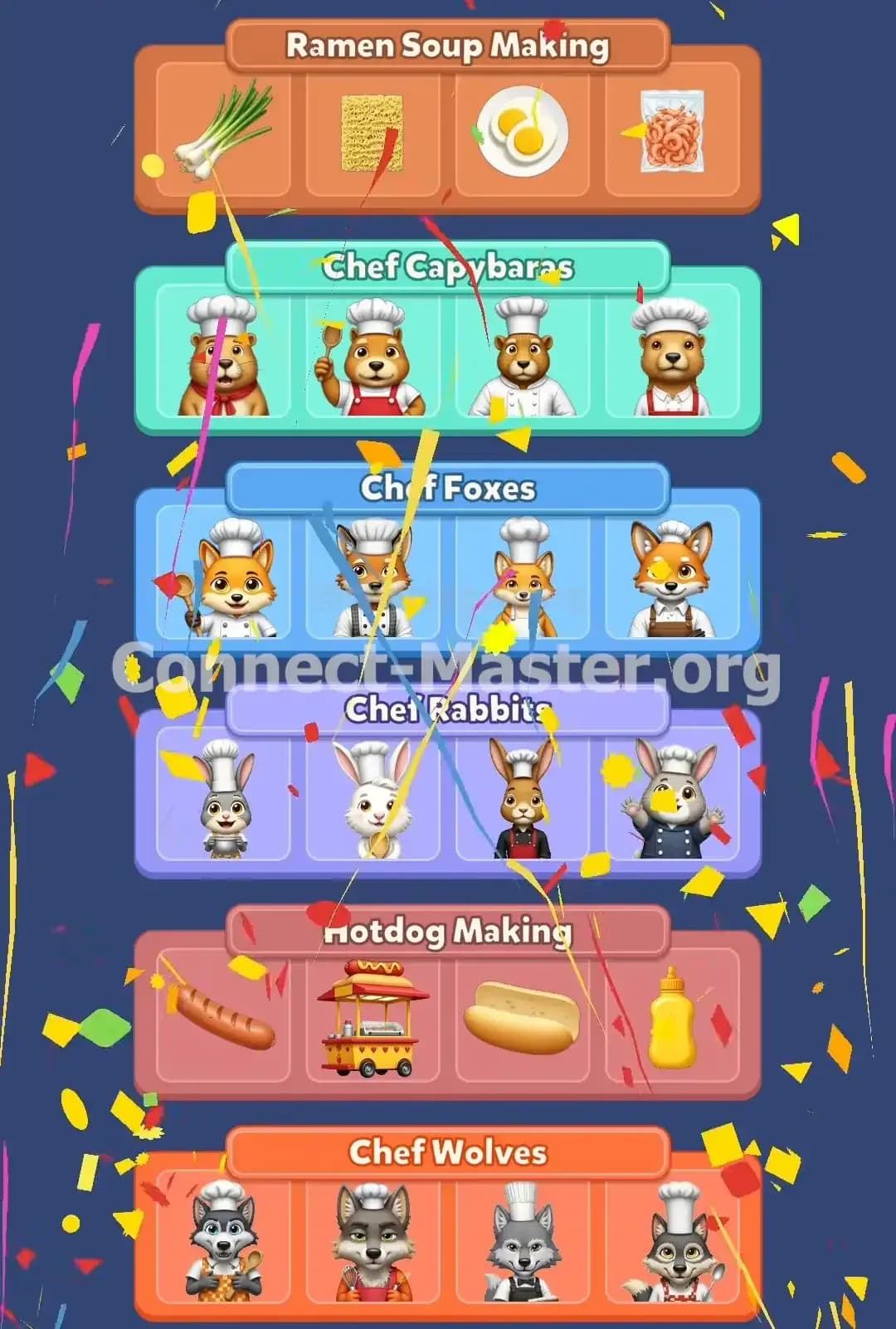
Connect Master Level 1607 uses a cheerful cooking theme built around animal chefs and food-preparation clues. There are six complete sets, with each set containing exactly four tiles. Four groups feature chef animals—capybaras, foxes, rabbits, and wolves—while the other two groups show ingredients or equipment connected to ramen and hot dogs.
The board is designed to make the animal tiles look similar at first. Nearly every character wears a chef hat, and several hold cooking tools or have aprons. The safest approach is to identify the animal species first, then use the food tiles as their own object-based groups.
The six sets in Connect Master 1607
- Ramen Soup Ingredients: scallions, a block of ramen noodles with a chili pepper, boiled eggs, and shrimp. These four tiles are food items that can be used in or served with ramen soup.
- Chef Capybaras: four capybara chefs, including characters with a red scarf, a spoon and red apron, a white chef coat, and a red-trimmed apron. Their shared trait is the capybara character design.
- Chef Foxes: four fox chefs shown in different uniforms and poses. Their pointed ears, orange fur, and fox faces identify this group.
- Chef Rabbits: four rabbit chefs, including gray, white, brown, and gray-and-white characters. Their long ears are the key feature.
- Hotdog Making: a sausage, a hot-dog cart, a bun, and a mustard bottle. These four tiles represent the basic ingredients, serving equipment, and condiment used to make a hot dog.
- Chef Wolves: four wolf chefs with gray fur, pointed ears, and varied aprons or cooking tools. Their wolf faces and heavier muzzle shapes separate them from the foxes.
Why Connect Master Level 1607 Feels So Tricky
The most confusing set: Chef Wolves
The most easily overlooked group in Connect Master 1607 is Chef Wolves. The wolves wear chef hats just like the capybaras, foxes, and rabbits, so the first impression is that all the animal tiles belong to one broad “cooking characters” category. Their gray coloring also creates a visual connection with some of the rabbits.
Look closely at the face rather than the clothing. The wolf tiles have broader muzzles, thick fur around the cheeks, and pointed ears. One wolf holds a spoon, another wears a warm-toned apron, and another has a dark apron, but those outfit differences are distractions. The animal identity is the real rule.
Subtle overlaps between the groups
The first major overlap is between Chef Foxes and Chef Wolves. Both animals have pointed ears and similar gray, orange, or brown coloring. To separate them, check the snout and cheek fur. Foxes have narrower, more pointed faces, while wolves have wider faces and a more substantial muzzle. Don’t use apron color as your deciding clue.
The second overlap is between Chef Rabbits and the other animal groups. The rabbit tiles are dressed in especially varied outfits, and some are holding objects that resemble the tools carried by the foxes or wolves. Their long upright ears are the reliable identifier. Even when a rabbit’s ears are partly hidden by the chef hat, the visible ear length and softer face make the match clearer.
The third overlap involves Ramen Soup Ingredients and Hotdog Making. Both object groups contain food, but their categories are different. The ramen set is made up of soup toppings or ingredients: scallions, noodles, eggs, and shrimp. The hot-dog set includes a sausage, bun, mustard, and a hot-dog cart. If an item is a condiment or serving object, it belongs with Hotdog Making, not with the ramen ingredients.
My pattern-recognition moment
I initially wanted to sort the animals by clothing because the hats and aprons were so prominent. That was the wrong level of detail. Once I ignored the costumes and focused on ears, muzzle shape, and fur, the board became much easier. The “I finally saw it!” moment came when the four wolves stopped looking like generic gray chefs and became an obvious species group.
Step-by-Step Solution for Connect Master 1607
Opening: lock in the obvious object sets
Start Connect Master Level 1607 by locating the two non-character groups. The Ramen Soup Ingredients set is usually the clearest: select the scallions, noodle block, boiled eggs, and shrimp. They form a coherent collection of ramen components, and none of them is an animal tile.
Next, identify Hotdog Making. Match the sausage, hot-dog cart, bun, and mustard bottle. The cart can seem unrelated to the food items if you’re searching only for ingredients, but it belongs because it represents the preparation and serving of the same dish.
Removing these eight object tiles leaves only the chef animals. That immediately reduces the visual clutter and makes species comparison much more manageable.
Mid-game: sort the animal chefs by anatomy
With the food tiles removed, separate the characters into four species groups. Begin with Chef Rabbits, since the long ears are the most distinctive feature. Find all four rabbit faces before selecting them, and don’t let a white coat or gray fur pull you toward another group.
Then look for Chef Foxes. Their pointed ears may resemble wolf ears, but their faces are slimmer and more angular. The orange fox fur is helpful, although one tile’s clothing or shading may make the color less obvious. Compare the eyes, cheeks, and nose shape instead of relying on the uniform.
After that, collect Chef Capybaras. Capybaras have rounded ears, broad rounded faces, and a softer, flatter profile. Their red scarf, spoon, or apron details are secondary clues. Confirm that all four share the same rounded animal structure before committing.
As you work, avoid using a tile in your mental notes twice. If a character seems to fit both foxes and wolves, mark the uncertain tile and compare it against the other three confirmed examples. This prevents one attractive near-match from breaking an otherwise correct set.
End-game: finish with the look-alike groups
The final difficult comparison is generally Chef Foxes versus Chef Wolves. For Chef Foxes, use the narrow snout, alert pointed ears, and orange or russet facial coloring. For Chef Wolves, look for the wider muzzle, stronger cheek fur, and gray wolf appearance.
The last four remaining tiles should form the final group automatically, but still verify the trait before finishing. In Connect Master Level 1607, elimination is safest when the remaining tiles all share a clear species identity—not merely matching hats, aprons, or cooking tools.
The Logic Behind This Connect Master Level 1607 Solution
Move from broad traits to precise details
The solution works because it moves from the strongest visual categories to the smallest distinguishing details. Food tiles are separated first by their dish: ramen items versus hot-dog items. Once those are gone, the character tiles are sorted by species. Only then do you need subtle clues such as ear shape, muzzle width, cheek fur, and face proportions.
This order systematically reduces confusion. It also protects you from decoys, because a shared chef hat or spoon is a weak connection, while four matching animal species provide a much stronger one.
Use category names to keep the board organized
I recommend naming each group in your head as soon as you recognize it: Ramen Soup Ingredients, Hotdog Making, Chef Rabbits, Chef Foxes, Chef Capybaras, and Chef Wolves. These short labels make it easier to remember which tiles are already accounted for.
They also prevent double-using a tile. If you’re about to place a gray, pointed-eared character into Chef Foxes, ask whether it truly matches the fox face or whether it belongs to Chef Wolves. By checking every tile against a named group, you can complete Connect Master 1607 confidently and ensure that all 24 tiles fit one—and only one—correct set.