Connect Master Level 1621 Solution Walkthrough & Answer
How to solve Connect Master level 1621? Get instant solution & answer for Connect Master 1621.
Connect Master Level 1621 Pattern Overview
The overall theme and board structure
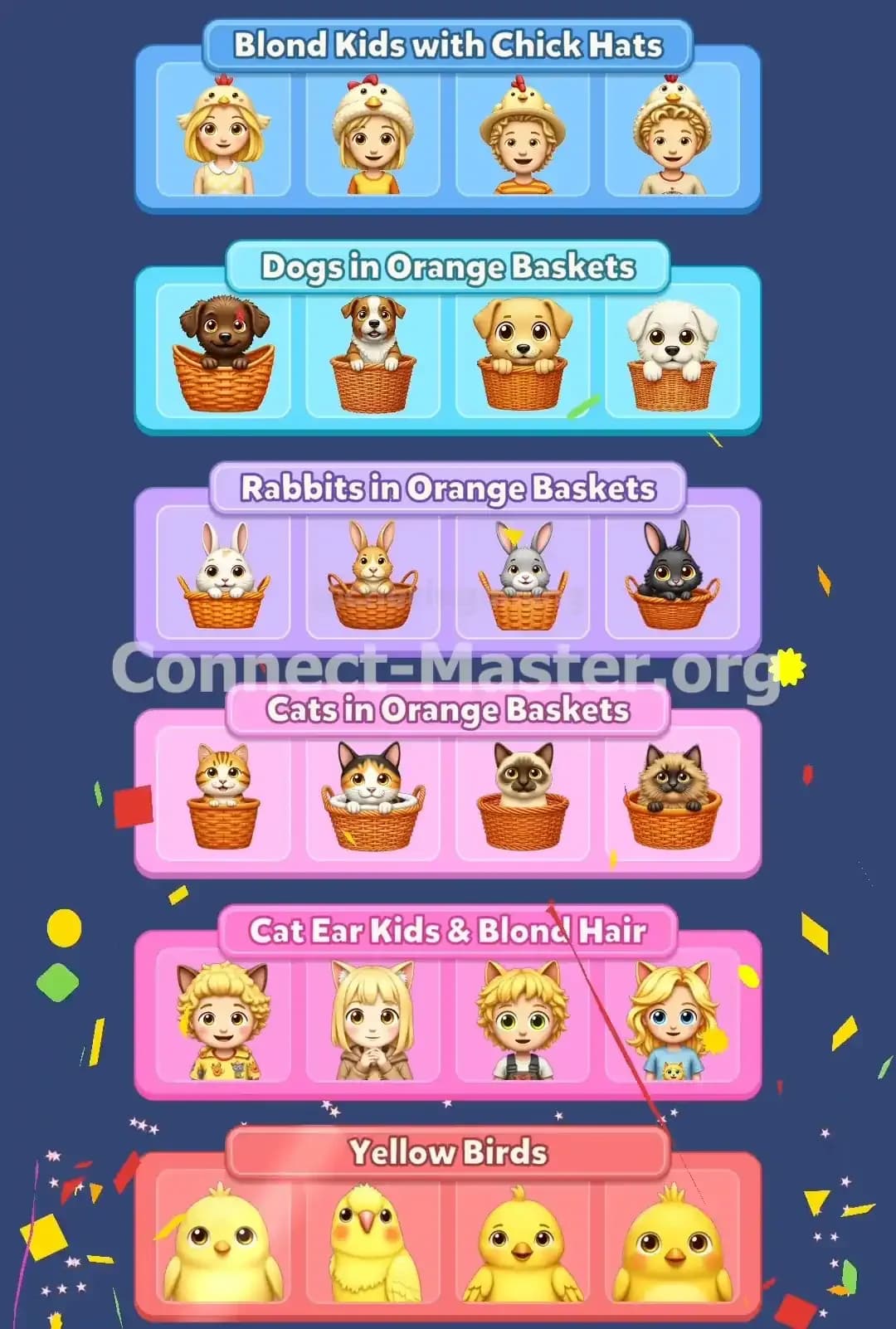
Connect Master Level 1621 uses a cheerful mix of cartoon children, pets, and birds. The board contains 24 tiles divided into six correct sets of four. At first glance, several groups seem to share the same visual clues, especially the animals sitting in orange baskets and the children with light hair. The key is to identify the main subject first, then confirm the smaller details that make each group unique.
The six categories in Connect Master 1621 are:
- Blond Kids with Chick Hats: Four blond children wearing hats designed like yellow chicks. The hats include chick faces, beaks, feathers, or red comb details.
- Dogs in Orange Baskets: Four different puppies, each sitting inside a woven orange basket.
- Rabbits in Orange Baskets: Four rabbits with long ears, all placed in orange baskets.
- Cats in Orange Baskets: Four cats with clearly feline faces and pointed ears, also sitting in orange baskets.
- Cat Ear Kids & Blond Hair: Four blond children wearing cat-ear headbands or hairstyles with visible cat ears. These are human characters, not animals, and their cat ears are the important clue.
- Yellow Birds: Four small yellow bird characters with beaks, wings, and rounded bird-like bodies.
The repeated basket design is intentional. Don’t group every basket tile together; the animal inside the basket determines whether it belongs to Dogs in Orange Baskets, Rabbits in Orange Baskets, or Cats in Orange Baskets.
Why Connect Master Level 1621 Feels So Tricky
The most confusing set: Cat Ear Kids & Blond Hair
The hardest category in Connect Master 1621 is usually Cat Ear Kids & Blond Hair. These four tiles can look similar to Blond Kids with Chick Hats because both groups feature young, light-haired characters. The difference is found above the head: the chick-hat group has novelty hats with chick faces or beaks, while the cat-ear group has pointed feline ears connected to the hairstyle or headband.
Players often overlook this category because the cat ears are small and may blend into curls, bangs, or pale hair. Look at the silhouette rather than the hair color alone. If the head has two unmistakable pointed ears and the character is a child, test it against Cat Ear Kids & Blond Hair.
Subtle overlaps to watch for
The first major overlap involves Dogs in Orange Baskets, Rabbits in Orange Baskets, and Cats in Orange Baskets. All three sets use the same warm basket color and a similar seated pose. Separate them by anatomy:
- Dogs have floppy or rounded ears, short snouts, and puppy-like faces.
- Rabbits have long upright ears and small, twitchy-looking noses.
- Cats have pointed ears, whisker areas, and more distinctly feline eyes or facial markings.
The second overlap is between Blond Kids with Chick Hats and Cat Ear Kids & Blond Hair. Hair color is not enough to solve either group because both contain blond children. Check the accessory: chick hats usually show a beak, chick face, feather, or red comb, while cat-ear children have simple pointed ears without a bird face.
The third overlap occurs between Yellow Birds and the chick hats. The yellow birds are complete animal characters with wings, beaks, and bird bodies. The children in Blond Kids with Chick Hats only wear a bird-themed hat; their faces, shoulders, and clothing remain clearly human. That distinction prevents you from treating a hat as the whole character.
The pattern-recognition moment
I found the level much easier once I stopped sorting by color. The yellow tiles, blond hair, orange baskets, and pink backgrounds create several distractions, but the real solution is based on character type and accessory details. My “I finally saw it” moment came when I separated the three basket groups by animal instead of by container. Once the dogs, rabbits, and cats were treated as separate categories, the remaining children and birds became much more obvious.
Step-by-Step Solution for Connect Master Level 1621
Opening: lock in the obvious sets first
Begin Connect Master 1621 by finding the easiest group: Yellow Birds. These four tiles are complete yellow bird characters, so they stand out through their beaks, wings, rounded bodies, and bird posture. They are not children wearing yellow clothing and not hats placed on human heads. Lock them in as soon as you can identify all four.
Next, locate Dogs in Orange Baskets. Compare the animal faces carefully and select the four puppies with floppy ears, puppy muzzles, and dog-like eyes. Don’t worry that the baskets look identical to the ones under the rabbits and cats; the dog features are the deciding trait.
After that, find Rabbits in Orange Baskets. The long ears make this group the most visually recognizable of the three basket categories. Confirm that each selected tile shows a rabbit rather than a cat with tall ears or a dog with upright ears. Once all four rabbit tiles are removed, the basket confusion drops significantly.
Mid-game: separate the remaining animal and child groups
Now solve Cats in Orange Baskets by examining the leftover basket tiles. Look for pointed cat ears, whisker details, feline eyes, and cat markings such as stripes or darker facial patterns. Some cats may look fluffy or have rounded cheeks, so focus on the ears and muzzle rather than fur color.
With the basket animals cleared, turn to the human characters. Identify the four children wearing chick-themed hats for Blond Kids with Chick Hats. The hat details can vary, but each one should include a recognizable chick design. Look for a small beak, a chick face, a feathered cap, or a red comb. Make sure you’re not selecting a child whose head only has cat ears.
At this stage, use elimination carefully. Every tile can belong to only one set, so a child that seems to fit both blond categories must be assigned by the accessory. Write the category names mentally—“chick hats” and “cat ears”—and compare each head against those labels.
End-game: finish with the precise accessory clue
The final set is Cat Ear Kids & Blond Hair. These four tiles are all blond human children, but their defining trait is the pair of cat ears. Some may have curly hair, straight bangs, or different clothing, so ignore the outfit unless it helps confirm that the character is human.
To keep this group separate from Blond Kids with Chick Hats, inspect the top center of each head. A chick hat tends to have a visible bird face, beak, or comb. Cat ears form two triangular points and do not show a bird face. Once four children share that feline-ear detail, the level is complete.
If one tile seems uncertain, don’t force it into a group too early. Recheck the basket animals and bird tiles first. Connect Master 1621 is designed so that a mistaken early selection can make the final children appear impossible, even though the categories are balanced.
The Logic Behind This Connect Master Level 1621 Solution
Move from broad traits to specific details
The safest method for Connect Master Level 1621 is to begin with broad, unmistakable traits and gradually move toward smaller clues. Complete yellow birds are easy because the entire character is avian. Rabbits are also relatively clear because of their long ears. These choices remove tiles while preserving the more subtle comparisons for later.
Once the obvious groups are gone, use specific visual evidence. For the basket sets, the basket is only the shared setting; the animal species is the real category. For the children, blond hair is a supporting detail, while the hat or ear shape is the deciding feature. This progression reduces the number of possible matches after every correct group.
Because there are six sets of four and no leftovers, a correct solution must account for every tile exactly once. If a proposed category contains five tiles, or if another category can only reach three, revisit the smallest visual detail before committing.
Use category names to organize your choices
Naming each group in your head keeps the board manageable. Think Yellow Birds, Dogs in Orange Baskets, Rabbits in Orange Baskets, Cats in Orange Baskets, Blond Kids with Chick Hats, and Cat Ear Kids & Blond Hair. These short labels remind you what trait matters and stop you from reusing a tile in two different groups.
This naming method also makes the final check simple: four tiles per category, six categories total, and no duplicates. Follow that structure and Connect Master Level 1621 becomes a logical sorting exercise rather than a guessing game.