Connect Master Level 1638 Solution Walkthrough & Answer
How to solve Connect Master level 1638? Get instant solution & answer for Connect Master 1638.
Connect Master Level 1638 Pattern Overview
The overall theme and board structure
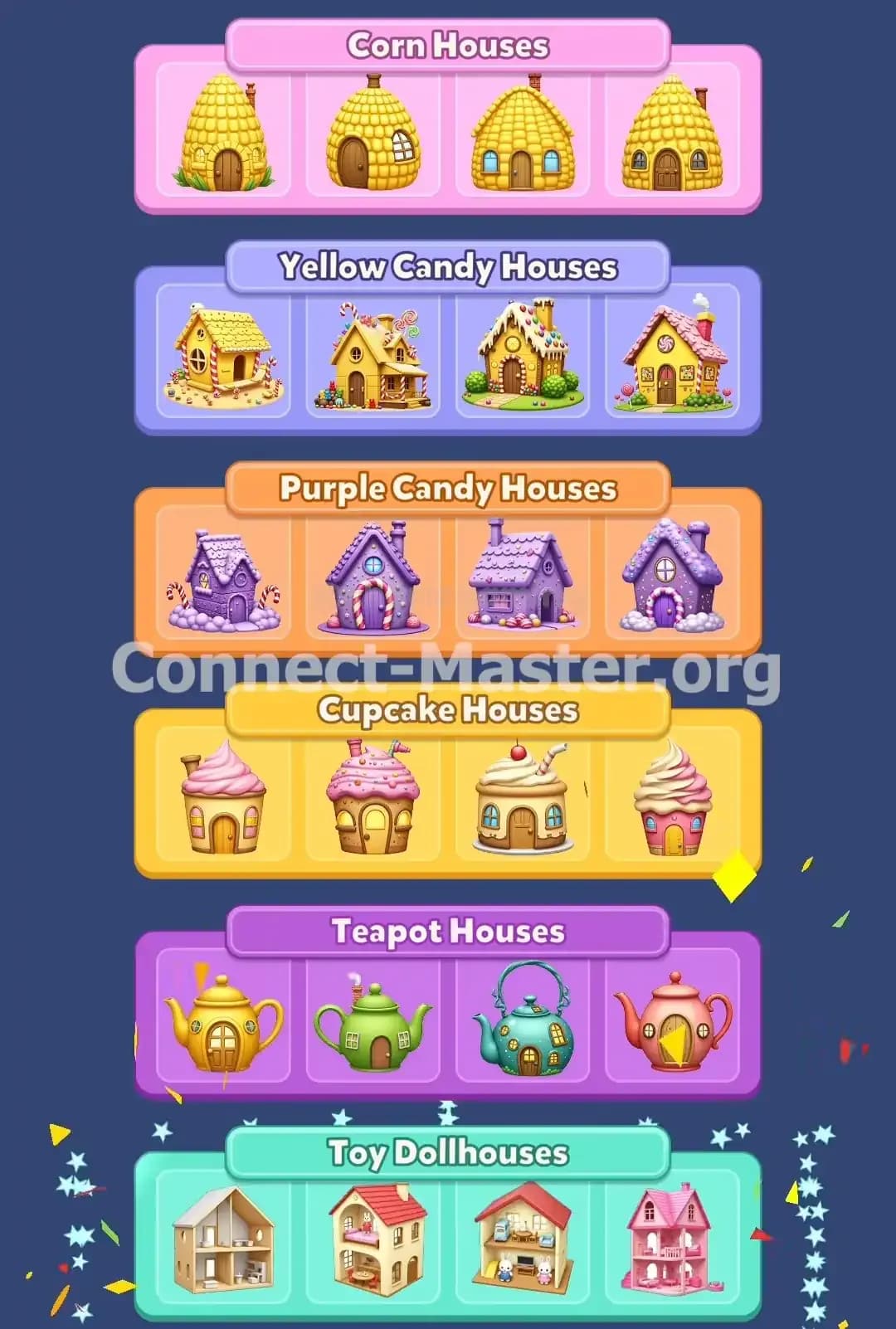
Connect Master Level 1638 uses a playful miniature-house theme, with every tile showing a different kind of whimsical building. Instead of matching characters by faces or clothing, you’re sorting houses by their construction style, color family, and recognizable food or toy design.
There are six complete sets in Connect Master 1638, with four tiles in each set. The main categories are corn-shaped houses, yellow candy houses, purple candy houses, cupcake houses, teapot houses, and toy dollhouses. Because several groups use similar bright colors and sweet-shop decorations, the level rewards careful comparison rather than quick matching.
The six sets in Connect Master 1638
- Corn Houses: Four rounded yellow houses built from corn-like kernels, with small doors and windows that vary from tile to tile. Their defining feature is the repeated corn texture covering the walls and roofs.
- Yellow Candy Houses: Four yellow or golden candy cottages decorated with sweets, frosting, lollipops, and colorful confectionery details. These are more traditionally house-shaped than the Corn Houses.
- Purple Candy Houses: Four purple or lavender candy cottages with frosting-like roofs, candy-cane trim, icing, and sugary decorations around the doors or ground.
- Cupcake Houses: Four small buildings shaped like cupcakes, with cake-like lower sections and large swirls of frosting forming the roofs.
- Teapot Houses: Four buildings designed as teapots, complete with spouts, handles, lids, and house-like doors or windows placed on the body.
- Toy Dollhouses: Four open-front or miniature residential dollhouses, showing rooms, balconies, furniture, or toy-like interior spaces.
Once you give each category a short mental label, the board becomes much easier to organize. I used “corn,” “yellow candy,” “purple candy,” “cupcake,” “teapot,” and “dollhouse” as my working labels.
Why Connect Master Level 1638 Feels So Tricky
The most confusing set: Yellow Candy Houses
The Yellow Candy Houses are the easiest group to overlook because they don’t all look identical at first glance. Some have strong candy decorations such as lollipops and gumdrops, while others look more like ordinary yellow cottages with only small sweet-themed details.
The key is to ignore the exact roof shape and focus on the combination of a yellow house body and confectionery decoration. One tile may have a candy-covered roof, another may show frosting around the edges, and another may use colorful sweets in the yard. They still belong together because they are candy cottages rather than plain yellow buildings.
Subtle overlaps between categories
The first major overlap is between the Corn Houses and the Yellow Candy Houses. Both groups are dominated by yellow, and both contain rounded cottage-like buildings. To separate them, inspect the wall texture. Corn Houses have repeated kernel-shaped blocks across the entire structure, giving them a segmented, corn-on-the-cob appearance. Yellow Candy Houses instead use shingles, icing, candy pieces, or smoother cottage walls.
The second overlap appears between Yellow Candy Houses and Cupcake Houses. Both can have frosting-like shapes and bright dessert colors, but their silhouettes are different. Cupcake Houses have a clear cupcake structure: a short cake or wrapper-like base topped by a large swirl of frosting. Yellow Candy Houses remain recognizable as full cottages with pitched roofs, windows, chimneys, and candy decorations attached to the building.
The third overlap is between Purple Candy Houses and Teapot Houses, especially when a purple teapot has a rounded body. Look for functional teapot parts rather than color. A Teapot House has a curved handle on one side, a spout on the other, and usually a lid or knob on top. Purple Candy Houses have icing, candy canes, frosting trim, or snowy-looking confectionery details instead.
There’s also a visual distinction between Toy Dollhouses and the other five categories. Several buildings have normal doors and windows, but dollhouses expose their interiors. Open walls, visible rooms, tiny furniture, balconies, and miniature household scenes identify this set. Don’t place a regular cottage here just because it has a small scale.
My pattern-recognition moment
I initially found the yellow groups the most misleading because the Corn Houses looked like oversized candy cottages from a distance. The “I finally saw it” moment came when I stopped judging by color and followed the construction texture instead. Once the kernel pattern became the deciding clue, the corn group separated cleanly, and the remaining yellow tiles clearly formed the candy set.
Step-by-Step Solution for Connect Master Level 1638
Opening: lock in the obvious silhouettes first
Start Connect Master Level 1638 by finding the sets with the strongest, least ambiguous shapes. The Teapot Houses should be one of your first locks because the handles, spouts, and lids are unique. Even though the teapots use different colors, their silhouettes immediately identify them as one category.
Next, locate the Cupcake Houses. Their frosting tops are unmistakable, and the buildings look more like individual cupcakes than normal houses. Check that each tile has the same dessert-based structure before committing the group.
The Toy Dollhouses are another strong early set. Look for open-front buildings and visible interiors, including rooms, furniture, balconies, or toy furnishings. Removing these three groups quickly leaves fewer decorative cottage tiles to compare.
Mid-game: separate the candy houses from the corn houses
With the obvious sets removed, focus on the Corn Houses, Yellow Candy Houses, and Purple Candy Houses. Find the four Corn Houses first by scanning for the kernel pattern. Their walls and roofs are made of repeated rounded yellow segments, and their doors and windows are set into a bulky, corn-shaped structure.
Be strict here: a yellow tile with candies does not belong to the corn group simply because it shares the same color. The Corn Houses should have the same agricultural texture, while the Yellow Candy Houses should show sweets, icing, lollipops, gumdrops, or candy-themed landscaping.
After taking out the Corn Houses, compare the remaining candy cottages by dominant color. The Yellow Candy Houses use golden or pale yellow bodies and roofs, often with colorful sweets added around them. The Purple Candy Houses are lavender, violet, or pinkish-purple and feature candy-cane arches, icing, sugar-like roof trim, or other purple dessert styling.
Before confirming either candy group, make sure every tile has the same broad identity. You’re not matching one exact decoration; you’re matching the complete visual language of the house. A candy cane alone isn’t enough, and a purple roof alone isn’t enough. The structure must belong to the candy-cottage family.
End-game: resolve the final candy distinction
The last tricky step in Connect Master 1638 is usually confirming the Purple Candy Houses after the other categories have been removed. These four tiles share a purple or lavender cottage body and candy-inspired details. Watch for frosting-like roof edges, candy-cane door frames, sugar-coated ground decorations, and sweet-shaped trim.
Keep them separate from the Yellow Candy Houses by checking the house’s primary color, not a single accent. A yellow candy house may contain pink, red, or green sweets, but its main walls and roof remain yellow or golden. A purple candy house may have white or pink icing, but the cottage itself remains purple or lavender.
If only eight tiles remain, use the one-and-only-one rule. Every tile must fit a category of four, so don’t borrow a visually attractive match from a completed group. If three tiles clearly form Purple Candy Houses and one purple-looking tile is missing, revisit the unassigned tiles and inspect the roof, door trim, and surrounding decorations rather than forcing an incorrect yellow match.
The Logic Behind This Connect Master Level 1638 Solution
Move from broad shapes to specific details
The safest strategy for Connect Master 1638 is to work from the most obvious physical traits toward the smallest visual clues. Start with silhouette-based categories such as Teapot Houses, Cupcake Houses, and Toy Dollhouses. Their handles, frosting tops, or open interiors are stronger evidence than color.
Then move to texture and decoration. The kernel pattern identifies Corn Houses, while candy colors and sweet-themed trim divide Yellow Candy Houses from Purple Candy Houses. This progression steadily reduces the number of possible homes for each tile.
Use category names to prevent double-using tiles
Naming every group in your head keeps the puzzle organized. When you see a rounded yellow tile, ask whether it belongs to “corn” or “yellow candy” instead of treating it as an unexplained yellow house. When you see a purple cottage, ask whether it is “purple candy” or “teapot,” then check for icing versus a handle and spout.
This method prevents you from using one tile twice and helps expose false groups. Once four tiles satisfy a clear category, mentally remove them and test the remaining board again. By combining the one-and-only-one rule with increasingly specific visual checks, you can solve Connect Master Level 1638 reliably without guessing.