Connect Master Level 1519 Solution Walkthrough & Answer
How to solve Connect Master level 1519? Get instant solution & answer for Connect Master 1519.
Connect Master Level 1519 Pattern Overview
Theme, layout, and number of sets
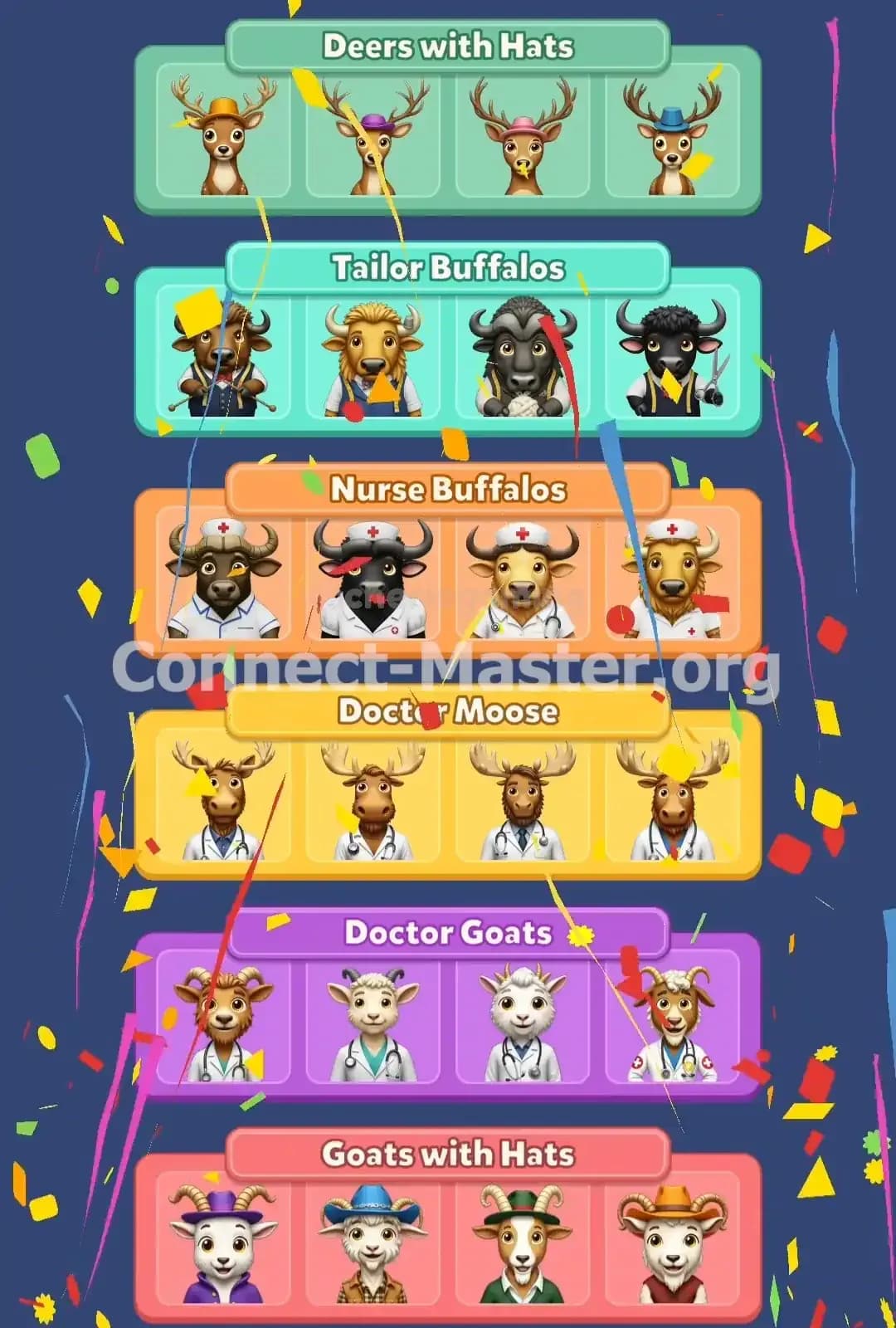
Connect Master Level 1519 uses a cheerful animal-and-profession theme. The board mixes deer, buffalo, moose, goats, hats, medical uniforms, and tailoring tools. There are six sets of four tiles, so every one of the 24 tiles must be assigned to a complete group with no leftovers.
The main challenge is that several animals appear in similar clothing. Buffalo tiles can look like medical workers or tailors, while moose and goats both wear doctor coats. A few animals also wear hats, creating another layer of overlap. In Connect Master 1519, don’t group by a broad idea such as “animals in uniforms.” Look for the exact combination of species and role.
The six complete groups
- Deers with Hats: Four deer wearing different colored hats. Their antlers, long deer faces, and hat accessories are the key clues.
- Tailor Buffalos: Four buffalo working as tailors, identified by dark work outfits and sewing-related props such as needles, thread, fabric, or scissors.
- Nurse Buffalos: Four buffalo dressed as nurses, with white medical clothing and nurse caps marked by red crosses.
- Doctor Moose: Four moose wearing doctor coats and medical accessories, including stethoscopes and professional ties or shirts.
- Doctor Goats: Four goats dressed as doctors, also wearing white coats and stethoscopes but clearly showing goat faces, horns, and beards.
- Goats with Hats: Four goats wearing colorful hats and casual outfits rather than medical uniforms.
Why Connect Master Level 1519 Feels So Tricky
The most confusing group: Tailor Buffalos
The Tailor Buffalos are the easiest set to overlook because their category isn’t represented by one identical item. One buffalo holds sewing tools, another appears to be handling fabric or thread, and another has scissors. Their outfits also resemble formal workwear, so it’s tempting to compare them with the nurses or doctors instead.
The important pattern is the occupation, not the clothing color. Check the props closely: scissors, sewing needles, thread, and other tailoring details point to this group. Once you recognize one or two Tailor Buffalos, keep searching for the remaining buffalo tiles with craft-related tools instead of selecting every buffalo in a jacket.
Subtle overlaps between possible groups
The first major overlap is between Nurse Buffalos and Doctor Moose. Both groups wear white medical clothing and may show a stethoscope or a clean professional uniform. The species separates them: buffalo have broad, heavy faces and thick curved horns, while moose have long faces and large branching antlers. The red-cross nurse cap is also a strong clue for the buffalo nurse group.
The second overlap is between Doctor Moose and Doctor Goats. Both groups clearly look like medical professionals, and several tiles use similar white coats, ties, and stethoscopes. Focus on the head shape and horns. Moose have wide antlers and a longer, heavier muzzle. Goats have narrower faces, shorter horns, pointed ears, and often a visible beard. Don’t let a matching stethoscope outweigh the animal identity.
The third overlap involves Deers with Hats and Goats with Hats. Both sets use colorful hats, and the hats can be more visually noticeable than the animals underneath them. Deer have branched antlers and smooth deer faces, while goats have curled or ridged horns, lighter beards, and smaller muzzles. The outfit helps too: the goat hat group wears casual tops, while the deer group is primarily identified by deer anatomy plus headwear.
The pattern-recognition moment
I found the level much easier once I stopped treating every hat or white coat as a category by itself. The “aha” moment comes when you notice that each repeated animal type has a different job: deer are hat wearers, buffalo are split between nurses and tailors, and the doctors are divided between moose and goats. That two-part structure is what makes Connect Master Level 1519 feel difficult at first but logical once the board is organized.
Step-by-Step Solution for Connect Master Level 1519
Opening: lock in the clearest sets first
Start with Nurse Buffalos. The nurse caps with red crosses are unusually specific, and the buffalo faces and horns confirm the group. Select all four nurse buffalo tiles together. This removes the most obvious medical-looking buffaloes and prevents you from accidentally mixing them with the Tailor Buffalos.
Next, find Deers with Hats. Look for the four tiles with deer antlers and colored hats. Ignore the hat colors and concentrate on the branching antlers and deer facial features. Locking in this group clears away one of the two hat-based possibilities.
At this stage, you should also be able to identify Goats with Hats. These animals have goat horns rather than deer antlers and wear casual, colorful clothing beneath their hats. Check all four carefully before selecting them, because a goat in a medical coat belongs to Doctor Goats, not this set.
Mid-game: separate professions from species
With the obvious hat and nurse groups removed, compare the remaining buffaloes. The four Tailor Buffalos should stand out through their work props. Look for the tiles showing scissors, sewing needles, thread, or fabric-handling details. Their dark or formal outfits are secondary evidence; the tools are what make the category reliable.
After removing the tailors, the remaining medical animals divide into Doctor Moose and Doctor Goats. Don’t try to form one large “doctor” category, since Connect Master requires exactly four tiles and every species has its own complete set.
Use a quick species checklist:
- Branching antlers and a long moose muzzle indicate Doctor Moose.
- Shorter horns, pointed ears, and a goat beard indicate Doctor Goats.
- White coats and stethoscopes confirm the medical role but do not identify the species group by themselves.
If a tile seems to fit both doctor groups, set it aside temporarily. It’s safer to leave one uncertain tile unselected than to force a wrong four-tile combination and disturb the rest of the board.
End-game: finish the two doctor groups
The final tricky step is dividing the doctor tiles. First gather the four moose doctors by checking their large branching antlers, longer noses, and heavier facial structure. Their coats, ties, and stethoscopes support the category, but the antlers are the decisive trait.
The remaining four medical tiles form Doctor Goats. Confirm the goat horns, slimmer face, pointed ears, and facial hair. Some goat doctors have different coat colors or accessories, so don’t require their uniforms to look identical. The exact link is “goat dressed as a doctor,” not “goat wearing the same shirt.”
Before committing the final group, scan the board and make sure no tile has already been mentally counted twice. In Connect Master 1519, the correct final set should use every remaining tile exactly once and leave no suspicious extra animal behind.
The Logic Behind This Connect Master 1519 Solution
Move from broad traits to precise details
The solution works because it shifts from obvious clues to increasingly specific ones. Start with red-cross nurse caps and clearly visible hats. Then use occupation props to identify Tailor Buffalos. Finally, resolve the doctor tiles by species anatomy.
This approach reduces confusion systematically. A broad clue such as “wearing white” can match several tiles, but a narrow clue such as “buffalo with a red-cross cap” or “moose with a doctor coat” produces a much safer group. If you compare species, clothing, and props together, every tile eventually has one natural destination.
Name every category in your head
I recommend silently labeling the groups as Deers with Hats, Tailor Buffalos, Nurse Buffalos, Doctor Moose, Doctor Goats, and Goats with Hats. These short names keep the board organized and stop you from reusing a tile in two possible groups.
For example, once you label a tile “Doctor Goat,” you no longer chase its white coat as evidence for Doctor Moose. Once a buffalo has sewing tools, you stop considering it for the nurse set. That mental filing system is the key to solving Connect Master Level 1519 cleanly: identify the strongest category, reserve each tile once, and use the remaining tiles to confirm the final groups.