Connect Master Level 1544 Solution Walkthrough & Answer
How to solve Connect Master level 1544? Get instant solution & answer for Connect Master 1544.
Connect Master Level 1544 Pattern Overview
The overall theme and board structure
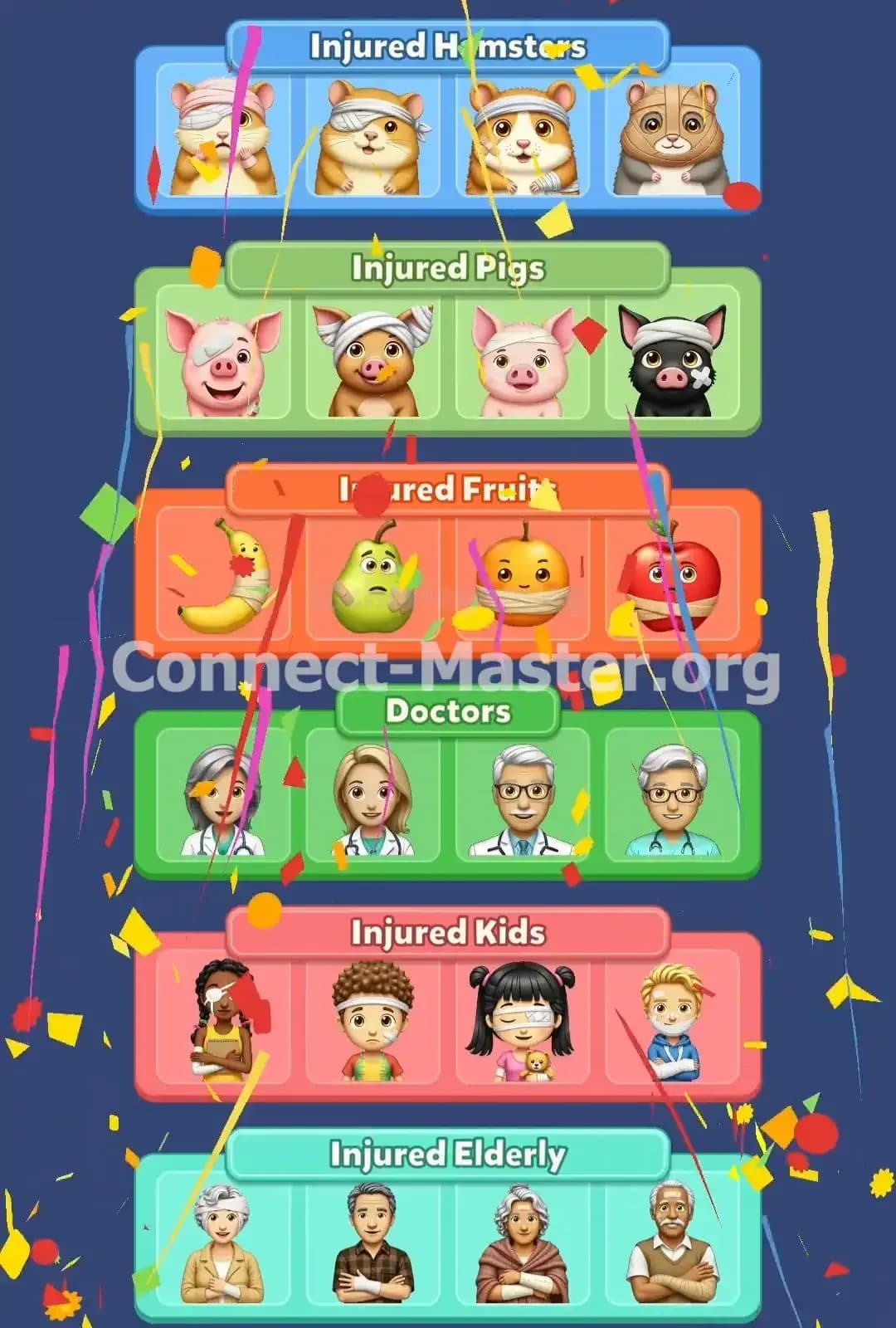
Connect Master Level 1544 uses a clear “injured characters” theme, but it mixes animals, food, and people closely enough to create several convincing decoys. The board contains 24 tiles divided into six correct groups of four. Every tile belongs to one group only, so the goal is to recognize both the broad subject and the specific visual details that confirm it.
The six groups are Injured Hamsters, Injured Pigs, Injured Fruits, Doctors, Injured Kids, and Injured Elderly. Four groups show injured or bandaged subjects, while the Doctors group provides a visual break with medical characters who are treating or associated with the injury theme rather than being patients themselves.
The six Connect Master Level 1544 sets
- Injured Hamsters: Four hamster characters with visible medical treatment, including head bandages, eye coverings, facial wraps, or other injury-related details.
- Injured Pigs: Four pig characters wearing different bandages or showing clear signs of injury. Their pig snouts and ears are the key identifying features.
- Injured Fruits: A banana, pear, orange, and apple portrayed as characters, each wrapped or treated like an injured patient.
- Doctors: Four medical professionals in white coats or scrubs. Their stethoscopes, medical clothing, and adult human appearance separate them from the patient groups.
- Injured Kids: Four children with injuries such as eye patches, arm slings, head wraps, or bandages.
- Injured Elderly: Four older adults with gray or white hair, mature facial features, and visible injuries or arm supports.
Why Connect Master Level 1544 Feels So Tricky
The most confusing set: Injured Fruits
The Injured Fruits group is the easiest to overlook because the tiles are drawn with expressive faces and body-like poses. At first glance, they can look like cartoon patients rather than fruit. The banana, pear, orange, and apple all have eyes, mouths, and bandages, so you may focus on the injury detail instead of the underlying object.
Look at the silhouette and the stem first. The curved yellow banana, green pear, round orange, and red apple form a complete object-based set. Their colors are not the only clue; each character retains the recognizable shape of its fruit. Once you spot those four, lock them immediately. Leaving one fruit behind can make the remaining animal and human tiles appear to fit incorrectly.
Subtle overlaps between possible groups
The first major overlap is between Injured Hamsters and Injured Pigs. Both groups are small furry animals with rounded faces, ears, and bandages. Compare the nose and muzzle instead of relying on size. Hamsters have compact rodent faces and small rounded ears, while pigs have unmistakable broad snouts and flatter noses. The pig ears also tend to look more triangular or floppy, whereas the hamster ears are smaller and rounder.
The second overlap appears between Injured Kids and Doctors. Both groups are human characters, and several tiles use white clothing or medical-looking accessories. The doctors are identified by professional details such as white coats, stethoscopes, glasses, and adult facial features. The children have youthful faces, smaller proportions, playful clothing, and obvious patient injuries such as an eye patch or arm sling. Don’t group a child with the doctors simply because both tiles contain white fabric.
The third overlap is between Injured Elderly and the adult Doctors. Gray hair can appear in both sets, and the doctors may look older than the children. The elderly group is defined by age-specific features: white or gray hair, wrinkles, mature facial structure, sweaters or vests, and patient-style bandages. A doctor’s coat and stethoscope should outweigh hair color when you’re making the final decision.
My pattern-recognition moment
I found Connect Master 1544 much easier after stopping myself from grouping every bandaged tile together. The “injured” trait is deliberately shared by most of the board, so it’s useful only as a starting clue. The real breakthrough comes when you ask, “What kind of thing is this character?” Once I separated fruit, animals, children, elderly people, and doctors, the board became much more orderly.
Step-by-Step Solution for Connect Master 1544
Opening: lock in the obvious categories
Start with Doctors if the medical clothing is easy to recognize. Find the four adult professionals with white coats, scrubs, stethoscopes, or clearly clinical styling. These tiles are visually distinct from the injured patients, and removing them immediately reduces the number of human decoys.
Next, identify Injured Fruits. Search for the four non-animal objects with stems, bright fruit colors, and cartoon faces: the banana, pear, orange, and apple. Their bandages are secondary evidence, so focus on their shapes. Locking this category prevents those colorful tiles from being mistaken for unusual patients.
After that, look for the strongest animal features. The four broad-snouted tiles make up Injured Pigs, while the smaller rodent-like faces form Injured Hamsters. Check noses, ears, and muzzle proportions carefully before confirming. If a tile looks furry but has a clearly pig-like snout, it belongs with the pigs.
Mid-game: sort the remaining people
Once the doctors, fruits, pigs, and hamsters are removed, the remaining eight tiles should be the two human patient groups: Injured Kids and Injured Elderly. This is where process of elimination becomes useful, but don’t rely on elimination alone. Confirm each tile’s age group using face shape, hair, clothing, and body proportions.
For Injured Kids, look for youthful facial features, smaller frames, colorful casual clothing, and child-specific injury accessories. An eye patch, bandaged head, sling, or wrapped arm can help, but the character’s age is the deciding trait.
For Injured Elderly, compare gray or white hair, wrinkles, mature facial features, and conservative clothing. Some elderly characters may be standing with folded or crossed arms, so inspect the visible bandage or support rather than assuming every crossed-arm pose is the same injury.
End-game: separate the final two groups
The last tricky division is between Injured Kids and Injured Elderly. Both are human patients, and both may have similar bandages. The exact separating trait is age, not the location of the injury. A child with a wrapped head still belongs to Injured Kids, while an older person with a supported arm remains in Injured Elderly.
Before submitting either group, check that all four tiles share the same life stage. For the kids, look for youthful eyes, smaller proportions, school-age styling, and bright clothing. For the elderly, verify gray hair, mature skin details, and older adult clothing. This final check prevents a tempting but incorrect swap.
The Logic Behind This Connect Master Level 1544 Solution
Move from broad traits to precise details
The most reliable method for Connect Master Level 1544 is to begin with the largest visual distinctions and then narrow your focus. First separate objects, animals, and people. Among the animals, compare snouts and ear shapes. Among the people, compare age and profession. Only after that should you use smaller clues such as bandages, eye coverings, slings, glasses, or stethoscopes.
This approach systematically reduces confusion because each confirmed group removes four tiles from consideration. It also prevents the shared “injured” theme from becoming a misleading category. Since every tile must fit one and only one set, each confirmed decision gives you stronger evidence for the remaining choices.
Use category names to organize the board
I recommend naming the groups in your head as soon as you recognize them: Injured Hamsters, Injured Pigs, Injured Fruits, Doctors, Injured Kids, and Injured Elderly. These short names act like mental containers. When you inspect a questionable tile, ask which container it belongs to instead of judging it against the entire board.
This naming system also prevents double-using a tile. Once a fruit is assigned to Injured Fruits, you no longer need to consider it as a possible child or animal. Follow that process through all six categories, and the Connect Master Level 1544 solution becomes a controlled sequence of comparisons rather than a series of guesses.