Connect Master Level 1635 Solution Walkthrough & Answer
How to solve Connect Master level 1635? Get instant solution & answer for Connect Master 1635.
Connect Master Level 1635 Pattern Overview
The overall theme and board structure
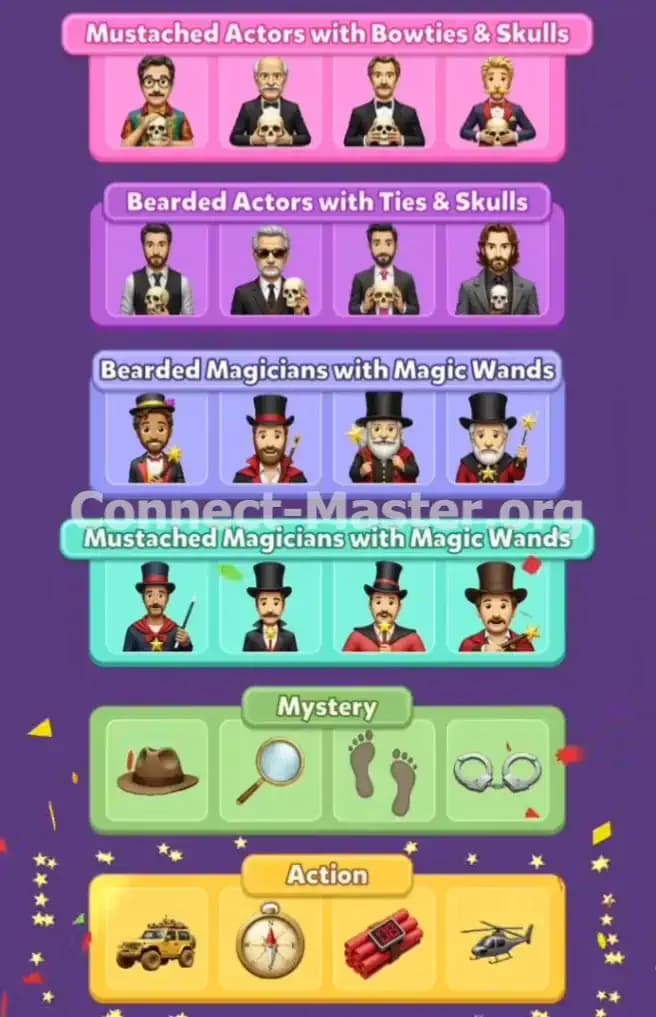
Connect Master Level 1635 contains 24 tiles divided into six exact groups of four. The board mixes illustrated people with recognizable mystery and action objects, so the challenge comes from switching between character details and item categories.
The character tiles are split across four closely related groups: actors versus magicians, then mustached versus bearded characters. The remaining eight tiles form two straightforward object groups. Because every tile belongs to one group only, you’ll want to identify the broad categories first and use facial hair, clothing, and props to resolve the close matches.
The six groups to identify
- Mustached Actors with Bowties & Skulls: Four actors with visible mustaches, formal bowties, and skulls held in front of them.
- Bearded Actors with Ties & Skulls: Four bearded actors wearing standard neckties and also holding skulls.
- Bearded Magicians with Magic Wands: Four bearded magicians wearing tall hats and carrying magic wands.
- Mustached Magicians with Magic Wands: Four mustached magicians with tall hats and magic wands.
- Mystery Investigation Objects: A brown hat, magnifying glass, footprints, and handcuffs.
- Action Objects: A rugged vehicle, compass, dynamite, and helicopter.
Keeping these names in mind makes Connect Master 1635 much easier to organize. They describe both the main subject and the detail that separates one group from another.
Why Connect Master Level 1635 Feels So Tricky
The most confusing group
The hardest group is usually Mustached Magicians with Magic Wands. At first glance, the magicians look almost interchangeable because they share tall hats, colorful formal clothing, and wands. The beard and mustache distinction is easy to miss, especially when a character’s facial hair is partly covered by the hat brim or displayed at a smaller size.
Players also tend to notice the wand before the face. That creates a tempting but incomplete pattern: “four people with wands.” You still need to divide those four characters by facial hair, creating the two magician groups.
Small overlaps that cause mistakes
The first major overlap is between Mustached Actors with Bowties & Skulls and Bearded Actors with Ties & Skulls. Both groups include actors holding skulls, so the skull is only a useful starting clue. To separate them, inspect the neckwear and face together. The mustached actors wear bowties, while the bearded actors wear longer, ordinary ties. A narrow strip beneath the collar is a tie; a compact knot spreading sideways is a bowtie.
The second overlap is between the two magician groups. Every magician has a wand and a tall hat, so those props don’t distinguish the sets. Look directly at the lower half of each face. The Bearded Magicians with Magic Wands have fuller facial hair extending along the cheeks or chin. The Mustached Magicians with Magic Wands show a distinct mustache without the same full beard.
The third overlap happens between the character groups and the object groups when you scan too quickly. The mystery tiles include a hat and magnifying glass, while the magician characters also feature prominent hats and magical props. Don’t classify a tile by one isolated object. Ask whether it is a complete illustrated person or a standalone item. The object tiles have no character face, clothing, or hands attached to them.
My reaction to the pattern
I found Connect Master 1635 deceptively difficult because the board repeats the same visual ingredients: hats, facial hair, formal clothing, and handheld objects. The “I finally saw it” moment came when I stopped treating the skulls and wands as the main categories. Once I used facial hair as the divider and neckwear as confirmation, the four character groups became much clearer.
Step-by-Step Solution for Connect Master 1635
Opening: lock in the obvious object groups
Start by scanning for standalone objects rather than trying to sort all the characters immediately. The Mystery Investigation Objects group is made up of the brown hat, magnifying glass, footprints, and handcuffs. These four tiles share a crime-solving or investigation theme and don’t show any people.
Next, find the Action Objects group: the rugged vehicle, compass, dynamite, and helicopter. These items suggest travel, adventure, or action and are visually distinct from the mystery tools. Locking in both groups removes eight tiles and leaves only the character puzzle.
This opening is useful because it reduces the visual noise. Instead of comparing 24 tiles, you’re working with 16 similar-looking characters.
Mid-game: separate actors from magicians
Among the remaining tiles, divide the characters by their props. The actors are the four figures holding skulls, while the magicians are the four figures carrying magic wands. This gives you two provisional groups immediately:
- Four skull-holding characters
- Four wand-carrying characters
Don’t submit either group yet if the game requires exact confirmation, because each provisional group still contains two different facial-hair patterns. Use the skulls and wands as the broad category, then inspect the face and clothing.
For the skull-holding characters, identify the four with mustaches and bowties. These belong to Mustached Actors with Bowties & Skulls. The remaining skull-holding characters have fuller beards and regular ties, forming Bearded Actors with Ties & Skulls.
For the wand-carrying characters, make the same facial comparison. The bearded figures form Bearded Magicians with Magic Wands, while the mustached figures form Mustached Magicians with Magic Wands.
End-game: confirm the two closest sets
The final tricky comparison is between the two magician groups. Check each face at the same time rather than relying on memory. A mustache is concentrated around the upper lip, while a beard continues down the jaw or chin. Their hats, wands, and outfits may look similar, so facial hair is the deciding trait.
If you’re left with four actors, verify the neckwear before finishing. Mustached Actors with Bowties & Skulls must contain both the mustache and the bowtie. Bearded Actors with Ties & Skulls must contain both the beard and the standard tie. If one tile seems uncertain, compare its collar with the other three instead of forcing it into a group.
A reliable final check is to recite all six category names: Mystery Investigation Objects, Action Objects, Mustached Actors with Bowties & Skulls, Bearded Actors with Ties & Skulls, Bearded Magicians with Magic Wands, and Mustached Magicians with Magic Wands. Every tile should match one name exactly.
The Logic Behind This Connect Master Level 1635 Solution
Use broad traits before tiny details
The solution works because it moves from large visual differences to small ones. First, remove standalone objects by recognizing the mystery and action themes. Then separate people holding skulls from people holding wands. Only after that should you compare facial hair and clothing.
This order prevents a common Connect Master 1635 mistake: trying to solve the entire board through one detail, such as hats or mustaches. A single detail may appear across several groups, but a combination such as “mustache, actor, bowtie, skull” is unique.
Name each set to prevent double-use
Short category names keep the board organized in your head. If you call four tiles Mustached Actors with Bowties & Skulls, you’re less likely to reuse one of them when building Bearded Actors with Ties & Skulls. The same approach works for the magicians: first remember “wand group,” then divide it into bearded and mustached sets.
That mental labeling guarantees that every tile has one destination. By checking the subject, prop, facial hair, and clothing in that order, you can solve Connect Master Level 1635 systematically rather than guessing from similar-looking designs.