Connect Master Level 1625 Solution Walkthrough & Answer
How to solve Connect Master level 1625? Get instant solution & answer for Connect Master 1625.
Connect Master Level 1625 Pattern Overview
The overall theme and board structure
Connect Master Level 1625 is built around a mix of cartoon children, everyday objects, food, and simple science or physics ideas. The board contains six sets of four tiles, for a total of 24 tiles. The challenge comes from switching between very different types of categories: some groups are based on appearance, while others depend on what an object does or what material it contains.
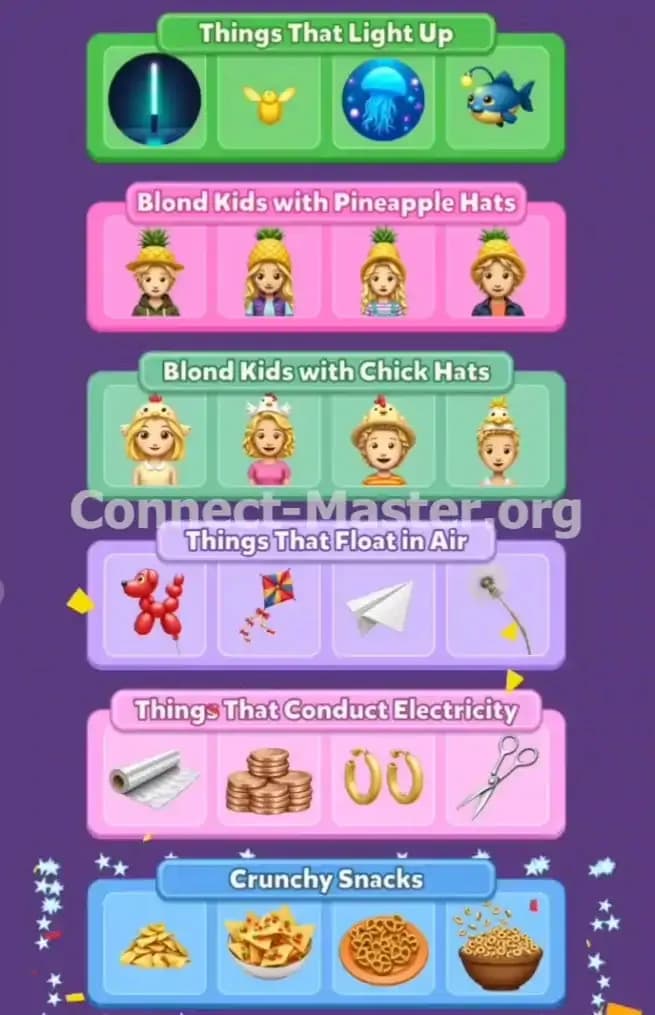
The six completed sets in Connect Master 1625 are:
- Things That Light Up: a glow stick, a small yellow light-like object, a glowing jellyfish, and an anglerfish with a glowing lure.
- Blond Kids with Pineapple Hats: four blond children wearing pineapple-themed hats.
- Blond Kids with Chick Hats: four blond children wearing hats decorated with small chicks.
- Things That Float in Air: a balloon animal, a kite, a paper airplane, and a floating dandelion-like object.
- Things That Conduct Electricity: a roll of metal foil, a stack of coins, hoop earrings, and scissors.
- Crunchy Snacks: chips, nachos or tortilla chips, a pretzel, and a bowl of crunchy cereal or snack pieces.
The important distinction is that the children are not one large “blond kids” group. They split into two precise hat categories, while the objects divide according to light, air, electricity, or texture.
Why Connect Master Level 1625 Feels So Tricky
The most confusing set: Blond Kids with Pineapple Hats
The hardest category in Connect Master 1625 is usually Blond Kids with Pineapple Hats. At first glance, the children look extremely similar: they all have blond hair, round cartoon faces, and colorful clothing. If you focus only on the characters, it’s easy to assume they form one broad group.
The overlooked clue is the hat. The pineapple hats have a leafy green crown sticking upward, with a yellow or tan pineapple body around the child’s head. The other four children wear chick hats, which include a small yellow bird or chick shape instead. Once you inspect the top of each character rather than the face or outfit, the division becomes much clearer.
Small overlaps between nearly matching tiles
The first overlap is between the two groups of blond children. Hair color is a shared trait, so it’s a tempting but incomplete category. Compare the headwear carefully: a pineapple has a leafy top, while a chick hat has a tiny bird-like figure, often with a red detail or beak. Clothing colors are not reliable enough to separate these sets.
The second overlap appears among Things That Light Up and Things That Float in Air. Some floating objects are colorful and visually bright, which can make them seem connected to the lighting group. The glowing jellyfish and anglerfish belong with the light-up tiles because they visibly emit light or feature a glowing element. The kite, paper airplane, balloon animal, and dandelion-like object belong together because they can be carried or suspended in the air.
The third overlap is in Things That Conduct Electricity. Metal objects such as coins, foil, scissors, and earrings may look unrelated in shape and purpose. Their shared trait is material, not appearance. Look for metal: the foil roll, stacked coins, hoop earrings, and scissors all conduct electricity, even though none of them looks like an electrical device.
I’ll admit that I needed a second look at the last few children. The “I finally saw it!” moment came when I stopped comparing faces and checked the hat decorations one by one. That tiny detail instantly separated the two character sets.
Step-by-Step Solution for Connect Master Level 1625
Opening: lock in the most obvious groups
Start Connect Master 1625 by identifying the categories with the clearest visual or functional clues. The easiest opening group is Crunchy Snacks. Select the chips, nacho-style pieces, pretzel, and bowl of crunchy snack pieces. They are all food, but the more specific shared trait is their crunchy texture.
Next, look for Things That Conduct Electricity. The roll of foil, stack of coins, hoop earrings, and scissors are all metal-based objects. This group is especially useful because the tiles have very different silhouettes, so removing them early reduces visual clutter without creating much risk.
You can also lock in Things That Float in Air. The balloon animal, kite, paper airplane, and dandelion-like floating object are connected by their ability to remain or travel in the air. Don’t let the bright colors distract you; the category is about floating or flying, not color.
Mid-game: separate the character groups
After removing the snacks, conductive objects, and airborne objects, focus on the eight blond children. This is where Connect Master Level 1625 demands close inspection rather than quick matching.
Divide the children into two temporary piles. In the first pile, place every child with a pineapple hat. Confirm the leafy crown and pineapple-shaped yellow body before selecting. In the second pile, place every child with a chick hat. Look for the small bird decoration, beak-like shape, or red accent on top.
Do not use clothing as the deciding feature. One child may wear a pink shirt, another may have a blue or green outfit, and another may have a darker jacket, but those colors are distractions. The hats are the consistent trait. Count each temporary pile before confirming: every group must contain exactly four tiles.
End-game: finish the two light-based groups
The final sets are Things That Light Up and the remaining four character tiles, assuming you handled the children in the middle game. For the light-up group, select the glow stick, yellow light-like object, glowing jellyfish, and anglerfish with the glowing lure.
The anglerfish is the likely near-match trap. It resembles a normal fish, but the small light attached to its head is the important clue. Likewise, the jellyfish is not grouped merely because it is an underwater creature; its bright glowing appearance places it with the other light-producing tiles.
If any child remains after making one hat group, don’t immediately force that child into another category. Recheck the hat. The solution to Connect Master 1625 requires four pineapple hats and four chick hats, with no child used twice. Once both groups contain exactly four, the board should resolve cleanly.
The Logic Behind This Connect Master Level 1625 Solution
Move from broad traits to precise details
The solution works because it begins with broad, highly reliable traits and gradually moves toward smaller details. Food is easy to recognize, so Crunchy Snacks removes four tiles immediately. Metal objects are another dependable category, allowing Things That Conduct Electricity to be cleared next. Airborne objects follow the same principle.
Once the obvious object groups are gone, the board becomes less crowded and the character sets are easier to compare. The final step is not guessing; it’s checking a specific feature. Pineapple leaves, chick decorations, glowing parts, and metal surfaces are all concrete clues that can be verified tile by tile.
This method also protects you from decoys. A colorful object may look bright, but that doesn’t make it a light source. A blond child may resemble every other child, but hair color alone doesn’t define a set. Always ask what exact trait appears in all four tiles and nowhere else.
Use category names to keep the board organized
I recommend naming each set in your head as soon as you see it: Things That Light Up, Blond Kids with Pineapple Hats, Blond Kids with Chick Hats, Things That Float in Air, Things That Conduct Electricity, and Crunchy Snacks.
These labels prevent you from double-using a tile or chasing a vague connection. If a tile seems to fit two groups, return to the category name and test the strongest defining trait. With that approach, Connect Master Level 1625 becomes a controlled process: identify the broad groups, remove them, inspect the small details, and make sure every tile belongs to one—and only one—set.