Connect Master Level 1646 Solution Walkthrough & Answer
How to solve Connect Master level 1646? Get instant solution & answer for Connect Master 1646.
Connect Master Level 1646 Pattern Overview
Six clear themes make up the board
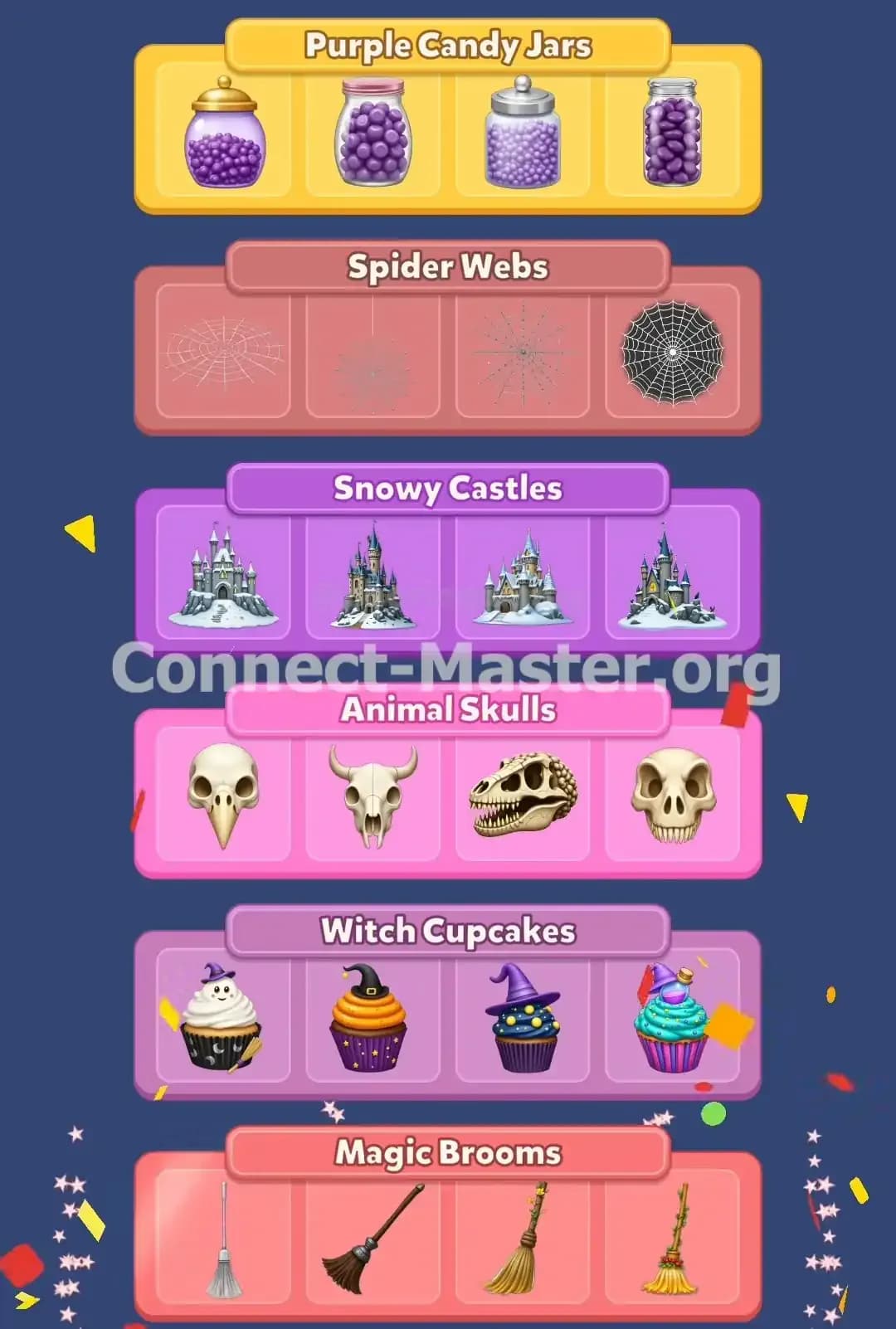
Connect Master Level 1646 contains six sets of four tiles, giving you 24 tiles in total. The board mixes fantasy objects, food, architecture, natural designs, and skulls. At first, the variety can make the puzzle seem random, but each group is built around one strong visual idea.
The six completed categories in Connect Master 1646 are:
- Purple Candy Jars: Four different glass jars filled with purple sweets or candies. Their lids, jar shapes, and candy sizes vary, but the purple candy theme is consistent.
- Spider Webs: Four web designs with different layouts, line thicknesses, and levels of detail. Each one is recognizable by radiating strands and connecting web rings.
- Snowy Castles: Four fantasy castles covered with snow. Their towers and colors differ, but every castle has snowy ground, rooftops, or icy architectural details.
- Animal Skulls: Four skulls belonging to different animals. The group includes a bird-like skull, a horned skull, a long-jawed animal skull, and a more human-shaped skull.
- Witch Cupcakes: Four cupcakes decorated with witch-themed frosting, hats, colors, or magical toppings. Each one looks like a Halloween dessert rather than an ordinary cupcake.
- Magic Brooms: Four enchanted broom designs, including slim handled brooms and more traditional bristle brooms. Their handles and brush shapes change, but all clearly belong to the magical cleaning-tool theme.
The important point is that Connect Master Level 1646 does not ask you to match identical pictures. You’re matching a shared concept, so differences in color, silhouette, or decoration are deliberate distractions.
Why Connect Master Level 1646 Feels So Tricky
The most confusing set is the Spider Webs
The Spider Webs group is the easiest to overlook in Connect Master 1646 because the webs don’t all have the same structure. One may look broad and circular, another may be faint, and a third may have uneven or widely spaced strands. The strongest-looking web can grab your attention while the less detailed examples seem like random line patterns.
Look for the underlying construction instead of the overall appearance. A web normally has a central point, lines radiating outward, and cross-lines joining those spokes. Even when the design is pale or partially hidden, those repeated connections identify it as part of Spider Webs.
Small details create several false matches
The Animal Skulls can initially overlap with the Snowy Castles because both sets contain pale, high-contrast shapes with pointed features. Don’t match a skull based only on its triangular outline. Check for eye sockets, nasal openings, teeth, horns, or a long animal snout. Those anatomical details separate Animal Skulls from every architectural tile.
The Witch Cupcakes also create a few decoys. A cupcake with a pointed purple topping may look like it belongs with a castle tower, especially when you’re scanning quickly. The difference is the base: cupcakes have frosting, wrappers, sprinkles, or candy decorations, while Snowy Castles have walls, windows, towers, and snow-covered foundations. A pointed shape alone isn’t enough evidence.
The Magic Brooms can overlap visually with castle spires because their handles are long and narrow. Focus on the lower end of each tile. A broom has bristles or a brush head, while a castle has a building base and multiple structural levels. Also compare the accessories: colorful ribbons, crooked wooden handles, and bundled fibers support Magic Brooms, not Snowy Castles.
The pattern-recognition moment
I found the board much easier once I stopped judging tiles by color. Purple appears in the jars, cupcakes, and some castle details, so color alone leads you toward bad guesses. The “I finally saw it” moment comes when you notice that the tiles are organized by object type: containers, webs, buildings, skulls, desserts, and tools. Once that distinction clicked, Connect Master 1646 became a classification exercise rather than a guessing game.
Step-by-Step Solution for Connect Master Level 1646
Opening: lock in the most obvious categories
Start with Purple Candy Jars. The four tiles all show containers packed with purple candy, even though one jar may be short and rounded while another is tall and narrow. Compare the contents rather than the lids. The candy color and jar-filled appearance make this a reliable opening group.
Next, identify Magic Brooms. Look for the four tiles with long handles and brush ends. Their bristles may be gray, brown, yellow, or decorated, but the broom silhouette is unmistakable. Locking in these two categories removes eight tiles and makes the remaining board much less crowded.
After that, select Animal Skulls. Use the eye sockets, teeth, horns, and beak-like structures to confirm each member. The bird-shaped skull is especially useful because its long pointed front distinguishes it from the rounded skulls. Keep the horned skull with this group even though its silhouette is very different from the others.
Mid-game: separate the visual themes carefully
With the obvious objects removed, look for the four Snowy Castles. Don’t require every castle to have identical colors or the same number of towers. Instead, check for snow resting on rooftops, snowy ground around the base, and unmistakable castle architecture. Spires, turrets, windows, and walls are stronger clues than color.
Then gather Witch Cupcakes. Search for frosting shaped like witch hats, dark cupcake wrappers, magical decorations, stars, candy pieces, or unusual bright icing. Some may be more obviously Halloween-themed than others, so inspect the top and bottom of each dessert. A purple frosting swirl is not automatically a cupcake from this group; it should also have a dessert base and witch-like decoration.
At this stage, avoid moving a tile into a group just because it shares one color. The purple jars, purple cupcakes, and purple castle accents are designed to encourage that mistake. Ask what the tile physically is before asking what color it uses.
End-game: finish with the delicate web designs
The final category is Spider Webs. This is where players often hesitate because the four designs may differ dramatically in brightness and symmetry. Examine the center of each remaining tile, then trace outward. If you can follow spokes and connecting strands that form a web pattern, it belongs here.
Keep Spider Webs separate from the thin handles of Magic Brooms. A broom has one dominant lengthwise shaft and a brush cluster at one end. A web spreads outward from a center and contains repeated cross-connections. That structural difference is the deciding clue.
The completed order is therefore:
- Purple Candy Jars
- Magic Brooms
- Animal Skulls
- Snowy Castles
- Witch Cupcakes
- Spider Webs
The game may allow you to select categories in a different order, but these are the six exact sets required to solve Connect Master Level 1646.
The Logic Behind This Connect Master Level 1646 Solution
Move from broad traits to precise details
The safest method for Connect Master 1646 is to begin with large, unmistakable traits. “This is a jar,” “this is a broom,” and “this is a skull” are broad classifications that quickly remove uncertainty. Once those groups are gone, you can focus on more delicate differences such as web structure, frosting decorations, and snowy architecture.
This approach works because every tile belongs to one and only one set. If a tile seems to fit two categories, one of your proposed groups probably isn’t specific enough yet. For example, “purple things” is not a valid category, but “jars filled with purple candy” is. “Pointed objects” is too broad, while “snow-covered castles” is precise.
Use category names to prevent double-use
I recommend naming the groups in your head exactly as you work: Purple Candy Jars, Spider Webs, Snowy Castles, Animal Skulls, Witch Cupcakes, and Magic Brooms. These names act like labels on an organizer. When you consider a tile, ask which label describes its whole design rather than one isolated feature.
That habit prevents you from borrowing a tile twice or chasing a tempting near-match. Once four tiles clearly belong to Animal Skulls, mentally remove them from consideration. Then compare only the remaining tiles. By repeatedly narrowing the board from obvious objects to subtle patterns, you can solve Connect Master Level 1646 methodically instead of relying on trial and error.